E Guitar Chord
E is the E major chord. It has three notes: E, G♯ and B. It is the biggest sounding chord in the beginner set: all six strings are played and three of them ring open, with the root sitting on the open low E string.

The standard open E, and the shape the movable E barre chords are built from. All six strings play.
How to play E, step by step
- Index finger: 1st fret, G string
- Middle finger: 2nd fret, A string
- Ring finger: 2nd fret, D string
- Strum all six strings.
From E, the most useful next chords are A and B7. Those three together cover a complete blues in E, one of the oldest patterns in guitar music.
More ways to play E
There are 3 common E shapes in total: the standard one at the top of the page, plus these, easiest first. You only ever need one. Tap any card to hear it.

Tighter and more polite than the open shape, with the shimmer taken out.

Compact and mid heavy, a good E when the open strings would ring too long.
Songs that use the E chord
- Learn this song(opens a new tab on our partner site)
Highway To Hell
AC/DC
- Learn this song(opens a new tab on our partner site)
TNT
AC/DC
- Learn this song(opens a new tab on our partner site)
Hells Bells
AC/DC
- Learn this song(opens a new tab on our partner site)
Back In Black
AC/DC
- Learn this song(opens a new tab on our partner site)
Imagine
John Lennon
- Learn this song(opens a new tab on our partner site)
(I Can't Get No) Satisfaction
The Rolling Stones
If E sounds muffled
- The open B or high E string dies
- The index finger on the G string is lying flat. Stand it up on its tip so the thinner strings next to it can ring.
- Buzzing on the A or D string
- The middle and ring fingers are sitting too far back in the 2nd fret. Slide the pair forward so both tips sit just behind the fret.
- The chord sounds slightly out of tune
- You may be pressing so hard that the strings bend sideways. Relax the grip until the notes ring at their true pitch.
What makes it an E
E · G♯ · B 1 3 5
E major is the root E, the major third G♯ and the fifth B. It is the I chord in the key of E, the IV chord in B, and the V chord in A. E is also the natural home of blues and rock guitar: the lowest string of the instrument is an E, so chords and riffs in E can lean on the deepest open note the guitar has.
E vs Em
E has G♯ where Em has G, and on guitar this is the simplest major to minor switch there is: lift your index finger off the G string and E becomes Em. Nothing else moves. Because the switch is one finger, songs can flick between the two colors instantly, and it is worth practicing the pair as a single move.
E in major keys
Every note of E sits inside these keys. See how it works alongside the other chords in each one.
E chord questions
Do you strum all six strings on E?
Yes. Every string is a chord tone, including both open E strings. It is one of the few beginner chords with nothing to avoid.
Is E an easy chord?
Yes. Three fingers, no barre, no skipped strings. Most players have it working in their first week.
What is the difference between E and Em?
One finger. Lift the index off the G string and the major third G♯ becomes G, turning the chord minor.
Why does E sound so full?
Six strings, three of them open, and the root on the lowest note the guitar has. No other beginner chord combines all three.
What songs use the E chord?
From this page: Three Little Birds, House of the Rising Sun, Sympathy for the Devil and Chasing Cars. E also anchors most blues played in E.
Chords to learn next
- Emthe minor version of E
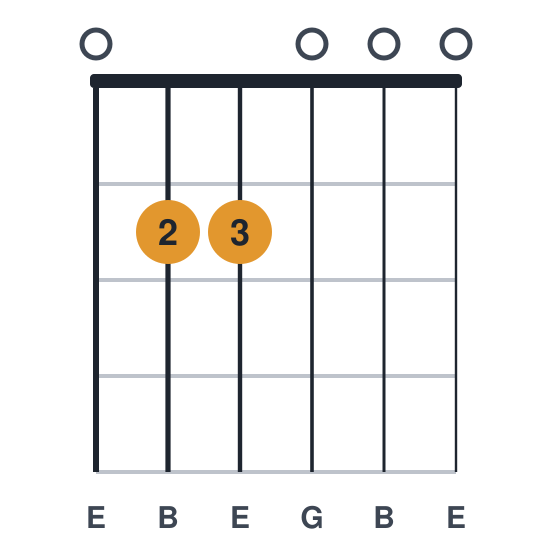
- E7E with the seventh that pushes to A
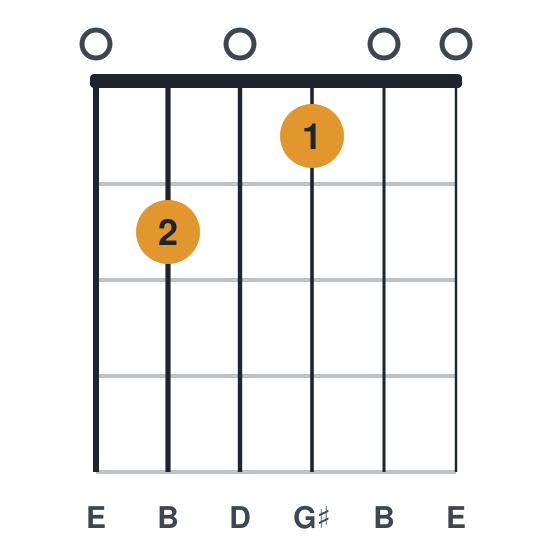
- C#mthe relative minor of E
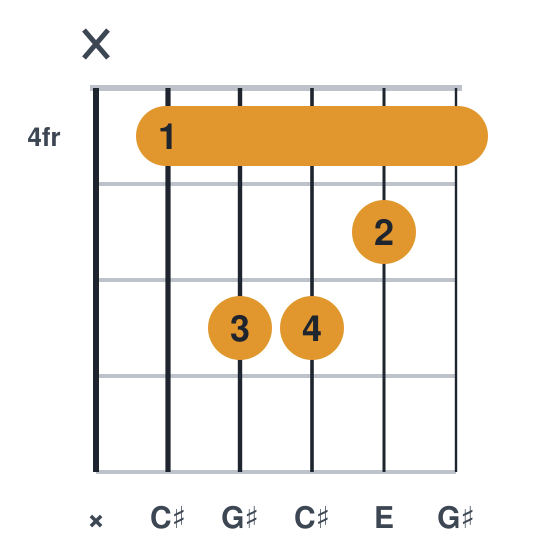
- Eadd9adds a ninth on top for extra shimmer, same root
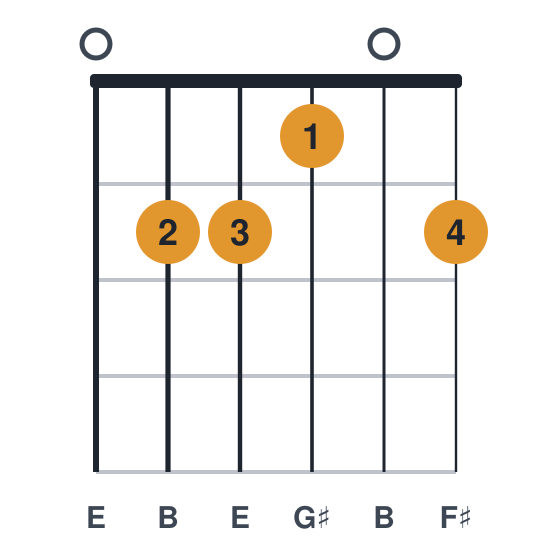


Other E chords
E guitar chord chart (022100) from melodician.com