Edim7 Guitar Chord
Edim7 is the E diminished seventh chord. It has four notes: E, G, B♭ and D♭. Every note sits three frets from the next, which makes it one of the few chords that sounds the same whichever of its notes you call the root.

The open shape, and the only diminished seventh that gets one, because E, G and the open strings happen to line up. Three fingers, three open strings.
How to play Edim7, step by step
- Index finger: 1st fret, A string
- Middle finger: 2nd fret, D string
- Ring finger: 2nd fret, B string
- Strum all six strings.
More ways to play Edim7
There are 2 common Edim7 shapes in total: the standard one at the top of the page, plus these, easiest first. You only ever need one. Tap any card to hear it.

Tighter and more compact, with each of the four notes sounding once. This is the version to use as a passing chord, because it is easy to move and easy to stop.
Songs that use the Edim7 chord
- Learn this song(opens a new tab on our partner site)
Deep River Blues
Doc Watson
If it buzzes or sounds muffled
- The open G string sounds wrong against the rest
- It is right. G is the flat third of the chord, so the open string belongs there. If it sounds off, the buzz is usually the D string next to it, not the G.
- The B string at the 2nd fret is muffled
- The ring finger has to arch over the open G string to reach it. Bring the finger in more upright and press with the very tip.
- The chord sounds tense and unfinished
- That is what it is for. A diminished seventh is a passing chord. Play it between two chords a half step apart and it stops sounding like a mistake.
What makes it an Edim7
E · G · B♭ · D♭ 1 ♭3 ♭5 ♭♭7
A diminished seventh is a stack of minor thirds. Start on E, go up three semitones to G, three more to B♭, three more to D♭. Because every gap is the same, the chord has no obvious root and no home key: E dim7, G dim7, B♭ dim7 and D♭ dim7 all contain the same four notes. That symmetry is also why one shape covers everything. Move any diminished seventh grip three frets in either direction and you get the same chord again, and move it one fret and you get one of the only three diminished sevenths that exist. In use it is a passing chord. Its most common job is to sit a half step below the chord you are heading for and climb into it, which is why Edim7 so often leads to F.
Edim7 vs Edim
Edim is a three note chord: E, G and B♭. Edim7 adds a fourth note, D♭, three frets above the B♭. That one note changes how the chord behaves. Edim on its own sounds unstable but still recognisably a triad. Edim7 is fully symmetrical, which makes it more restless and more useful as a passing chord. Charts are inconsistent here: many write dim or the ° sign when the recording actually plays the seventh. If a plain Edim sounds thin against the record, try Edim7.
Edim7 chord questions
Is Edim7 a hard chord?
No. The open shape uses three fingers at the 1st and 2nd frets with three open strings, which puts it in the same bracket as the open E and Em shapes.
Why do Edim7, Gdim7, B♭dim7 and D♭dim7 sound the same?
Because they contain exactly the same four notes. The chord is built from equal gaps, so any of its notes can act as the root. Which name a chart uses depends on where the chord is going, not on how it sounds.
What is the ° sign?
It means diminished. E°7 is another way of writing Edim7. A ° with no 7 usually means the three note chord, Edim, though not every chart is careful about it.
What songs use Edim7?
Deep River Blues by Doc Watson uses it between E7 and A7. Diminished sevenths turn up more often as a passing chord in blues, ragtime and jazz than as a chord a song is built on.
Where does Edim7 usually go next?
Up a half step to F, or to an F chord's relatives. It also works as a way into Am, sitting under the note that leads there. Its job is nearly always to connect two other chords.
Chords to learn next
- Edimthe same chord without the fourth note
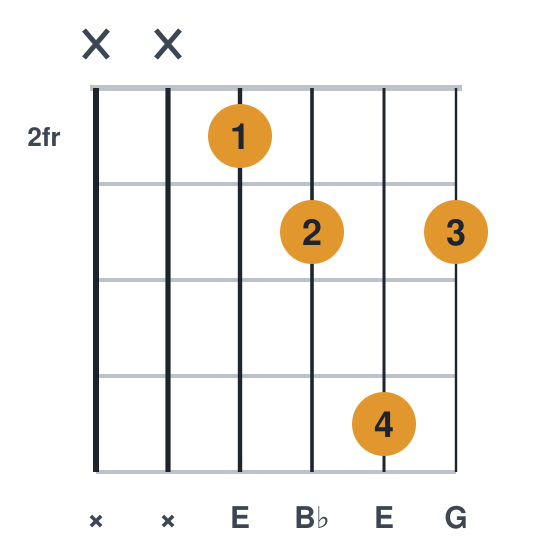
- FEdim7 pulls up a half step to F
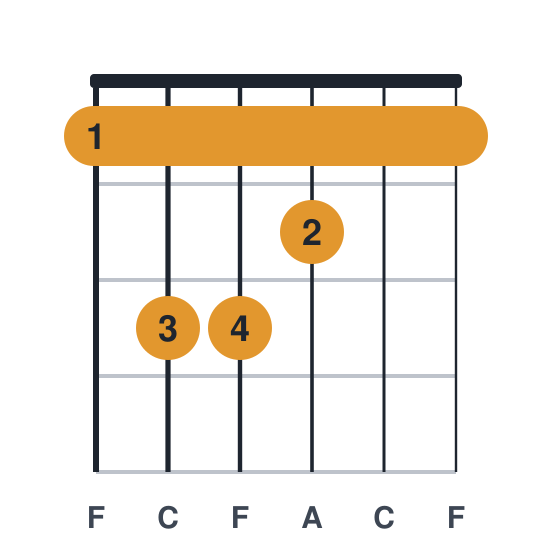
- Fmthe minor resolution one fret up
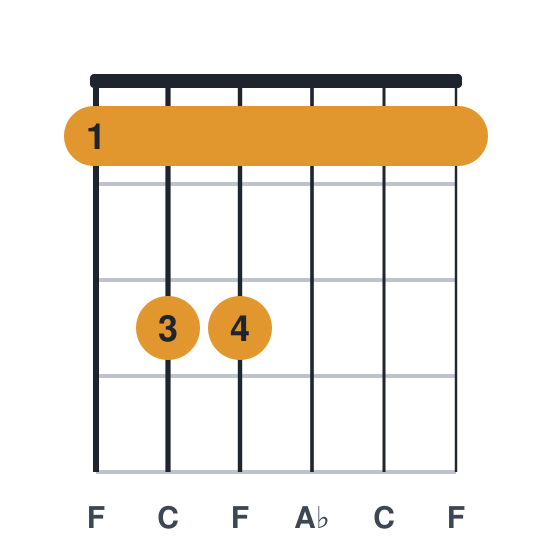
- Ethe plain major on the same root
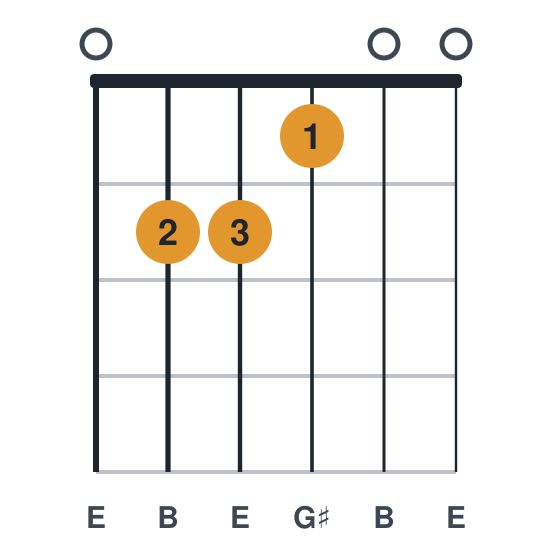


Other E chords
Edim7 guitar chord chart (012020) from melodician.com