Eaug Guitar Chord
Eaug is the E augmented chord. It has three notes: E, G♯ and C. It is one of the few augmented chords with a full six string open shape, built from open E major by raising both B notes a half step. If you have heard the dramatic single chord that opens Oh! Darling, you have heard Eaug.

Open E major with both B notes raised a half step: pinky takes the 3rd fret on the A string, index and middle sit side by side at fret 1. Every string rings.
How to play Eaug, step by step
- Index finger: 1st fret, G string
- Middle finger: 1st fret, B string
- Ring finger: 2nd fret, D string
- Pinky finger: 3rd fret, A string
- Strum all six strings.
Learn it next to open E major: the D and G string notes keep their pitches, while the two B notes each move up one fret. Feeling that relationship makes the chord easy to find mid song.
More ways to play Eaug
There are 2 common Eaug shapes in total: the standard one at the top of the page, plus these, easiest first. You only ever need one. Tap any card to hear it.

Smaller and tidier than the open giant, easier to tuck into the middle of a song.
If it sounds muddy or buzzes
- Index and middle fight for space at fret 1
- They sit on neighboring strings at the same fret. Stagger them slightly, index further back in the fret, middle right behind the wire, so neither lies on top of the other.
- The A string note buzzes
- The pinky at the 3rd fret is the weakest finger doing the deepest job here. Keep it curled and press with the corner of the tip; if it collapses, the note dies.
- Open high E sounds sour to you
- It is not wrong, it is the chord. Eaug packs three E notes and two C notes into six strings, and the rub between C and the E next to it is the augmented sound. Trust the diagram.
What makes it an Eaug
E · G♯ · C 1 3 ♯5
Eaug is an augmented triad: E major with the fifth raised from B to C. That C is the engine of the chord. It sits a half step above the fifth it replaced and a half step below C♯, so whichever way the music goes next, Eaug slides there smoothly. Songwriters use it as a dramatic pivot, often at the very start of a phrase.
Its textbook home is the key of A, where Eaug is the V chord with a raised fifth. E to Eaug to A walks the top note chromatically, B to C to C♯, and that is exactly the move behind the Oh! Darling intro: an Eaug that hangs in the air, then falls into A. It resolves just as well to A minor, where the C is already the third.
E vs Eaug
Eaug is open E major with the fifth raised a half step, which on this shape means both B notes move up one fret. The physical change is small; the emotional change is not. E major is solid ground. Eaug is the same chord up on its toes, and it needs to step somewhere, usually to A or Am. Keep E for the progression's backbone and spend Eaug in single bars, where its drama counts.
Eaug chord questions
What songs use Eaug?
The best known example is Oh! Darling by The Beatles, which opens on a held Eaug before the first verse lands on A. It is a textbook V augmented resolving home.
Do you strum all six strings in Eaug?
Yes. Every string is a chord tone in the open shape: three Es, two Cs and a G♯. It is one of the few augmented voicings with a full six string sound.
Is Eaug hard to play?
Middling. There is no barre, but four fingers work in a small area and the pinky carries a fretted bass note. Players comfortable with open E usually get it quickly.
What is the difference between E and Eaug?
The fifth. E major contains E, G♯ and B; Eaug raises the B to C. On the open shapes that is two strings moving up one fret each.
What does Eaug resolve to?
A major or A minor, most of the time. Eaug is the V chord of A with a raised fifth, and its C note leads by half step to C♯ in A major, or stays put as the third of Am.
Chords to learn next
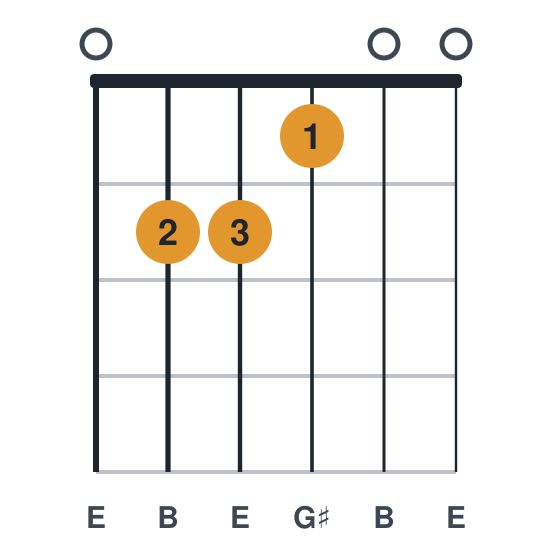
- Ethe plain major, one note apart
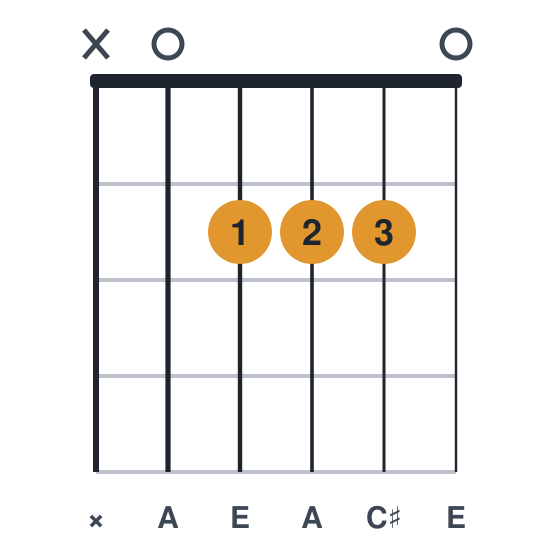
- Awhere Eaug usually resolves
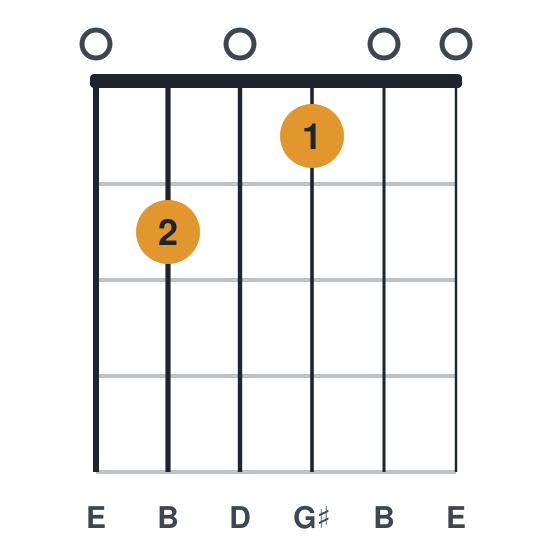
- E7another chord built to push forward
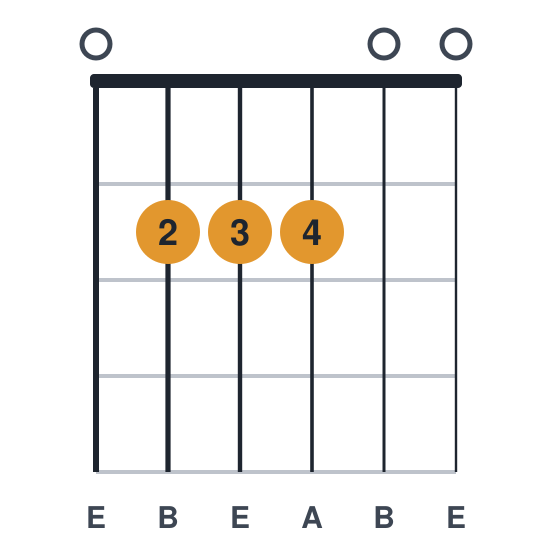
- Esus4another color built on the same root, pulling elsewhere


Other E chords
Eaug guitar chord chart (032110) from melodician.com