E5 Guitar Chord
E5 is the E power chord. It has only two notes: E and B. There is no third, so the chord is neither major nor minor, and the open shape uses the lowest and loudest strings on the guitar.

The open low E as the root, with the fifth on the A string and the root again on the D. The lowest and loudest power chord on the guitar.
How to play E5, step by step
- Index finger: 2nd fret, A string
- Ring finger: 2nd fret, D string
- Strum only the low E and A and D strings, and stop the downstroke at the D.
Keep the fretting hand light and let the palm of the strumming hand rest on the strings to mute them. Power chords are as much about stopping the sound as making it.
More ways to play E5
There are 5 common E5 shapes in total: the standard one at the top of the page, plus these, easiest first. You only ever need one. Tap any card to hear it.

Tight and focused. With only two strings sounding it cuts through anything.

Thick and solid, with the doubled root filling it out. This is the sound of a rock rhythm part.

Thick and solid, with the doubled root filling it out. This is the sound of a rock rhythm part.

Leaner than the three string version and quicker to move. Under distortion the missing octave is barely noticeable.
If it rings when it should not
- The higher strings sound
- Only the bottom three strings belong here. Let the fingers that are fretting lie flat enough to touch the G string, and stop the downstroke at the D.
- The chord sounds muddy
- Two notes an octave and a fifth apart should be clear. Check both fretted notes are right behind the 2nd fret, and try picking nearer the bridge.
- It buzzes when you move
- Lift the fingers a fraction before changing rather than dragging them along the strings. Power chords move fast and drag is what makes the noise.
What makes it an E5
E · B 1 5
E5 is the root E with a perfect fifth, B, seven half steps above it. The third of the chord, which would be G sharp for E major or G for E minor, is simply left out.
That missing third is the point. A third played through heavy distortion clashes with itself and turns muddy, while a bare fifth stays clean at any volume. It is also why a power chord fits over a major or a minor progression without choosing sides.
E5 vs E
Full E major has three notes and six ringing strings. E5 has two notes on three strings. Clean, the major chord sounds richer; distorted, E5 sounds bigger, because there is nothing in it to smear.
E5 also fits where E major would not. Over a riff in E minor, E5 sits comfortably, because the note that would fight the minor third is not there.
E5 in major keys
Every note of E5 sits inside these keys. See how it works alongside the other chords in each one.
E5 chord questions
Is E5 major or minor?
Neither. A power chord has only the root and the fifth, and the third is the note that decides major or minor. That is why E5 works over both.
Why is it called a power chord?
The name comes from electric guitar practice: two notes a fifth apart stay clean and sound huge through an overdriven amp, where a full chord turns to mush.
Can I play E5 with one finger?
Yes. The two string version is the open low E plus the 2nd fret of the A string, which is one finger. The three string version adds one more.
Which strings do I strum for E5?
The bottom three: low E, A and D. Stop the strum there. If you hit the top strings you will add notes that are not in the chord.
How do I move E5 to other chords?
Slide the whole shape up the neck. The same grip at the 5th fret of the low E is A5, and at the 7th fret it is B5, which gives you the three chords of a blues in E.
Chords to learn next
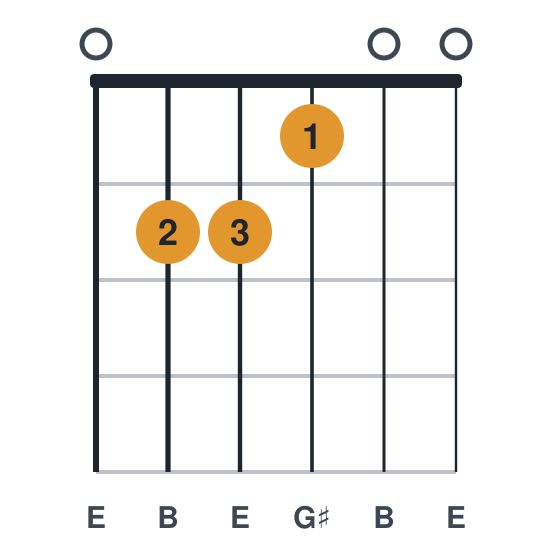
- Ethe full major chord on the same root
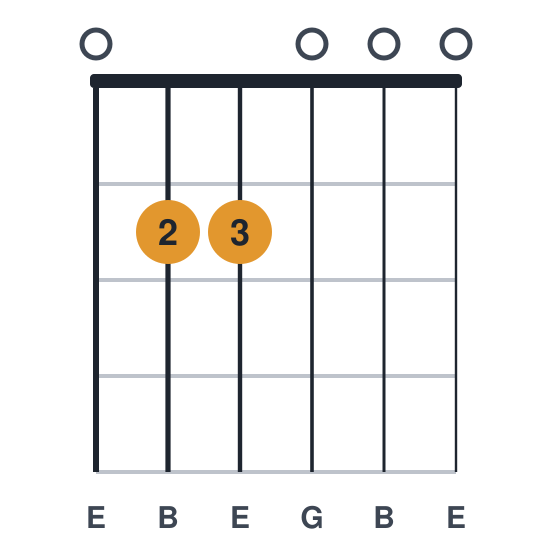
- Emthe minor a power chord leaves undecided
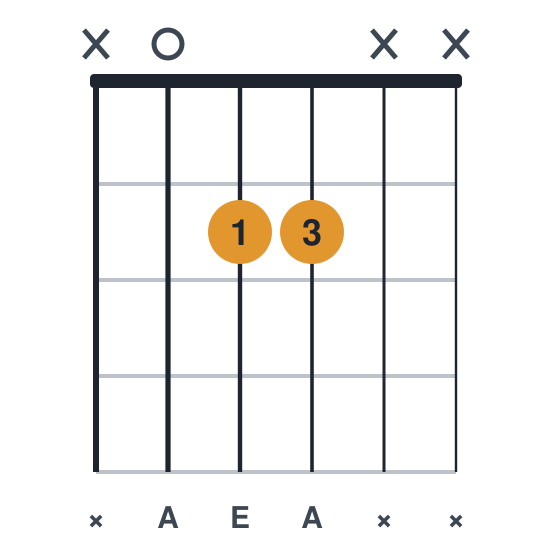
- A5the power chord a fourth up, the next move in most riffs
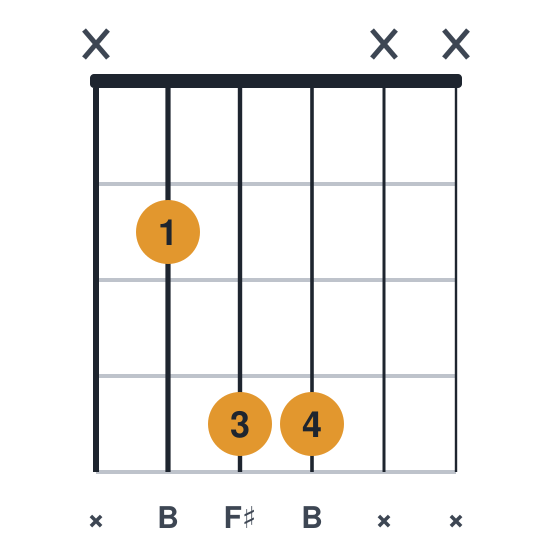
- B5the power chord a fifth up, the other half of most riffs


Other E chords
E5 guitar chord chart (022xxx) from melodician.com