Eadd9 Guitar Chord
Eadd9 is the E added ninth chord. It has four notes: E, G♯, B and F♯. The standard shape is the familiar open E with the pinky added at the 2nd fret of the high E string, so all six strings ring and the ninth sits right on top of the chord.

The open E chord with the pinky dropped onto the 2nd fret of the high E string. Everything else stays exactly where E always is.
How to play Eadd9, step by step
- Index finger: 1st fret, G string
- Middle finger: 2nd fret, A string
- Ring finger: 2nd fret, D string
- Pinky finger: 2nd fret, high E string
- Strum all six strings.
There is also a 3 finger version below that tucks the ninth into the middle of the chord instead of on top. It trades the pinky for a reach to the 4th fret, and the two shapes are worth knowing for their different characters.
More ways to play Eadd9
There are 2 common Eadd9 shapes in total: the standard one at the top of the page, plus these, easiest first. You only ever need one. Tap any card to hear it.

Softer and more blended than the standard shape, because the ninth sits in the middle instead of on top.
If it buzzes or loses notes
- Open B string goes quiet
- The pinky on the high E string is leaning onto its neighbour. Come down on the very tip, even if the pinky feels short; the open B has to ring between two fretted strings.
- G string buzzes at the 1st fret
- First fret notes need the finger right behind the fret wire. Slide the index forward and press with the tip, exactly as you would for plain E.
- The top note is faint
- The F♯ on the high E string is the whole point of this chord. Give the pinky a full, deliberate press; a half pressed thin string disappears in a strum.
What makes it an Eadd9
E · G♯ · B · F♯ 1 3 5 9
Eadd9 is an E major triad (E, G♯, B) plus a ninth: F♯. The F♯ is the second note of the E scale raised an octave, and because the third (G♯) is untouched, the chord stays firmly major. The ninth just adds a bright edge on top of a sound you already know.
It lives where E lives: the I chord in the key of E, the V chord in A, the IV chord in B. Reach for it when a plain E has to ring out on its own and needs a little more interest.
Eadd9 vs Esus2
Esus2 replaces the third of E (G♯) with F♯, so the chord turns hollow and undecided. Eadd9 keeps both notes: the G♯ that makes it major and the F♯ that makes it shimmer. There is a practical difference too: Esus2 has no comfortable open shape on guitar, while Eadd9 is just the open E chord plus a pinky, which makes it the natural way to get this colour on an E.
Eadd9 in major keys
Every note of Eadd9 sits inside these keys. See how it works alongside the other chords in each one.
Eadd9 chord questions
Is Eadd9 a hard chord?
Not really. It is the open E chord with one extra finger, no barre and no stretch. The only new skill is landing the pinky on the thin string without muting the B.
What is the difference between Eadd9 and E9?
E9 also contains a D, the flat seventh, which turns it into a dominant chord with a funky pull toward A. Eadd9 has no seventh; it is a major chord with extra brightness.
What is the difference between Eadd9 and Esus2?
Both use an F♯, but Esus2 drops the major third (G♯) and sounds unresolved, while Eadd9 keeps the G♯ and stays clearly major.
Do you strum all six strings in Eadd9?
Yes. Both shapes on this page use all six strings, with the root E at the bottom. Nothing needs muting.
Can I play Eadd9 instead of E?
Often yes, especially in the keys of E, A and B where the F♯ belongs. It is a common trick for making a held E chord sound less plain.
Chords to learn next
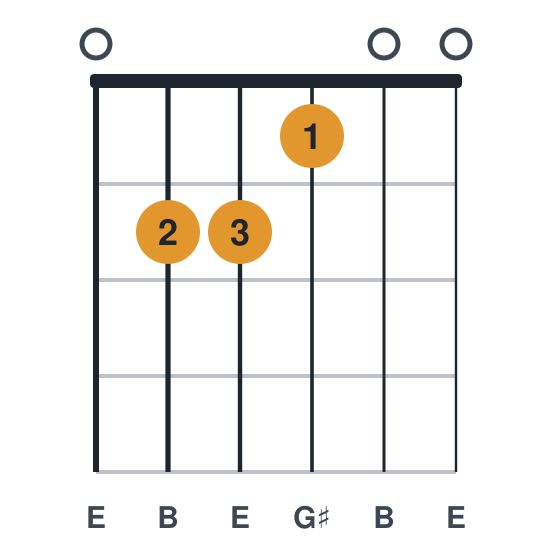
- Ethe plain major
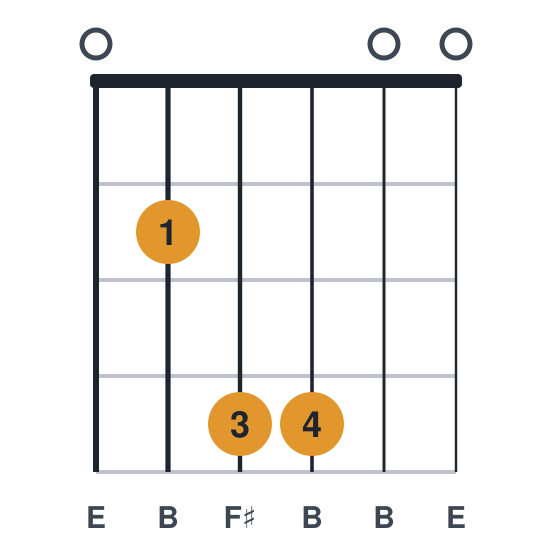
- Esus2the 9 without the 3
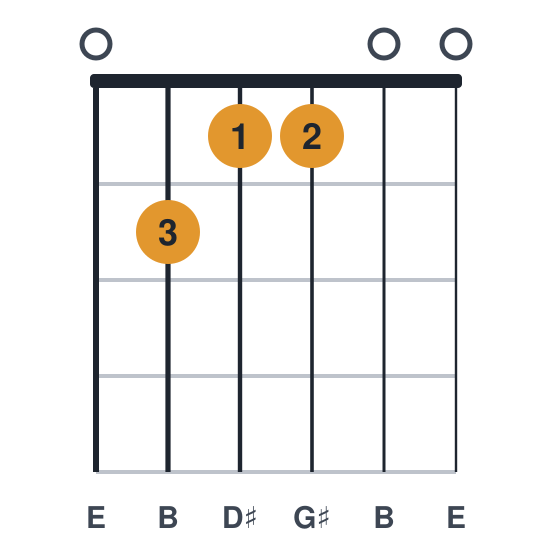
- Emaj7another colour on the same major
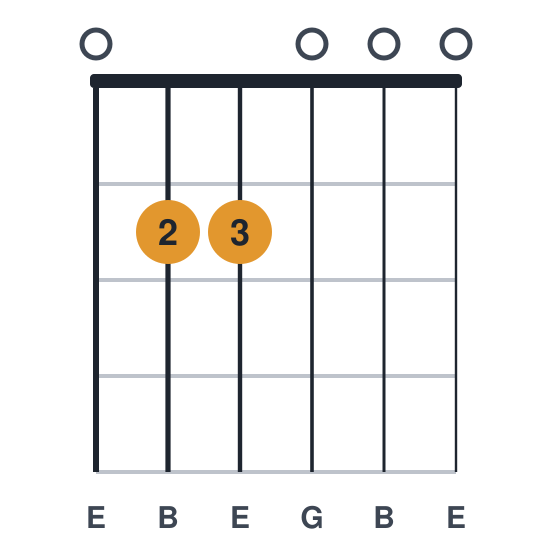
- Emthe minor chord on the same root, a darker place to go next


Other E chords
Eadd9 guitar chord chart (022102) from melodician.com