Gaug Guitar Chord
Gaug is the G augmented chord. It has three notes: G, B and D♯. The standard shape is open G major with one finger added: the open D string gets pressed at the 1st fret. All six strings ring, which makes this one of the biggest sounding augmented chords on the instrument.

Open G major with the index added at the 1st fret of the D string to raise the fifth. Six strings, no barre, and only one finger away from a chord you already know.
How to play Gaug, step by step
- Index finger: 1st fret, D string
- Middle finger: 2nd fret, A string
- Ring finger: 3rd fret, low E string
- Pinky finger: 3rd fret, high E string
- Strum all six strings.
If your usual G major uses the middle, ring and pinky fingers, you are already in position: Gaug just adds the index at the 1st fret of the D string. Practice toggling that one finger on and off.
More ways to play Gaug
There are 2 common Gaug shapes in total: the standard one at the top of the page, plus these, easiest first. You only ever need one. Tap any card to hear it.

Leaner and punchier than the open shape, four strings with no low end.
If it sounds off or buzzes
- The D♯ at the 1st fret buzzes
- The index is the newcomer in a familiar shape and often lands lazily mid fret. Place it right behind the fret wire and press with the tip.
- Open G or B string is muffled
- The index and middle fingers arch over both open strings. If either finger sags, it lands on them. Keep the palm off the neck and the knuckles high.
- The bass note is weak
- The ring finger on the low E at fret 3 has to hop over the middle finger. Give it a full curl so it presses straight down instead of glancing off the string.
What makes it a Gaug
G · B · D♯ 1 3 ♯5
Gaug is an augmented triad: G major with the fifth raised a half step, D becoming D♯. That D♯ is a leading tone in disguise. It sits one fret below E, and the pull from D♯ to E is one of the strongest in music, so a Gaug chord practically announces where the harmony is headed.
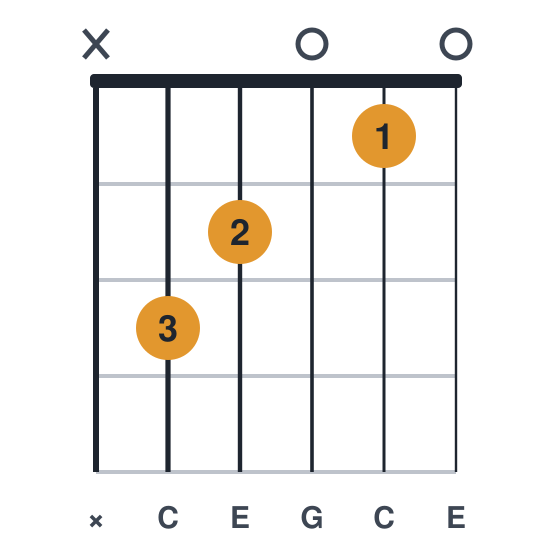
The classic destination is C major: Gaug works as the V chord of C with a raised fifth, and the D♯ resolves up into E, the third of C. G to Gaug to C is a stock ending flourish for that reason. The same pull lands on E minor too. And if you keep raising notes, you find the triad's symmetry: Gaug, Baug and Ebaug are one chord with three names.
G vs Gaug
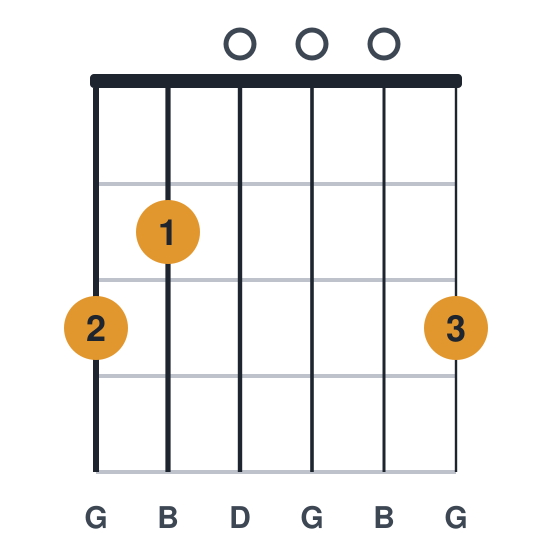
The distance between them is one added finger: press the open D string at the 1st fret and G major becomes Gaug. Hearing them side by side is the fastest way to understand augmented chords, because five of the six strings do not change. G is the resting chord; Gaug is the same chord straining upward. Use Gaug for a single bar between G and C, or between G and Em, and the switch will make sense immediately.
Gaug chord questions
Is Gaug hard if I already play G?
No. The open Gaug is your G major grip plus an index finger on the 1st fret of the D string. The added finger is the only new work.
Do you strum all six strings in Gaug?
Yes. In the open shape every string is a chord tone, including both E strings fretted at 3. It is a genuinely full six string chord.
What does Gaug resolve to?
C major is the textbook answer: the raised fifth D♯ climbs a half step to E. Gaug also resolves nicely to E minor, or relaxes back into plain G.
What is the difference between G and Gaug?
One note. G major is G, B and D; Gaug raises the D to D♯. On the open shape that is one fret on one string.
Is G+ the same as Gaug?
Yes. G+ is just shorthand for G augmented. Both mean the notes G, B and D♯.
Chords to learn next
- Gthe plain major, one note apart
- Cwhere Gaug usually resolves
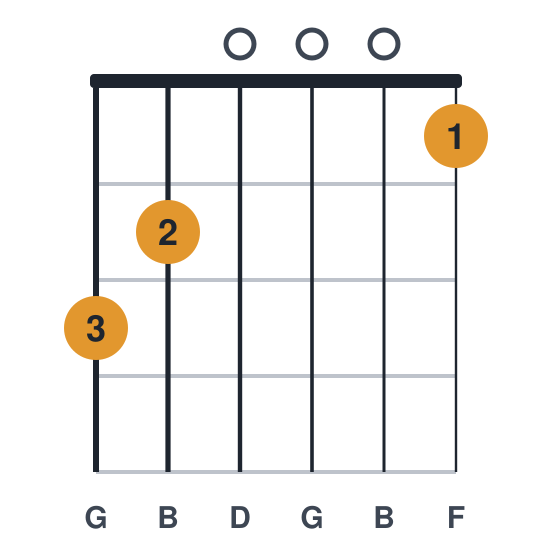
- G7another chord built to push forward
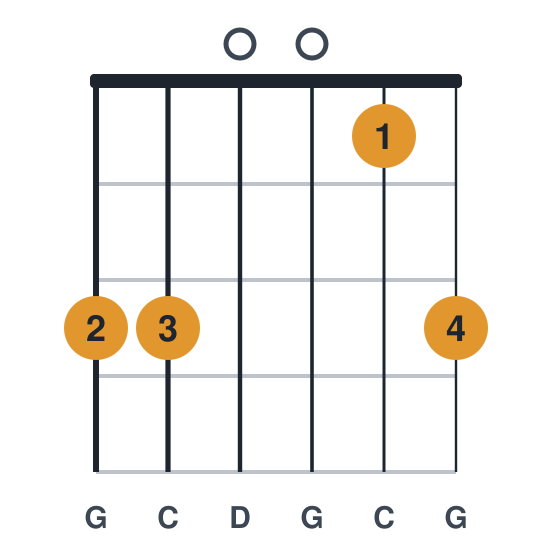
- Gsus4another color built on the same root, pulling elsewhere


Other G chords
Gaug guitar chord chart (321003) from melodician.com