C#maj7 Ukulele Chord
C#maj7 is the C sharp major seventh chord. It has four notes: C sharp, F, G sharp and C. The standard shape leaves the C string open as the seventh, with fingers at the 1st fret of the G and E strings and the 4th fret of the A.

Fingers at the 1st fret of the G and E strings and the 4th of the A, with the open C string sounding the major seventh.
How to play C#maj7 on ukulele, step by step
- Index finger: 1st fret, G string
- Middle finger: 1st fret, E string
- Ring finger: 4th fret, A string
- Leave the C string open. Strum all four strings.
The open C string does the clever work here: it sounds the major seventh while the three fretted notes build the chord around it. Not many chords this deep into the sharps get an open string for free.
More ways to play C#maj7
There are 3 common C#maj7 shapes: the standard one at the top of the page, plus these further up the neck. You only ever need one. Tap any card to hear it.

Even and fretted all through, handy when open strings would ring on too long.

Full and high, the fretted block giving the chord one firm voice.
If it will not ring
- The open C string sounds dull
- The fingers at the 1st fret sit either side of it, and one of them is leaning over. Curl the index and middle onto their tips so the open string has room.
- The reach to the 4th fret is a stretch
- Drop the thumb low behind the neck and let the ring finger swing out from the knuckle rather than dragging the whole hand up the neck.
- A note in the middle is missing
- Strum slowly and name what you hear. It is usually the E string at the 1st fret, choked by the ring finger arching across; re-point it at its own string.
What makes it a C#maj7
C♯ · F · G♯ · C 1 3 5 7
C#maj7 is a major seventh chord: a C sharp major triad (C sharp, F, G sharp) plus a major seventh (C). Strict spelling calls those notes E sharp and B sharp, but chord charts write the plain keys you press, F and C, and so does this page. The seventh still sits a half step under the root, which is where the maj7 shimmer comes from.
C#maj7 is the I chord of C sharp major and the IV chord of A flat major. Most charts spell the whole business in flats and write Dbmaj7; either way it is a favourite landing chord in soul and R&B.
C# vs C#maj7
C sharp major is 1114, with the C string fretted at the 1st fret as part of the barre. C#maj7 simply lets that string go: the open C takes over as the major seventh while the root moves to the top of the chord. Lifting one note out of a barre is the entire difference.
Plain C sharp resolves and settles. C#maj7 floats, the open string leaning up into the root a half step away, which is why slow songs in D flat live on it.
C#maj7 chord questions
Are C#maj7 and Dbmaj7 the same chord?
Yes, one chord spelled two ways. Real charts nearly always write Dbmaj7, since D flat is the working key name; the notes and the shape do not change.
Why does this page say F and C instead of E sharp and B sharp?
Strict theory spells the third of C sharp as E sharp and the seventh as B sharp, but they are the F and C keys you actually press. Chord charts, including this one, name the plain notes.
Is C#maj7 easy on the ukulele?
Easier than it looks. Two of its fretted notes sit at the 1st fret, one string rings open, and only the 4th fret reach takes practice.
What is the difference between C#maj7 and C#7?
The seventh. C#7 carries a B natural and pushes toward F sharp; C#maj7 carries a C, sitting one half step under the root, and stays home.
What keys use C#maj7?
It is the I chord of C sharp (usually written D flat) major and the IV chord of A flat major, both staples of soul, gospel and jazz.
Chords to learn next
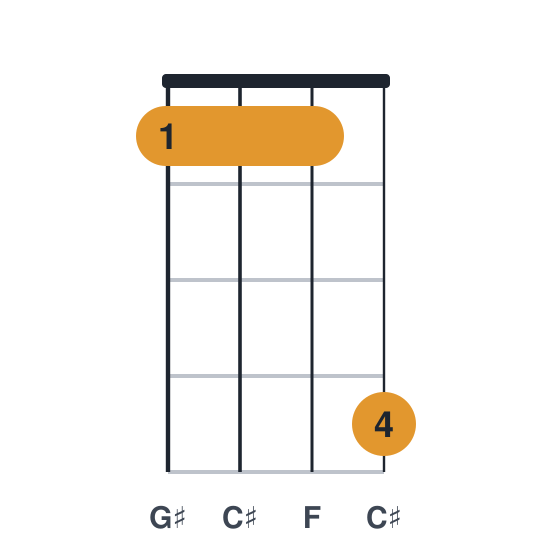
- C#the plain major
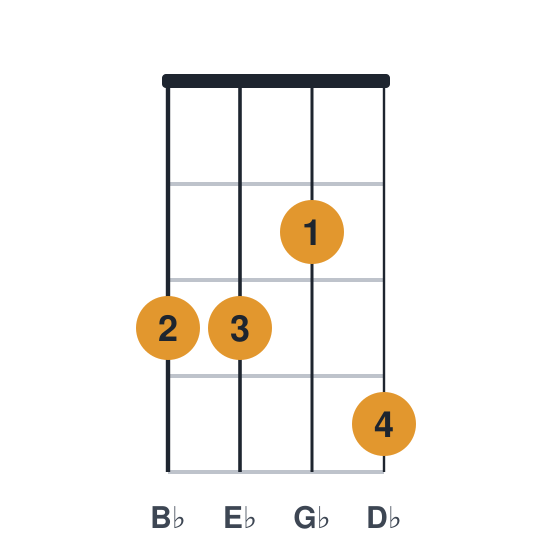
- Ebm7the ii chord beside C#maj7 in the key of C#
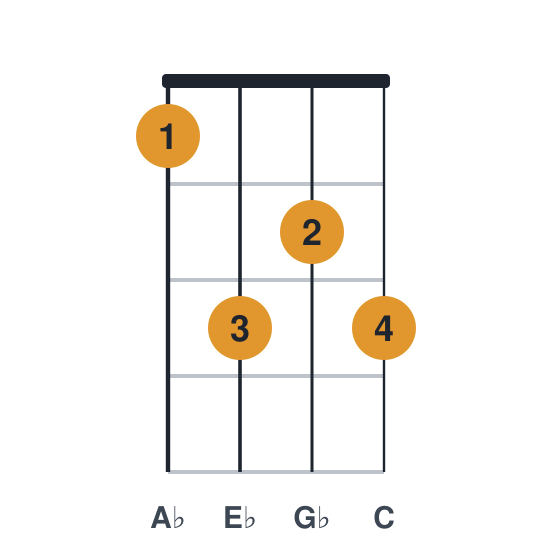
- Ab7the V chord of C#
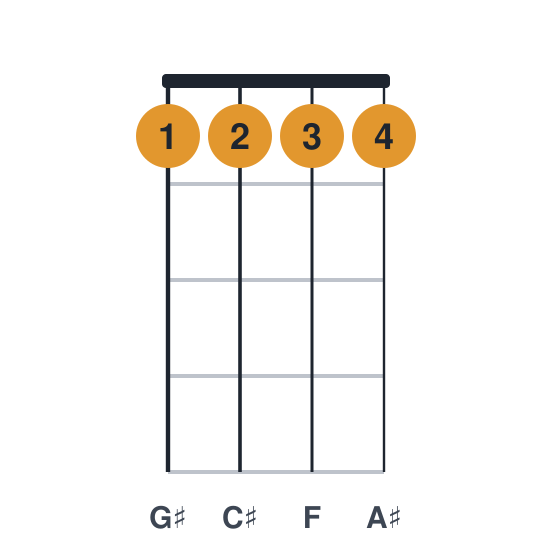
- C#6the other soft colour on the same major


Other C# chords
C#maj7 ukulele chord chart (1014) from melodician.com