C# Ukulele Chord
C# is the C sharp major chord, also written Db. It has three notes: C sharp, F and G sharp. The standard shape is the open C picture moved up one fret: a small index barre at the 1st fret with the pinky reaching the 4th.

The open C shape moved up one fret: index flat across the G, C and E strings at the 1st fret, pinky on the A string at the 4th.
How to play C# on ukulele, step by step
- Index finger: press flat across the G to E strings at fret 1
- Pinky finger: 4th fret, A string
- Strum all four strings.
This is exactly the open C shape slid up one fret, with the index flattening to do the job the nut used to do. That trick generalises: the same grip higher up the neck names a new major chord at every fret.
More ways to play C#
There are 3 common C# shapes: the standard one at the top of the page, plus these further up the neck. You only ever need one. Tap any card to hear it.

Fuller feeling than the 1st fret shape, with the root ringing low on the G string.

High and even. Everything is fretted, so the grip slides cleanly to name other chords.
If C# will not speak
- A string inside the barre is silent
- The index has to cover the G, C and E strings evenly at the 1st fret. Roll it slightly onto its side and keep it tight behind the fret wire.
- The pinky note is thin
- The pinky sits alone on the A string at the 4th fret. Arch it so it presses straight down; a flat pinky bleeds onto the E string.
- The chord sounds sharp
- Pressing a barre too hard this close to the nut bends the strings out of tune. Use just enough pressure for a clean ring and no more.
What makes it a C#
C♯ · F · G♯ 1 3 5
C sharp major is the root C sharp, the major third and the fifth G sharp. Strict spelling calls the third E sharp; charts, and this site, write the same key as F because that is the name players can find. The chord is unchanged either way.
C# is the I chord in the key of C sharp, the IV chord in A flat and the V chord in F sharp. It also sits exactly between C and D, so writers use it when a song steps up a fret for one more chorus.
C# vs C#m
One note falls: the third drops a half step, from F to E, and C sharp major becomes C sharp minor.
In the shapes the change is small and pleasing: the barre's edge lifts so the E string rings open, and the fretted third disappears. C#m keeps the same frame with one string set free.
C# chord questions
Is C# the same chord as Db?
Yes. C sharp and D flat name the same pitch, so the fingerings are identical. Which spelling appears depends on the key of the song.
Why does the chart say F instead of E#?
The strict spelling of the third is E sharp, which is the same key as F. Charts use the plain name so you can find the note; the theory is unchanged.
Is the barre in C# hard?
It covers three strings at the 1st fret, where strings are stiffest, so it asks more than the two string Bb barre. Landing the barre before the pinky makes it manageable.
What is the difference between C# and C#m?
The third: F, strictly E sharp, drops to E. On the ukulele the E string simply comes out of the barre and rings open.
What keys use the C# chord?
C# is home in C sharp, the IV in A flat and the V in F sharp. It also appears wherever a song in C shifts everything up one fret for a final chorus.
Chords to learn next
- C#mthe minor version of C#
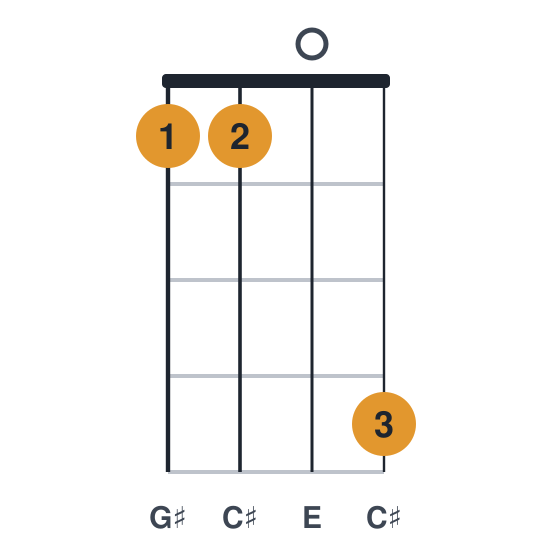
- C#7C# with the seventh that pushes to F#
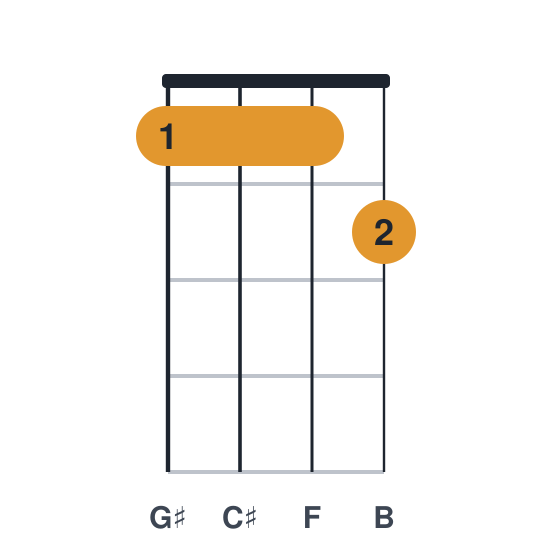
- Bbmthe relative minor of C#
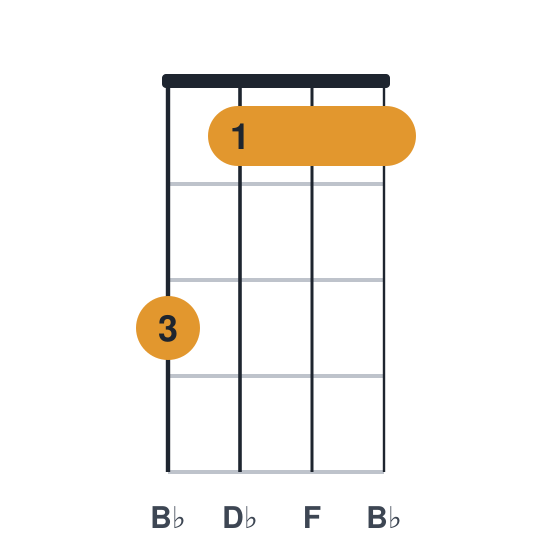
- C#maj7the soft version of the same chord
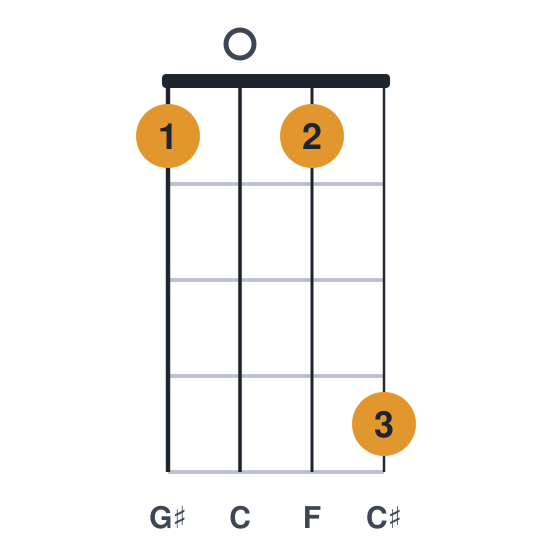


Other C# chords
C# ukulele chord chart (1114) from melodician.com