C#aug Ukulele Chord
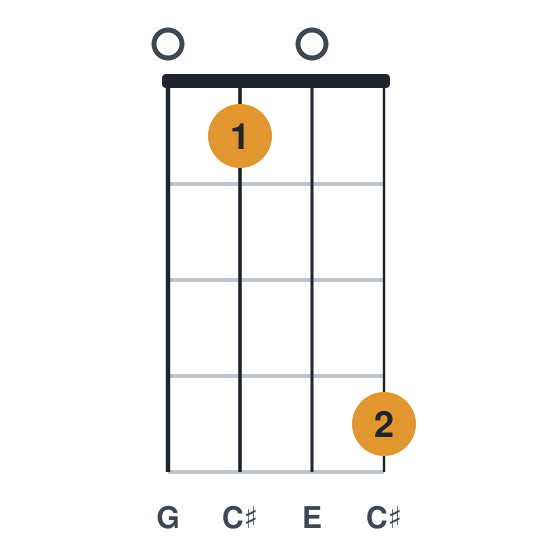
C#aug is the C sharp augmented chord, also written Dbaug. It has three notes: C sharp, F and A. The standard shape sits in the first two frets with the A string open, and the same grip four frets higher gives the chord again with its root at the bottom.

Index and middle paired at the 1st fret, ring on the G string at 2, A string open. The root C sharp sits on the C string under the index.
How to play C#aug on ukulele, step by step
- Index finger: 1st fret, C string
- Middle finger: 1st fret, E string
- Ring finger: 2nd fret, G string
- Leave the A string open. Strum all four strings.
Slide this whole shape up four frets to 6554 and you get C#aug again: an augmented chord repeats itself every four frets, because its three notes are all a major third apart. Both positions are on this page.
More ways to play C#aug
There are 3 common C#aug shapes: the standard one at the top of the page, plus these further up the neck. You only ever need one. Tap any card to hear it.

Rounder and more even than the open shape, with the root at the bottom of the strum. The movable version to learn.

Big and ringing for an augmented chord, the doubled root giving it unusual weight.
If it buzzes or sounds wrong
- The fret 1 pair buzzes
- The index and middle share the 1st fret on the C and E strings. Set both fingertips close behind the fret wire and keep a small gap between the knuckles.
- The open A gets muted
- The middle finger's underside is usually what touches it. Arch the finger so the string rings free; the open A is the raised fifth and the chord loses its point without it.
- The G string note is weak
- The ring finger reaches to the 2nd fret while two fingers sit below it. Bring the thumb behind the neck so the hand can arch instead of collapsing flat.
What makes it a C#aug
C♯ · F · A 1 3 ♯5
C#aug is an augmented triad: C sharp major with the fifth raised a half step, G sharp becoming A. The raised note hangs a half step below A sharp and a half step above the fifth it replaced, so the chord never sits still; it exists to connect two chords that do.
The textbook resolution is F sharp: C#aug acts as the V chord of F# with a raised fifth, and the A climbs to A sharp, the third of F#. Because C sharp to F and F to A are both major thirds, C#aug contains exactly the same notes as Faug and Aaug, one chord with three possible roots.
C# vs C#aug
Plain C# on ukulele is a one fret barre shape at 1114; C#aug rearranges to 2110 with the A string open. The musical difference is one note: the fifth G sharp rises to A, and the settled major turns into a chord leaning on the next bar.
Keep C# for the body of a progression. Reach for C#aug for a beat or two when the music should lift toward F#, or as a chromatic step back into the plain chord.
C#aug chord questions
Are C#aug and Dbaug the same chord?
Yes. C sharp and D flat are one pitch with two spellings, so C#aug and Dbaug are the same shape and the same sound. Sharp keys write C#aug, flat keys Dbaug.
What does C#aug resolve to?
F sharp major most often, with the raised fifth A climbing to A sharp. It also falls back to plain C# neatly.
Why does the chart say A instead of G double sharp?
Strict spelling raises C sharp major's fifth, G sharp, to G double sharp, which is the same key as A. Chord charts print the plain name and so does this page.
Does C#aug share notes with other chords?
Yes, with Faug and Aaug. An augmented triad is two identical major thirds stacked, so its three notes can each be read as the root.
Is C#aug hard to play?
No. It is the same easy shape as Aaug and Faug: two fingers paired at the 1st fret, the ring at the 2nd, and the A string open.
Chords to learn next
- C#the plain major, one note apart
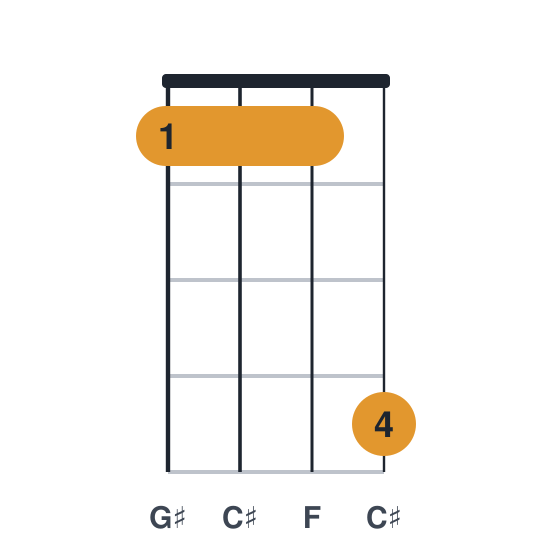
- F#where C#aug usually resolves
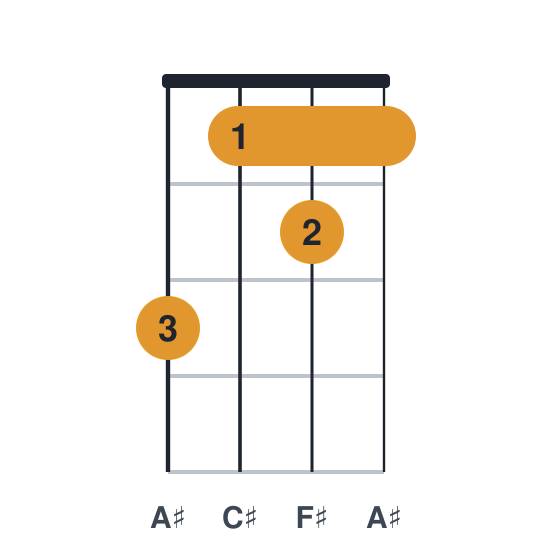
- C#7another chord built to push forward
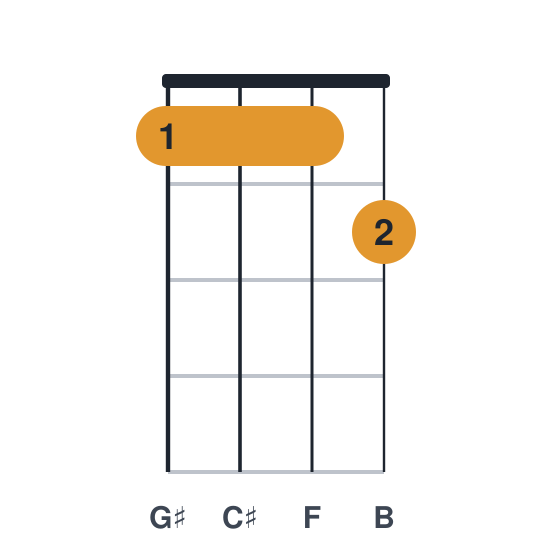
- C#dimthe other chord built out of equal intervals


Other C# chords
C#aug ukulele chord chart (2110) from melodician.com