C#7 Ukulele Chord
C#7 is the C sharp dominant seventh chord. It has four notes: C sharp, F, G sharp and B. The shape is a small barre: index flat across the g, C and E strings at the 1st fret, middle finger on the 2nd fret of the A string.

Index barred across the g, C and E strings at the 1st fret, middle on the 2nd fret of the A string. C7 moved up one fret, with the barre replacing the nut.
How to play C#7 on ukulele, step by step
- Index finger: press flat across the G to E strings at fret 1
- Middle finger: 2nd fret, A string
- Strum all four strings.
C#7 is C7 moved up one fret. The three open strings of C7 become the barre at the 1st fret, and the one finger of C7 becomes the middle finger one fret higher. Every seventh grip on the neck comes from this move.
More ways to play C#7
There are 3 common C#7 shapes: the standard one at the top of the page, plus these further up the neck. You only ever need one. Tap any card to hear it.

Rounder and fuller than the small barre, four fretted strings ringing together. Worth the wider barre when the chord has to carry a bar on its own.

Bright and high, with the root at the bottom of the grip. The finger spread suits a tenor neck best.
If the barre will not ring
- The barre chokes at the 1st fret
- Strings are stiffest beside the nut. Roll the index onto its edge, snug behind the fret wire, and add thumb pressure from behind the neck rather than squeezing the hand.
- The A string is dull
- The middle finger stands alone past the barre. Curl it so the tip lands cleanly; flat, it leans on the E string and takes two notes down.
- Some strings are silent
- Pick the four strings one at a time. Three of the notes come from the barre alone, so any silent string means the index needs to flatten more evenly.
What makes it a C#7
C♯ · F · G♯ · B 1 3 5 ♭7
C#7 is a dominant seventh: a C sharp major triad (C sharp, F, G sharp) plus a minor seventh, B. It is the V7 of F sharp, and pulls toward F sharp major and minor alike.
The third of C sharp is strictly E sharp, the same key as F, and charts write F because it is readable. This site does the same: the diagram teaches keys under fingers, not spelling exams.
C#7 vs C#
C# major is 1114: the barre plus the pinky far out on the 4th fret. C#7 swaps that long reach for the middle finger at the 2nd fret. The note that falls away is a doubled root; the note gained is B, the seventh.
As always with sevenths, the difference in feel is direction: C# sits, C#7 pushes toward F#. The pair moves as one grip, which makes progressions in F# far less scary than they look.
C#7 chord questions
Is C#7 the same as Db7?
Yes, one chord with two names. Songs in sharp keys write C#7, songs in flat keys write Db7; the fingers cannot tell the difference.
Why does the chord contain F and not E sharp?
Strict spelling calls the third E sharp, which is the same key as F. Chord charts, including this one, write F because that is the key your finger finds.
Is C#7 hard to play?
It is the first fret barre plus one finger. Harder than the open C7, easier than most guitar barres, and a good early test of a clean short barre.
What does C#7 resolve to?
F#. C#7 is the V7 chord of F sharp major and F sharp minor.
Where is C#7 used?
In songs in F#, and as a passing chord between C7 and D7 whenever a progression climbs the neck one fret at a time.
Chords to learn next
- F#7C#7 resolves to F#
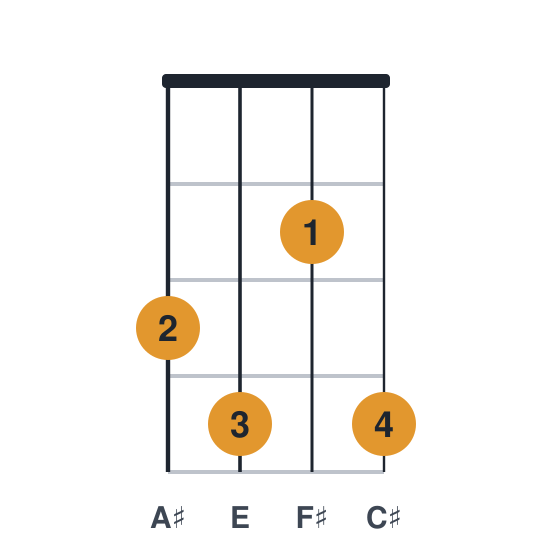
- C#the plain major underneath it
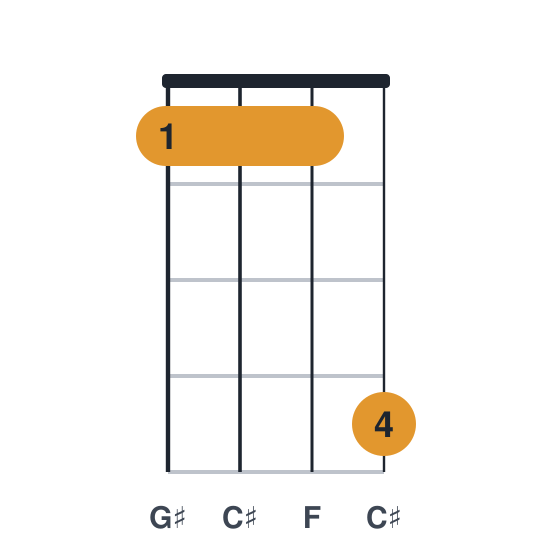
- B7the IV chord next to C#7 in blues in F#
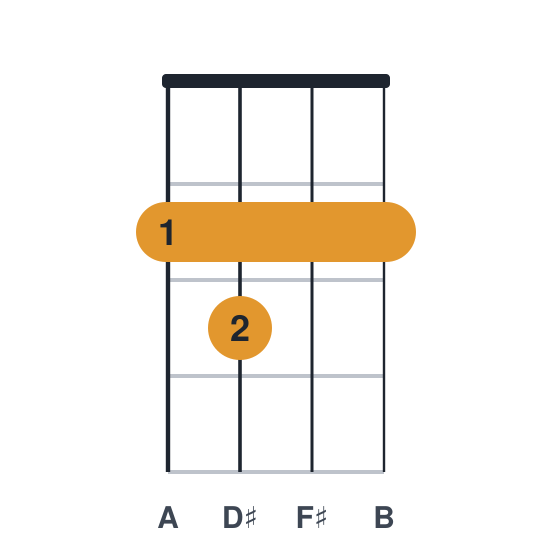
- C#9the same seventh with a ninth on top
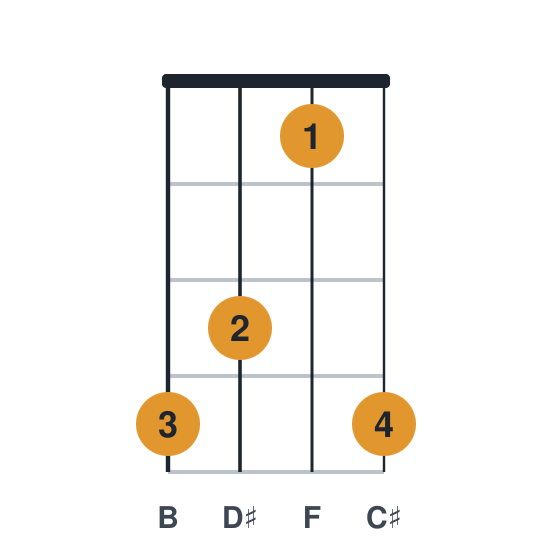


Other C# chords
C#7 ukulele chord chart (1112) from melodician.com