C#add9 Ukulele Chord
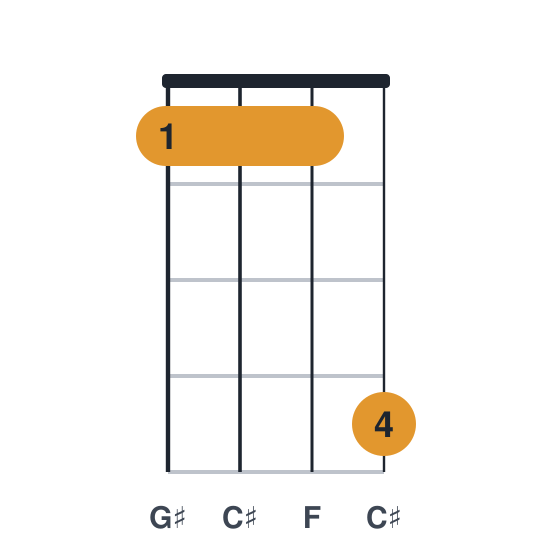
C#add9 is the C sharp added ninth chord. It has four notes: C sharp, F, G sharp and D sharp, with the F standing in for E sharp. The standard shape is a small barre across three strings at the 1st fret, with the ring and pinky fingers reaching the 3rd and 4th.

A small barre across three strings at the 1st fret, ring finger on the 3rd fret of the C string and pinky on the 4th fret of the A string.
How to play C#add9 on ukulele, step by step
- Index finger: press flat across the G to E strings at fret 1
- Ring finger: 3rd fret, C string
- Pinky finger: 4th fret, A string
- Strum all four strings.
The whole grip is fretted, so it moves: slide it up two frets and the same fingers play D#add9, down one and it is the shape Cadd9 players borrow when they want a fretted version.
More ways to play C#add9
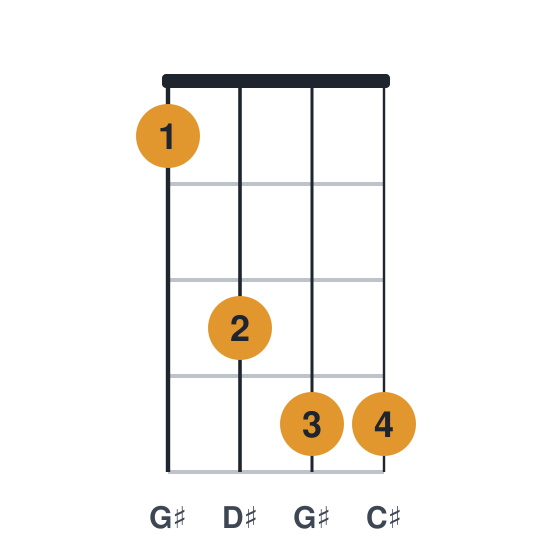
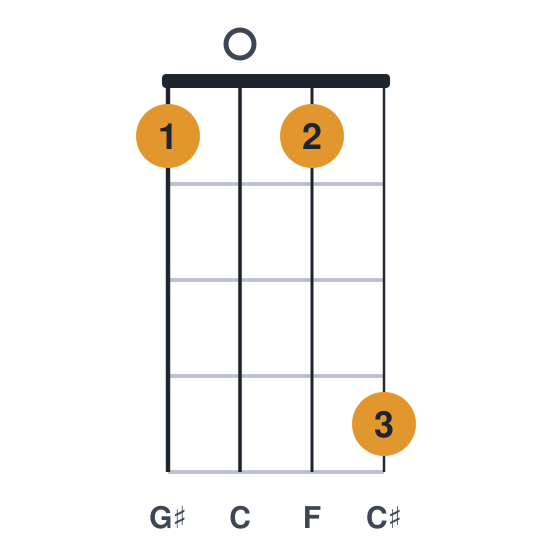
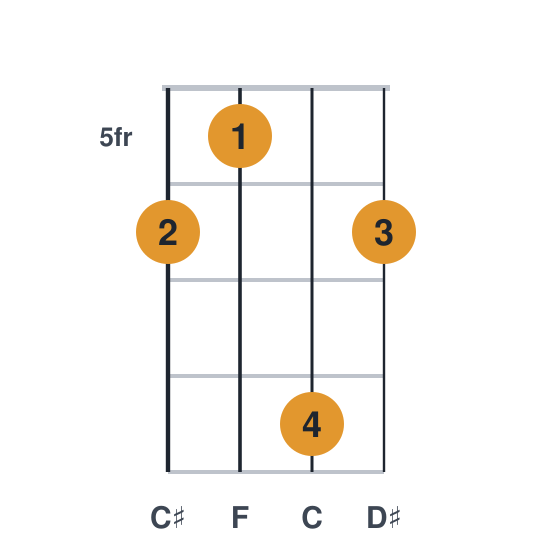
There are 3 common C#add9 shapes: the standard one at the top of the page, plus these further up the neck. You only ever need one. Tap any card to hear it.

Clear and even, all four notes in a tidy stack. The friendlier grip if barres are still a fight.

Glassy and high, over the body on most ukuleles. Better as an accent than as the everyday shape.
If it buzzes or sounds wrong
- The barre sounds patchy at the 1st fret
- The 1st fret is where strings are stiffest. Keep the index right behind the fret wire and roll it slightly onto its edge so all three strings under it speak.
- The A string note is weak
- The pinky has the longest reach in this shape, to the 4th fret. Bring the wrist forward a little so the pinky lands on its tip instead of collapsing flat.
- The middle of the chord is muffled
- The ring finger on the C string must arch over the strings the barre is holding. Check the E string still rings; if not, the ring finger is leaning on it.
What makes it a C#add9
C♯ · F · G♯ · D♯ 1 3 5 9
C#add9 is a C sharp major triad (C sharp, E sharp, G sharp) with a ninth added: D sharp. The third is spelled E sharp in strict notation, which is the same key as F, and F is how this site prints it, the way real chord charts do.
Because the third stays in the chord, C#add9 sounds fully major, just brighter than plain C sharp. It is the I chord of C sharp, the IV of G sharp and the V of F sharp, keys that appear when songs are tuned to fit a singer's voice, which is where this chord most often turns up.
C#add9 vs C#sus2
Both chords add a D sharp to C sharp, but C#sus2 removes the third to make room for it, while C#add9 keeps the third and stacks the D sharp alongside. One stays clearly major with extra shimmer, the other floats without committing.
If a chart says C# and you want more colour, add9 is the safe upgrade: the chord keeps its identity. Sus2 changes the harmony enough that the melody has to agree with it.
C#add9 chord questions
Is C#add9 the same as Dbadd9?
Yes, one chord with two names. C sharp is the spelling guitar and ukulele charts use most, so it is the name used here.
Why does this page show an F instead of E sharp?
Strict spelling calls the third of C sharp an E sharp, which is the same key as F. Chord charts print F because that is the note name players actually look for, and this site follows the charts.
What is the difference between C#add9 and C#9?
C#9 also contains a flat seventh, B, which makes it a dominant chord with a blues flavour. C#add9 adds only the D sharp and stays a bright major chord.
What is the difference between C#add9 and C#sus2?
Both contain a D sharp, but C#sus2 removes the third and floats, while C#add9 keeps the third and still sounds fully major.
Is there an easier C#add9?
The middle shape on this page uses four separate fingers at the 4th to 6th frets with no barre. If small barres frustrate you, start there.
Chords to learn next
- C#the plain major
- C#sus2the 9 without the 3
- C#maj7another colour on the same major
- C#maj9the same ninth with the seventh under it


Other C# chords
C#add9 ukulele chord chart (1314) from melodician.com