Ebm7 Ukulele Chord
Ebm7 is the E flat minor seventh chord. It has four notes: E flat, G flat, B flat and D flat. The standard shape uses all four fingers between the 2nd and 4th frets, with the root on the C string.

Index on the E string at the 2nd fret, middle and ring paired at the 3rd on the G and C strings, pinky on the A string at the 4th. Root on the C string.
How to play Ebm7 on ukulele, step by step
- Index finger: 2nd fret, E string
- Middle finger: 3rd fret, G string
- Ring finger: 3rd fret, C string
- Pinky finger: 4th fret, A string
- Strum all four strings.
Slide every finger down one fret and this exact shape plays Dm7. It is fully movable: each fret up renames the chord a half step higher.
More ways to play Ebm7
There are 3 common Ebm7 shapes: the standard one at the top of the page, plus these further up the neck. You only ever need one. Tap any card to hear it.

Even and percussive. The one finger version makes this the quickest Ebm7 to grab mid-song.

The high version: bright, tight and best where the chord needs to sit above another instrument.
If the shape is not clean
- The index gets squeezed out
- It takes the E string at the 2nd fret underneath three busier fingers. Set it first and build the rest of the shape over it.
- The pinky drags across the E string
- Reaching the A string at the 4th fret pulls the pinky flat. Keep it curled so it clears the E string, or the seventh goes quiet.
- The chord sounds tense rather than soft
- Usually a string is bending slightly under a crooked finger. Ease the grip, square the fingertips, and let the frets do the work.
What makes it an Ebm7
E♭ · G♭ · B♭ · D♭ 1 ♭3 5 ♭7
Ebm7 is a minor seventh chord: an E flat minor triad (E flat, G flat, B flat) plus a minor seventh (D flat). The seventh smooths the minor into something soft enough to sit on.
Its jobs live in the deepest flat keys: Ebm7 is the ii chord of D flat, spelled C sharp on this site, and the vi chord of G flat, spelled F sharp. Those are piano and vocal keys, so on the ukulele the chord mostly appears in songs kept in their original key.
Ebm7 vs Ebm
The pinky decides. Ebm puts the A string at the 1st fret, sounding B flat, the fifth; Ebm7 reaches it up to the 4th, where it sounds D flat, the seventh. The lower three notes stay put.
The reach makes the m7 the harder of the two here, which is unusual: on most roots the seventh version is the easier grip. If the stretch fights you, the straight line at the 6th fret is the same chord with no stretch at all.
Ebm7 chord questions
Is Ebm7 the same as D#m7?
Yes. E flat and D sharp are one pitch, so the chords are identical. Flat key charts write Ebm7, sharp key charts D#m7.
Is there an easier Ebm7?
Yes: every string at the 6th fret, playable as one flat index finger. The ukulele's open strings spell Am7, so that straight line six frets up is Ebm7.
What is the difference between Ebm and Ebm7?
Ebm7 moves the A string from the 1st fret up to the 4th, trading the fifth for D flat, the minor seventh. The chord softens and gains its jazz colour.
What keys use Ebm7?
D flat major, where it is the ii chord, G flat major, where it is the vi, and E flat minor itself. On this site those keys are spelled C sharp and F sharp.
Chords to learn next
- Ebmthe same chord without the seventh
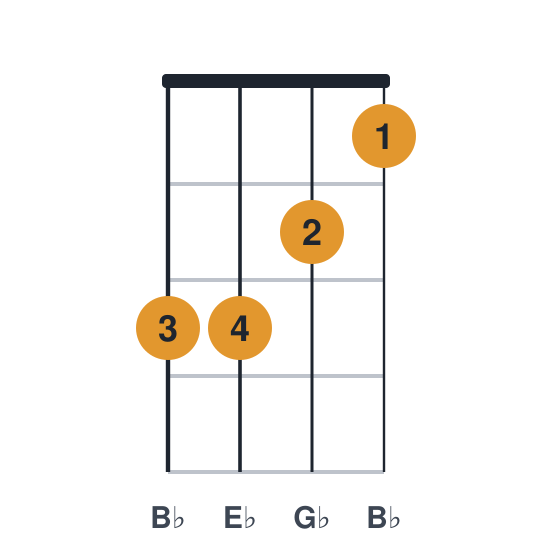
- Bb7the V chord that resolves to Eb minor
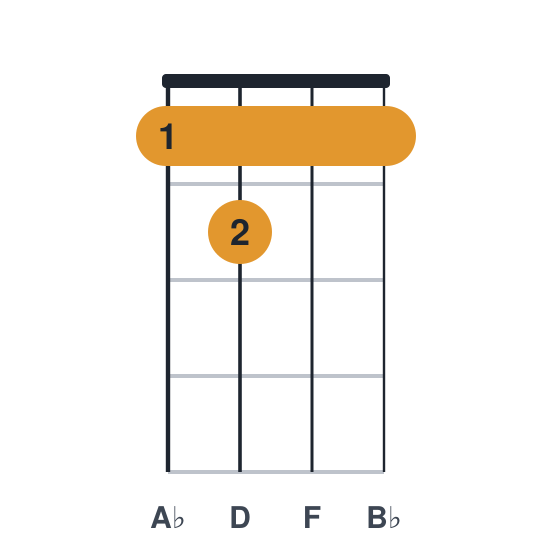
- Ab7partner in the ii V of C# major
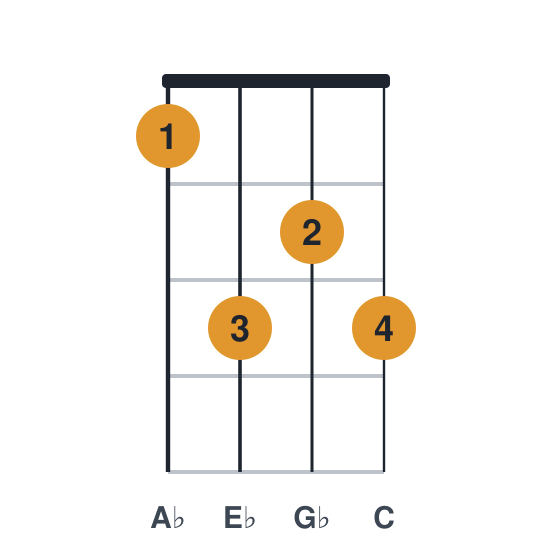
- Ebthe major on the same root
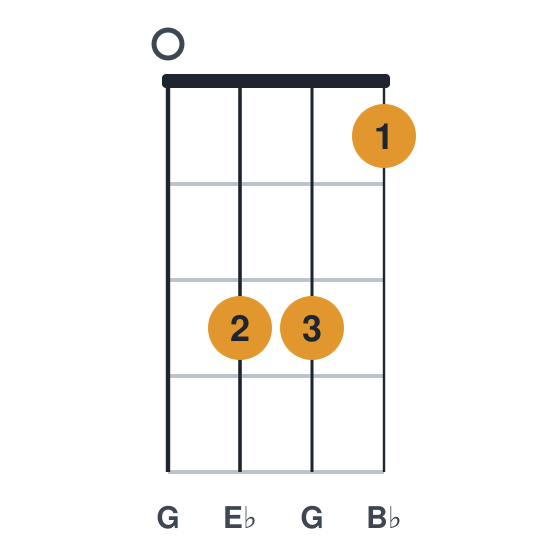


Other Eb chords
Ebm7 ukulele chord chart (3324) from melodician.com