Ebmaj7 Ukulele Chord
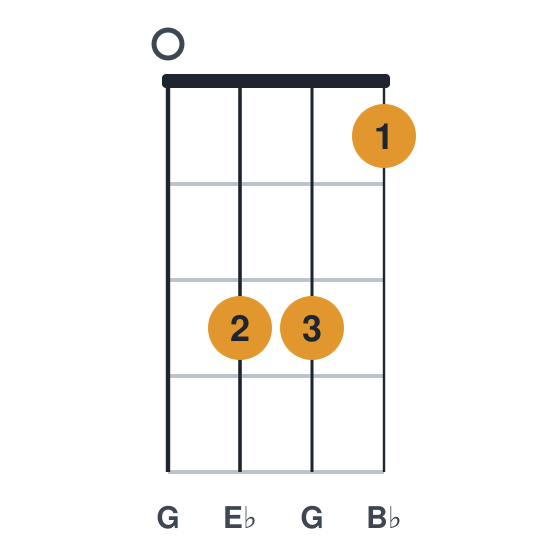
Ebmaj7 is the E flat major seventh chord. It has four notes: E flat, G, B flat and D. The standard shape keeps the G string open as the third and spreads three fingers between the 3rd fret and the 6th.

Open G string plus a three finger spread: index at the 3rd fret of the C string, middle at the 5th of the A, ring at the 6th of the E.
How to play Ebmaj7 on ukulele, step by step
- Index finger: 3rd fret, C string
- Middle finger: 5th fret, A string
- Ring finger: 6th fret, E string
- Leave the G string open. Strum all four strings.
The open G string earns the stretch: it sounds the chord's third while the fingers cover the rest. If the spread is too wide for now, the barre shape at the 6th fret further down the page plays the same notes in one compact grip.
More ways to play Ebmaj7
There are 3 common Ebmaj7 shapes: the standard one at the top of the page, plus these further up the neck. You only ever need one. Tap any card to hear it.

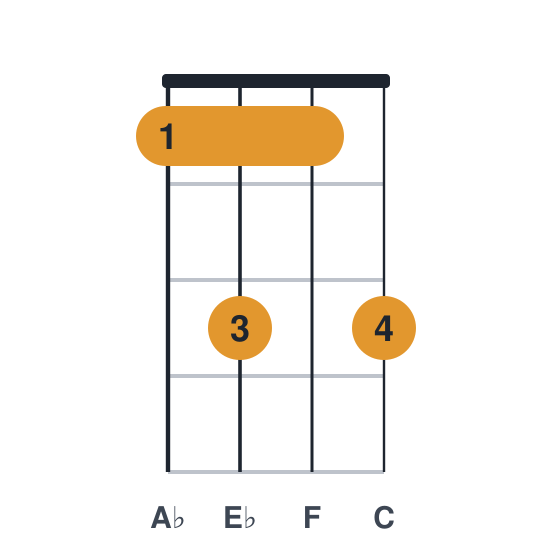
Compact and warm, the whole chord under one hand position.

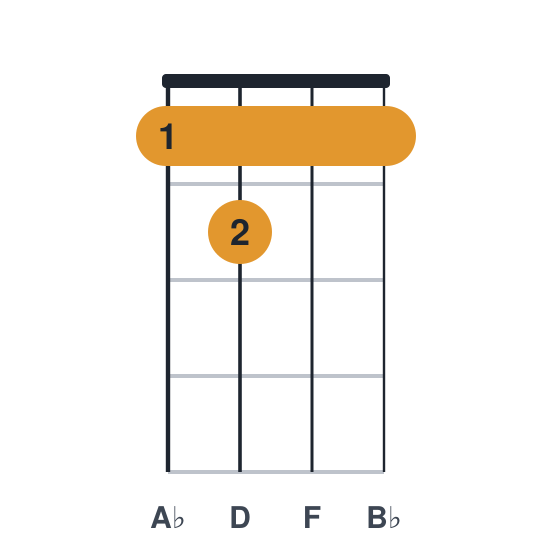
Big and high, the top of the neck version for when the chord has to ring out.
If the stretch defeats it
- The hand cannot cover the 3rd to 6th frets
- Open the gap from the knuckles, not the fingertips, and drop the thumb low behind the neck. The stretch arrives with a few days of patient repetition.
- The open G string goes quiet
- The index at the 3rd fret of the C string is brushing it. Stand the finger up on its tip and the open third comes back.
- The top of the chord chokes
- The ring finger at the 6th fret of the E string needs its own arch. If it leans, the A string dies with it; keep both high fingers curled.
What makes it an Ebmaj7
E♭ · G · B♭ · D 1 3 5 7
Ebmaj7 is a major seventh chord: an E flat major triad (E flat, G, B flat) plus a major seventh (D). The D sits one half step under the root, and that near miss is the glow every maj7 chord carries.
Ebmaj7 is the I chord of E flat major and the IV chord of B flat major. Those are horn, piano and singer keys, the heartland of soul and gospel, and this shape with its open third is how a ukulele reaches them gracefully.
Eb vs Ebmaj7
Both chords keep the open G string as their third, which is rare luck this deep into the flats. The maj7 adds a D against the E flat root and pushes the hand wider: plain E flat sits in the first three frets while Ebmaj7 stretches to the 6th.
Plain E flat resolves; Ebmaj7 hovers. In a slow soul progression the maj7 is usually the sound the arrangement wants on the home chord.
Ebmaj7 chord questions
Are Ebmaj7 and D#maj7 the same chord?
Yes, the same pitches with two spellings. Charts write Ebmaj7, because E flat is a real key and D sharp major is a thicket of double sharps.
Is there an easier Ebmaj7?
Yes: 7766, a small barre at the 6th fret with two fingers at the 7th. It trades the open string sparkle for a compact movable grip.
What is the difference between Ebmaj7 and Eb7?
The seventh. Eb7 carries a D flat and pulls hard toward A flat; Ebmaj7 carries a D natural and rests. Same root, opposite intent.
Do you strum all four strings in Ebmaj7?
Yes. The open G supplies the third; the fretted notes carry the root, fifth and seventh.
What keys use Ebmaj7?
It is the I chord of E flat major and the IV chord of B flat major, both central to jazz, soul and gospel writing.
Chords to learn next
- Ebthe plain major
- Fm7the ii chord beside Ebmaj7 in the key of Eb
- Bb7the V chord of Eb
- Eb6the other soft colour on the same major


Other Eb chords
Ebmaj7 ukulele chord chart (0365) from melodician.com