Eb Ukulele Chord
Eb is the E flat major chord, also written D sharp. It has three notes: E flat, G and B flat. On the ukulele it needs no barre: index on the A string at the 1st fret, middle and ring at the 3rd, with the open g string ringing on top.

Eb over the open g: index on the A string at the 1st fret, middle and ring at the 3rd on the C and E strings, with the g string sounding the chord's third untouched.
How to play Eb on ukulele, step by step
- Index finger: 1st fret, A string
- Middle finger: 3rd fret, C string
- Ring finger: 3rd fret, E string
- Leave the G string open. Strum all four strings.
The open g string is doing quiet work here: without being fretted at all it sounds G, the chord's third. That is the re-entrant tuning earning its keep, and it is why this Eb feels easier than its name suggests.
More ways to play Eb
There are 3 common Eb shapes: the standard one at the top of the page, plus these further up the neck. You only ever need one. Tap any card to hear it.

Brighter, with the root doubled at the top of the chord.

High and chiming. The fretted C string lands on the same G as the open string, and the unison doubling gives it a chorused glow.
If Eb sounds cloudy
- The open g goes dull
- The middle finger on the C string is leaning back into it. Arch the finger upright so the g string rings free.
- The A string buzzes at the 1st fret
- The index is sitting back from the fret. At the 1st fret the margin is small; park the fingertip against the fret wire.
- The two 3rd fret notes are uneven
- Middle and ring share a fret on neighbouring strings. Stand both on their tips and press them down as a pair, not in sequence.
What makes it an Eb
E♭ · G · B♭ 1 3 5
E flat major is the root E flat, the major third G and the fifth B flat. The open g string supplies that third for free, which is the small miracle of this shape: a flat key chord, normally barre territory, played over an open string.
Eb is the I chord in the key of E flat, the IV chord in B flat and the V chord in A flat. Those are horn and gospel keys, so the ukulele player usually meets Eb inside songs borrowed from piano led records.
Eb vs Ebm
One note separates them: the G in Eb drops to G flat in Ebm.
On the ukulele that one note is the open g string itself, and an open string cannot be lowered. So Ebm abandons the open shape entirely and frets all four strings, which makes this pair unusual: the minor is a different picture, not a moved finger.
Eb chord questions
Is Eb the same chord as D#?
Yes. E flat and D sharp name the same pitch, so the fingerings are identical. The flat spelling is standard because the chord lives in flat keys.
Does Eb need a barre on the ukulele?
No. The standard shape here uses three fingertips and the open g string. The guitar's barre habit does not apply.
What is the difference between Eb and Ebm?
The third: G in Eb, G flat in Ebm. Because the G in this shape is the open g string, Ebm has to switch to a fully fretted shape instead.
What keys use the Eb chord?
Eb is home in E flat, the IV in B flat and the V in A flat. Soul, gospel and big band songbooks reach for those keys constantly.
Chords to learn next
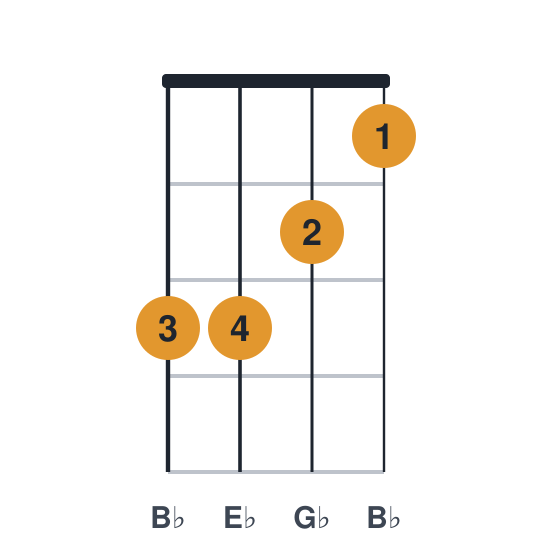
- Ebmthe minor version of Eb
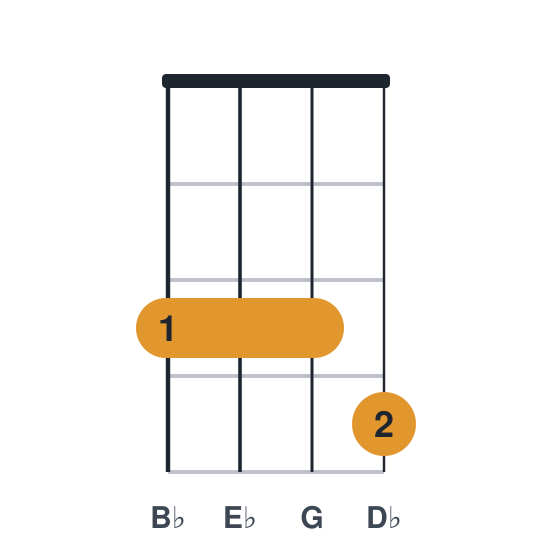
- Eb7Eb with the seventh that pushes to Ab
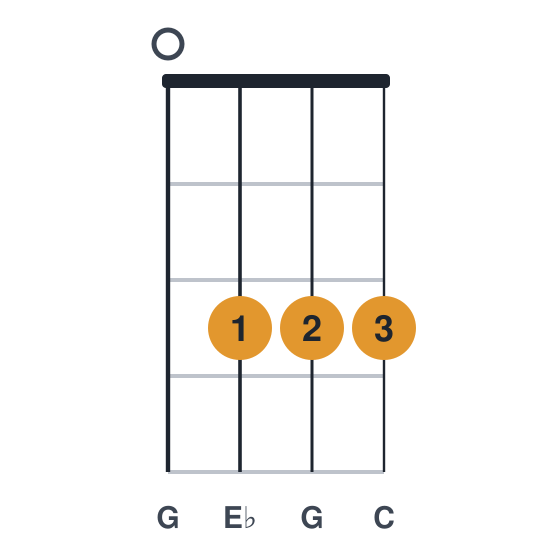
- Cmthe relative minor of Eb
- Ebmaj7the soft version of the same chord
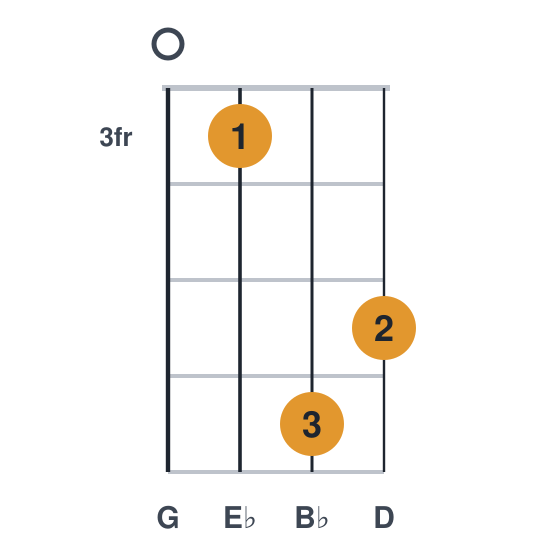


Other Eb chords
Eb ukulele chord chart (0331) from melodician.com