Cm Ukulele Chord
Cm is the C minor chord. It has three notes: C, E flat and G. The standard shape stacks three fingers side by side on the 3rd fret, one each on the C, E and A strings, with the G string ringing open.

Three fingers side by side at the 3rd fret on the C, E and A strings, with the G string open. Works equally well as one small index barre.
How to play Cm on ukulele, step by step
- Index finger: 3rd fret, C string
- Middle finger: 3rd fret, E string
- Ring finger: 3rd fret, A string
- Leave the G string open. Strum all four strings.
Plenty of players lay the index flat across all three strings at the 3rd fret instead, a small barre with the G string still open. Use whichever your hand finds first; the chord is identical.
More ways to play Cm
There are 3 common Cm shapes: the standard one at the top of the page, plus these further up the neck. You only ever need one. Tap any card to hear it.

Open and ringing, with the flat third on top and both open strings droning underneath.

A drone version of Cm: two open strings against two high fretted notes, more texture than rhythm chord.
If it sounds wrong
- Three fingers will not fit side by side
- Let them stack in a slight diagonal rather than a straight line, each on its tip. Or switch to the one finger barre and skip the crowding entirely.
- The open G string sounds off
- It should not: G is the fifth of Cm. If it clashes, a fretting finger is drifting over and bending it. Keep all three arched.
- The chord sounds major
- Make sure the C and E strings really are fretted at the 3rd fret. Leaving the E string open puts an E natural in the chord, which is the major third and cancels the minor.
What makes it a Cm
C · E♭ · G 1 ♭3 5
Cm is a minor triad: C, a minor third E flat, and a fifth G. The E flat is what separates it from the C major every beginner knows, and the open G string supplies the fifth, so only three notes need fretting.
Cm is the relative minor of E flat major and works as the ii of B flat and the vi of E flat, flat keys that belong to horns and piano more than to ukulele songbooks. When it appears in a strummed song it is usually on loan from one of those arrangements.
Cm vs C
C major is one finger: the A string at the 3rd fret. Cm keeps that note and frets the C and E strings at the same fret as well, replacing the open C and E with E flat and G. Two extra fingers, and the brightness goes with them.
Strum C, then flatten the two extra fingers down into Cm. Same root, same open G string; it is the middle of the chord that darkens.
Cm chord questions
Is Cm hard to play?
No. Three fingers in a row on the same fret, or one small barre across three strings. It usually lands easily for anyone who can already play C.
Can I barre Cm with one finger?
Yes. Lay the index flat across the C, E and A strings at the 3rd fret and let the G string ring open. Many charts print exactly that fingering.
What is the difference between Cm and C?
C major uses one finger and two open strings in the middle; Cm frets those middle strings at the 3rd fret, turning E into G and C into E flat. The flat third is what makes it minor.
Why does the open G string work in Cm?
G is the fifth of the chord, so the tuning donates it for free. The fretted notes supply the root and the flat third.
What keys use Cm?
It is the ii chord of B flat, the vi chord of E flat, and the home chord of C minor.
Chords to learn next
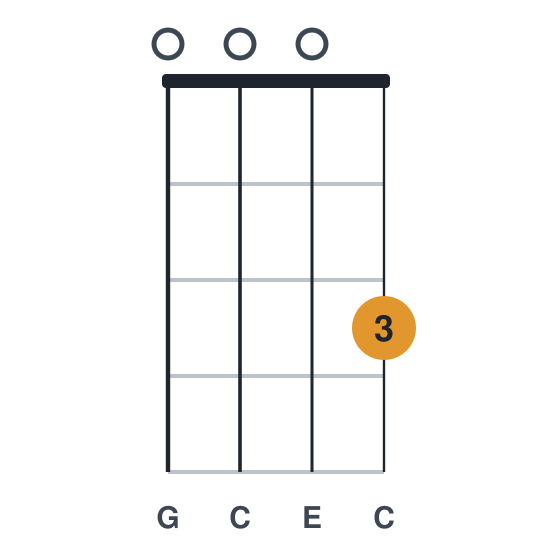
- Cthe major version of Cm
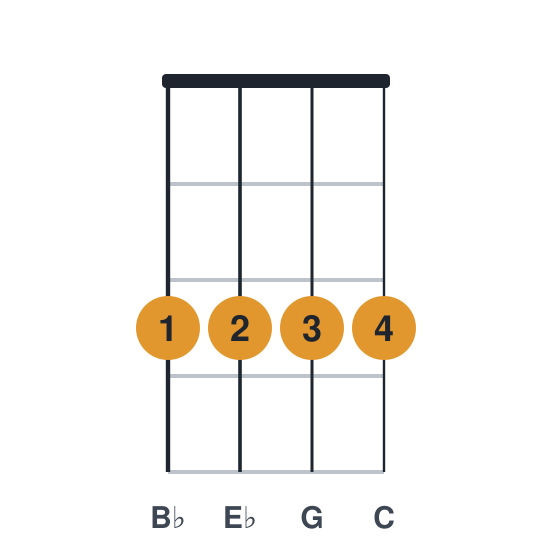
- Cm7adds a seventh for a softer Cm
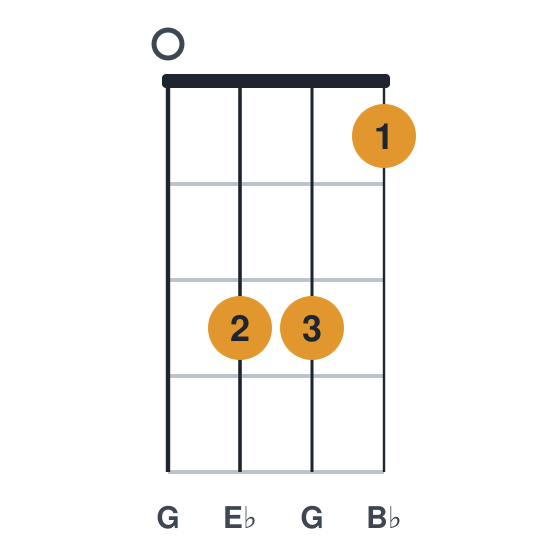
- Ebthe relative major of Cm
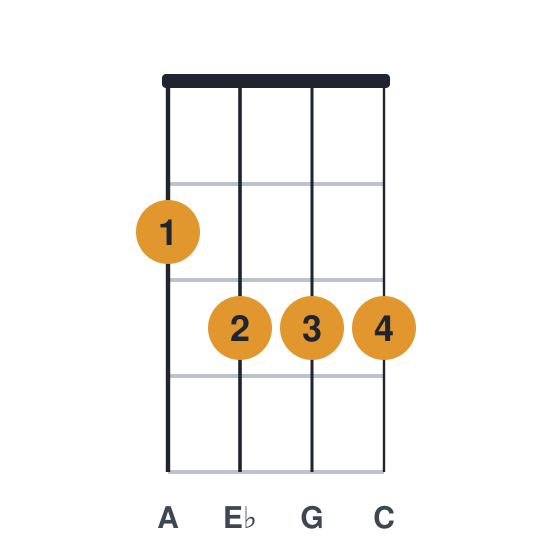
- Cm6the same minor with an old-fashioned sixth


Other C chords
Cm ukulele chord chart (0333) from melodician.com