C7 Ukulele Chord
C7 is the C dominant seventh chord. It has four notes: C, E, G and B flat. On the ukulele it takes one finger: the index on the 1st fret of the A string, with the other three strings open. No instrument has an easier seventh chord.

One finger on the 1st fret of the A string, everything else open. The open strings supply the fifth, root and third; the finger adds the seventh.
How to play C7 on ukulele, step by step
- Index finger: 1st fret, A string
- Leave the G, C and E strings open. Strum all four strings.
C7 is plain C with one finger moved: C frets the A string at the 3rd fret, C7 frets the same string at the 1st. Sliding that finger down two frets turns the doubled root into B flat, the seventh.
More ways to play C7
There are 3 common C7 shapes: the standard one at the top of the page, plus these further up the neck. You only ever need one. Tap any card to hear it.

Rounder and more compact than the open shape, with the root on top. Useful when the song sits mid neck and you do not want to jump back to the nut.

Airy and spread out, with the third ringing highest. The mix of open and fretted strings gives it a chime the other shapes do not have.
If it sounds wrong
- It sounds exactly like C
- Habit puts the finger back on the 3rd fret. C7 lives on the 1st fret of the A string; check the dot before you strum.
- The A string buzzes
- Put the fingertip right behind the 1st fret and press with the tip, not the pad. The first fret needs the least pressure on the neck.
- The chord sounds thin
- Strum all four strings evenly. The seventh sits on the A string, and a strum that fades before reaching it plays plain C, E and G.
What makes it a C7
C · E · G · B♭ 1 3 5 ♭7
C7 is a dominant seventh: a C major triad (C, E, G) plus a minor seventh, B flat. That added note is what makes the chord lean forward instead of sitting still: C7 is the V7 of F, and every C7 you play is pulling toward an F chord.
The one finger shape works because of how a ukulele is tuned. The open g, C and E strings already sound the fifth, the root and the third, so the only note missing from C7 is the seventh, and the 1st fret of the A string is exactly where B flat lives.
C7 vs C
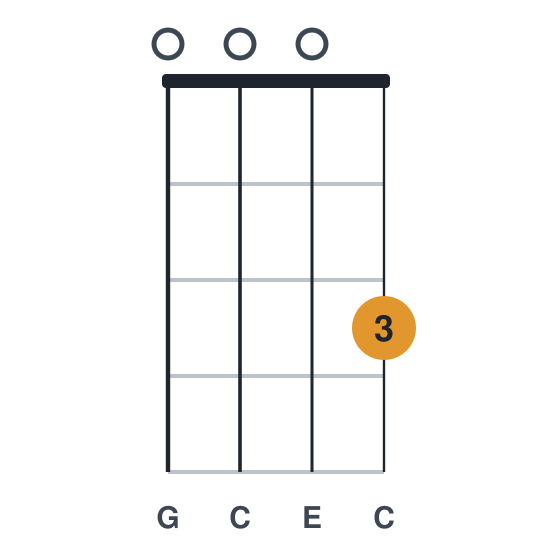
C is played 0003 and C7 is played 0001: the same single finger on the same string, two frets apart. Moving it down turns the second C into B flat, and that one change is the whole difference between the chords.
C sounds finished and C7 does not. Play C7 and let it hang: your ear waits for F. That pull is what dominant sevenths are for, which is why C7 shows up wherever a song in F, or a blues in C, needs to move.
C7 chord questions
Is C7 the easiest seventh chord?
On the ukulele, yes: one finger on the 1st fret. A7 is the only other one finger seventh here, and few instruments have any at all.
What is the difference between C7 and C?
One note. C is C, E and G; C7 adds B flat, the seventh. On the fretboard it is one finger moving from the 3rd fret to the 1st fret of the A string.
What does C7 resolve to?
F. C7 is the V7 chord of F major and F minor, and it also runs a blues in C alongside F7 and G7.
Why does one finger make a whole seventh chord?
Because the open strings do most of the work. The open g, C and E strings are already the fifth, root and third of C7, so only the seventh needs a finger.
Where is C7 used?
Anywhere a song heads to F, in blues in C, and all over old Hawaiian and Tin Pan Alley ukulele playing, where the seventh chord vamp is the signature sound.
Chords to learn next
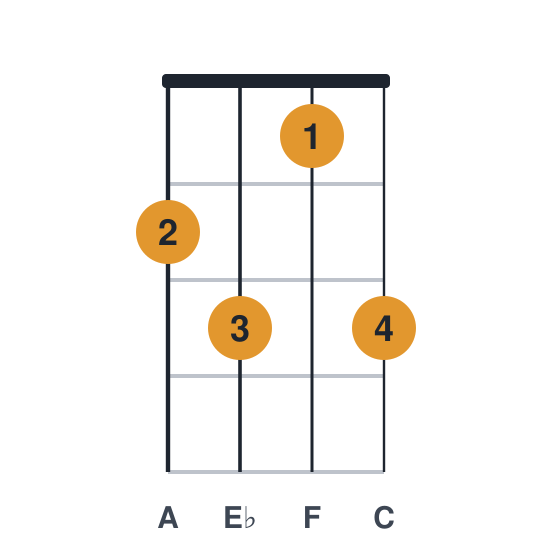
- F7C7 resolves to F
- Cthe plain major underneath it
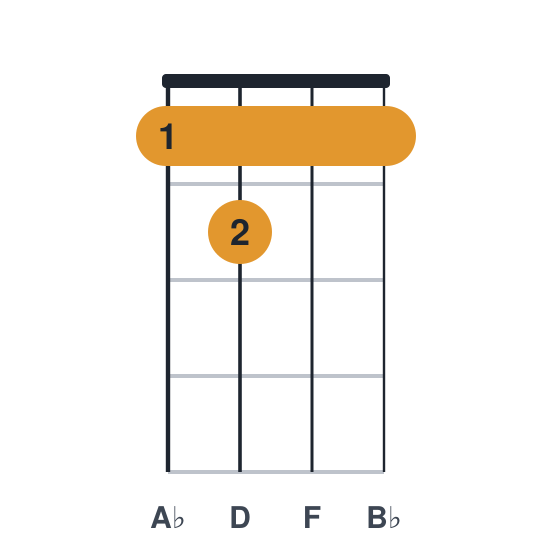
- Bb7the IV chord next to C7 in blues in F
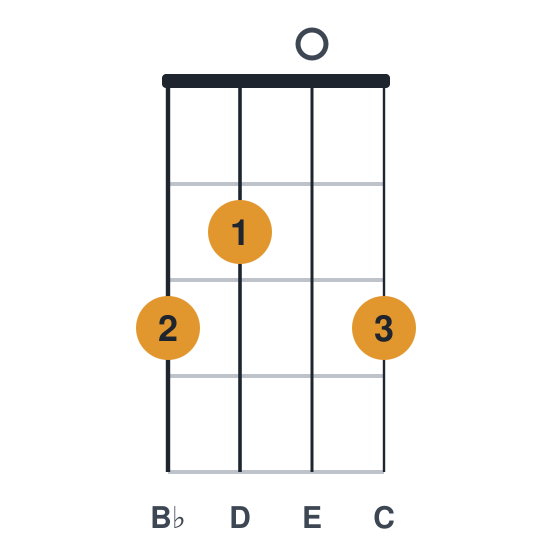
- C9the same seventh with a ninth on top


Other C chords
C7 ukulele chord chart (0001) from melodician.com