F7 Ukulele Chord
F7 is the F dominant seventh chord. It has four notes: F, A, C and E flat. The shape starts from plain F and adds two fingers: index on the 1st fret of the E string, middle on the 2nd fret of the g string, then ring and pinky side by side on the 3rd fret.

Plain F with two fingers added: index on the E string at 1, middle on the g string at 2, ring and pinky side by side on the C and A strings at 3.
How to play F7 on ukulele, step by step
- Index finger: 1st fret, E string
- Middle finger: 2nd fret, G string
- Ring finger: 3rd fret, C string
- Pinky finger: 3rd fret, A string
- Strum all four strings.
Hold F (2010) and keep both fingers exactly where they are: add the ring to the C string and the pinky to the A string, both at the 3rd fret, and F has become F7. Nothing moves; two notes join.
More ways to play F7
There are 3 common F7 shapes: the standard one at the top of the page, plus these further up the neck. You only ever need one. Tap any card to hear it.

Cleaner and easier than the four finger shape once barres hold: two working fingers, and a rounder tone away from the nut.

Big and bright at the top of the neck. The strongest F7 here for an ending or a stab, happiest on a tenor.
If it sounds wrong
- The pinky note is weak
- The pinky is the newest worker in this shape. Keep it curled and close behind the 3rd fret, and let it share the pressure with the ring finger beside it.
- The E string dies
- With four fingers down, the middle of the shape gets crowded. The index must stay on its very tip or the ring finger above it will pin the E string quiet.
- The chord will not ring as one
- Build it in order: play F cleanly first, then add ring and pinky together. If F itself buzzes, F7 only multiplies it.
What makes it an F7
F · A · C · E♭ 1 3 5 ♭7
F7 is a dominant seventh: an F major triad (F, A, C) plus a minor seventh, E flat. It is the V7 of B flat, and pulls toward B flat major and minor alike.
F7 also runs the blues in F alongside Bb7 and C7, and it is the IV7 chord of a blues in C, which keeps it busy on an instrument whose favourite key is C.
F7 vs F
F is two fingers and two open strings; F7 keeps both fingers and frets the two open strings at the 3rd fret. The open C string becomes E flat, the seventh, and the open A string becomes C, so the chord gains its lean without losing its shape.
Where F rests, F7 rolls toward Bb. In a blues in F the seventh IS the home sound, which is why the four finger investment pays off quickly for anyone playing blues on the ukulele.
F7 chord questions
Is F7 hard to play?
It is the busiest of the common sevenths: four fingers inside three frets. Because it grows straight out of plain F, building it two fingers at a time tames it.
What is the difference between F7 and F?
F7 frets the two strings F leaves open. The C string at the 3rd fret adds E flat, the seventh, and the A string at the 3rd adds C, the fifth.
Is there an easier F7?
Yes: the barre shape at the 5th fret (5556) is the C7 grip with a barre, two working fingers in place of four.
What does F7 resolve to?
Bb. F7 is the V7 chord of B flat major and B flat minor, and the IV7 of a blues in C.
Where is F7 used?
In blues in F and in C, in songs headed to Bb, and through the swing era songbook that the ukulele grew up playing.
Chords to learn next
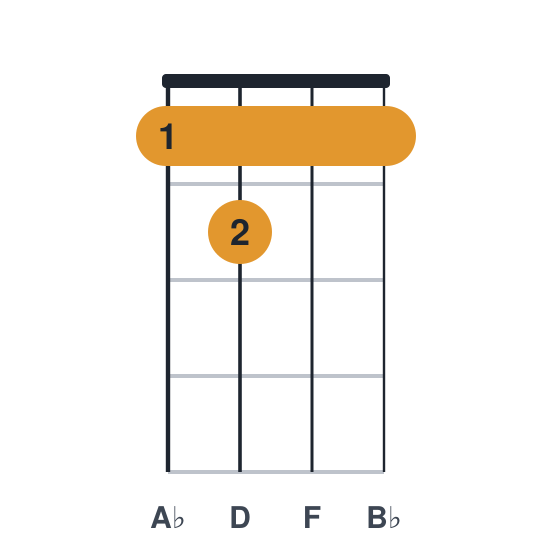
- Bb7F7 resolves to Bb
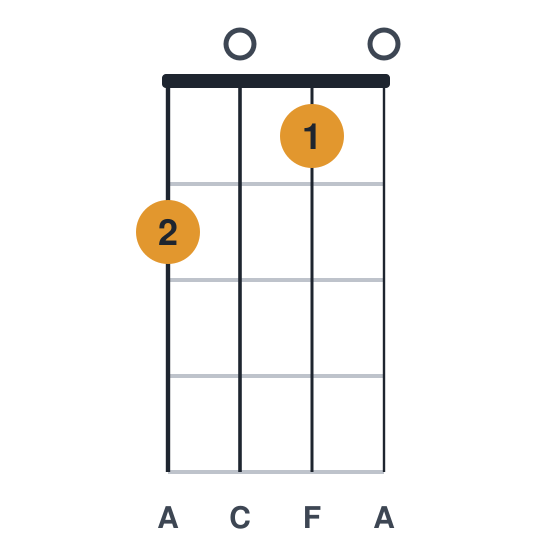
- Fthe plain major underneath it
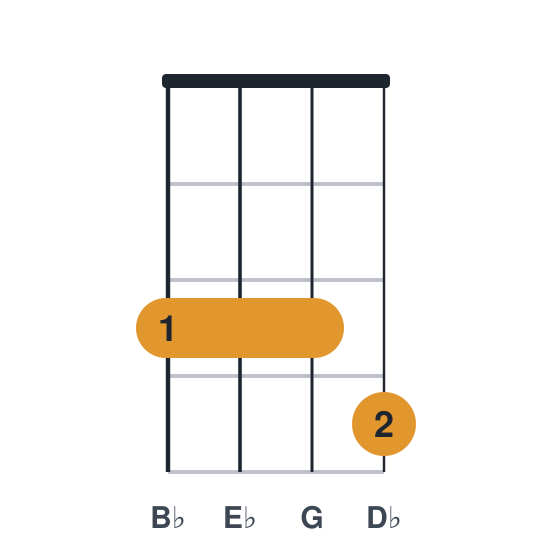
- Eb7the IV chord next to F7 in blues in Bb
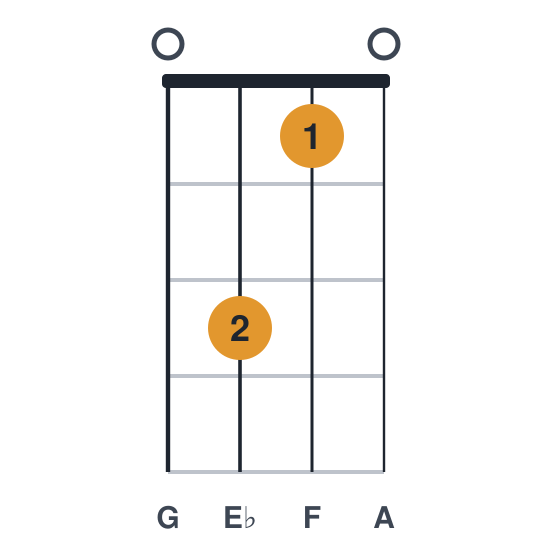
- F9the same seventh with a ninth on top


Other F chords
F7 ukulele chord chart (2313) from melodician.com