Faug Ukulele Chord
Faug is the F augmented chord. It has three notes: F, A and C sharp. The standard shape is plain F with one extra finger: the open C string fretted at 1, which is the fifth raised. The A string stays open.

Plain F with the index added at the 1st fret of the C string: the raised fifth. Ring on the G string at 2, A string open, and the root F under the middle finger on the E string.
How to play Faug on ukulele, step by step
- Index finger: 1st fret, C string
- Middle finger: 1st fret, E string
- Ring finger: 2nd fret, G string
- Leave the A string open. Strum all four strings.
Play F (2010), then add the index at the 1st fret of the C string. That one added note is the entire difference between F and Faug, and hearing the swap teaches the augmented sound faster than any description.
More ways to play Faug
There are 3 common Faug shapes: the standard one at the top of the page, plus these further up the neck. You only ever need one. Tap any card to hear it.

Even and compact, no open strings, the version that slides anywhere and works as any of its three roots.

Ringing and top heavy, with the root on the highest string. A good voice for ending a phrase on a question mark.
If it buzzes or sounds wrong
- The chord sounds like plain F
- The 1st fret C string note is the raised fifth; if the index is not pressing cleanly the open C rings instead and the chord loses its tension. Check that string alone before strumming.
- The fret 1 pair crowds itself
- Index and middle sit on neighbouring strings at the same fret. Keep both on their tips, angled slightly apart, each close behind the fret wire.
- The open A dies mid strum
- The middle finger on the E string can lean into it. Arch the last joint so the A string rings; it carries the third of the chord.
What makes it an Faug
F · A · C♯ 1 3 ♯5
Faug is an augmented triad: F major with the fifth raised a half step, C becoming C sharp. The raised note sits a half step below D and a half step above the fifth it replaced, so the chord sounds suspended between two magnets, ready to snap either way.
Its natural resolution is B flat, where Faug works as the V chord with a raised fifth: F to Faug to Bb, the C sharp rising to D. The same C sharp is the leading tone of D minor, so Faug slides there just as easily. And because F to A and A to C sharp are both major thirds, Faug contains exactly the same notes as Aaug and C#aug.
F vs Faug
One fret separates them on a ukulele: F is 2010 with the C string open, Faug is 2110 with that string at the 1st fret. The fifth rises from C to C sharp and the chord stops being furniture and starts being a doorway.
F can hold a whole verse. Faug wants one or two beats, usually between F and Bb, or between F and Dm. Let it pass through and resolve; parking on it is almost always a mistake.
Faug chord questions
Is Faug the same as F+?
Yes. F+, Faug and F augmented all name the same three notes: F, A and C sharp.
What does Faug resolve to?
B flat major is the classic landing, the raised fifth C sharp climbing to D. D minor works for the same reason, and plain F takes the chord back where it came from.
How is Faug different from plain F?
By one note. F is F, A and C; Faug raises the C to C sharp. On the standard shapes that is a single fret on the C string.
Does Faug share notes with other chords?
Yes, with Aaug and C#aug. The augmented triad stacks two equal major thirds, so the same three notes serve three roots.
Is Faug hard to play?
No. It is plain F plus one finger, all within the first two frets, with the A string ringing open.
Chords to learn next
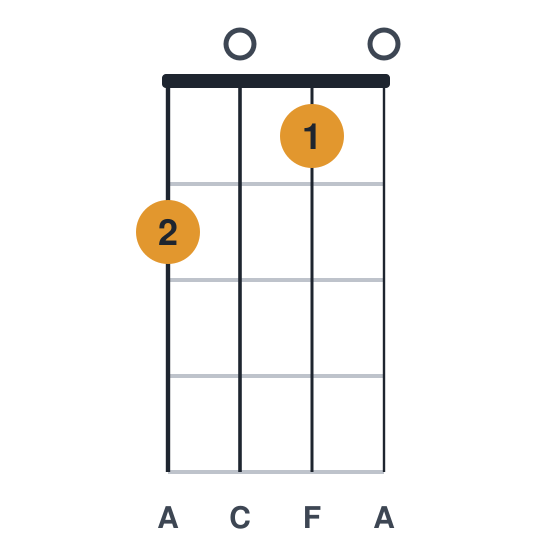
- Fthe plain major, one note apart
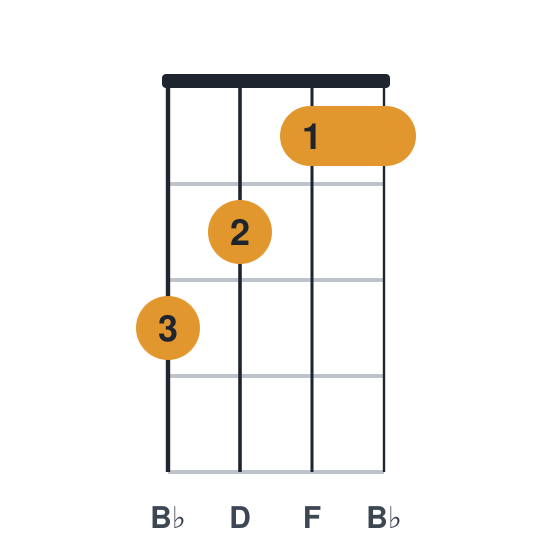
- Bbwhere Faug usually resolves
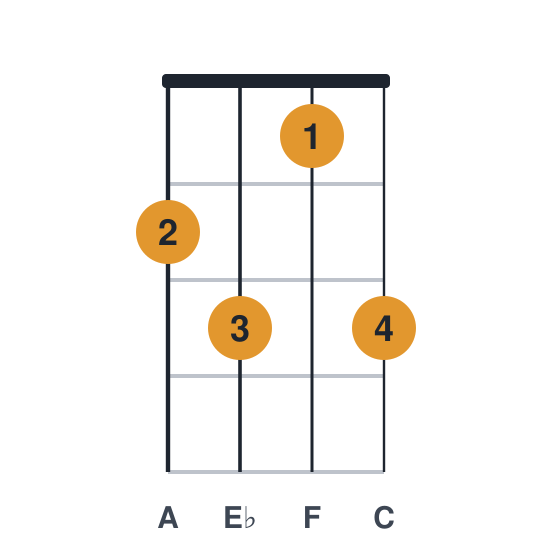
- F7another chord built to push forward
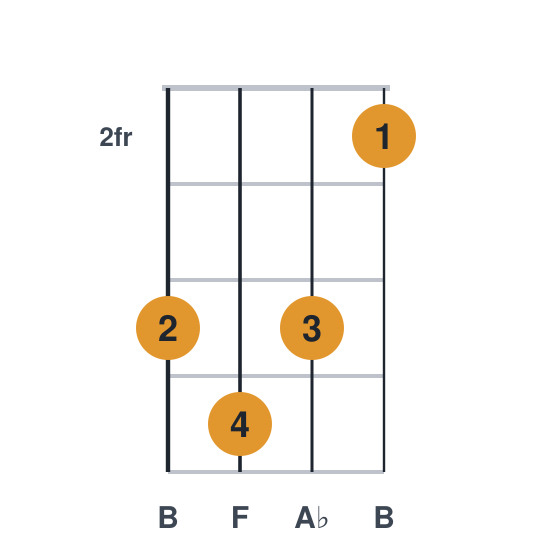
- Fdimthe other chord built out of equal intervals


Other F chords
Faug ukulele chord chart (2110) from melodician.com