F9 Ukulele Chord
F9 is the F dominant ninth chord. On ukulele it keeps four of its five notes: F, A, E flat and G, with the fifth left out. The standard shape needs only two fingers, because the open G and A strings supply the ninth and the third.

Two fingers only: the root at the 1st fret of the E string and the seventh at the 3rd fret of the C string, with the open G and A strings as the ninth and third.
How to play F9 on ukulele, step by step
- Index finger: 1st fret, E string
- Middle finger: 3rd fret, C string
- Leave the G and A strings open. Strum all four strings.
Two open strings do half the work here: the open G is the ninth itself and the open A is the third. Only the root and the flat seventh have to be fretted, which makes this one of the easiest ninth chords on any instrument.
More ways to play F9
There are 3 common F9 shapes: the standard one at the top of the page, plus these further up the neck. You only ever need one. Tap any card to hear it.

Warmer and more centred than the nut shape, with the open ninth chiming over fretted neighbours.

Tight and bright at the top of the neck. The movable F9 for stabs, and the proof the chord exists without its open strings.
If it sounds uneven
- The fretted notes disappear under the open ones
- Two loose strings ring longer than two pressed ones. Strum slightly toward the C and E strings so the root and seventh keep up.
- The E string note buzzes
- The index holds F at the 1st fret, where strings sit stiffest. Press right behind the fret wire with the very tip.
- It sounds like a strange F major
- The 3rd fret note on the C string is E flat, the seventh. If the middle finger lands at the 2nd fret instead, the chord loses its dominant pull and turns into something else.
What makes it an F9
F · A · C · E♭ · G 1 3 5 ♭7 9
F9 is an F7 chord with a ninth added: F, A and E flat carry the seventh chord and the G is the ninth. A ukulele has four strings for those five notes, so the fifth, C, is left out. In this shape the open G string is the ninth and the open A string the third.
It is the V chord of B flat and the I chord of a blues in F. Two open strings make it ring more freely than almost any other ninth chord on the instrument, so players in F reach for it constantly.
F9 vs F7
F9 adds a G on top of F7. Both pull toward B flat, but F7 talks plainly and F9 purrs.
On ukulele the two chords are cousins in shape as well as sound, and the ninth costs no extra difficulty here: two fingers either way. When in doubt in a blues in F, the ninth is the hipper choice.
F9 chord questions
Why is there no C in these shapes?
A ukulele has four strings and F9 has five notes. The fifth is the note a ninth chord misses least, so it is the one left out.
Is F9 really this easy?
Yes. The standard shape is two fingers, because the open G string happens to be the ninth of F and the open A string its third. The tuning does the hard part.
What is the difference between F9 and Fadd9?
F9 contains E flat, the flat seventh, and behaves like a blues chord heading for B flat. Fadd9 has no seventh and simply shimmers on F major.
Can I move this shape?
Not the standard one: its open strings only mean F9. The fully fretted form at the 9th fret is the movable version of the same chord.
Where is F9 used?
As the V chord in B flat, as the I chord of a blues in F, and in swing and jump blues, where F is a favourite horn key.
Chords to learn next
- F7the same chord without the ninth
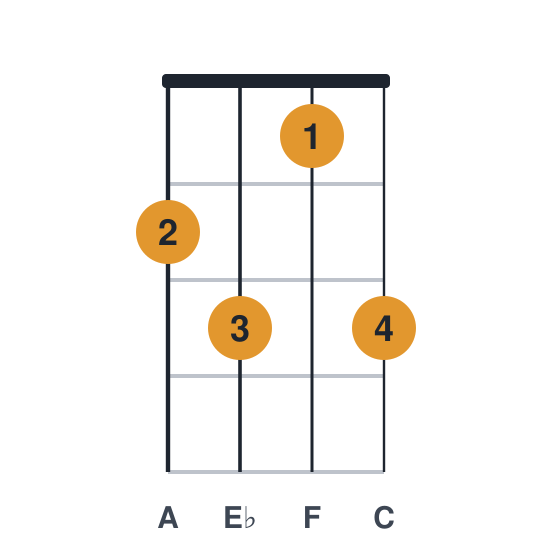
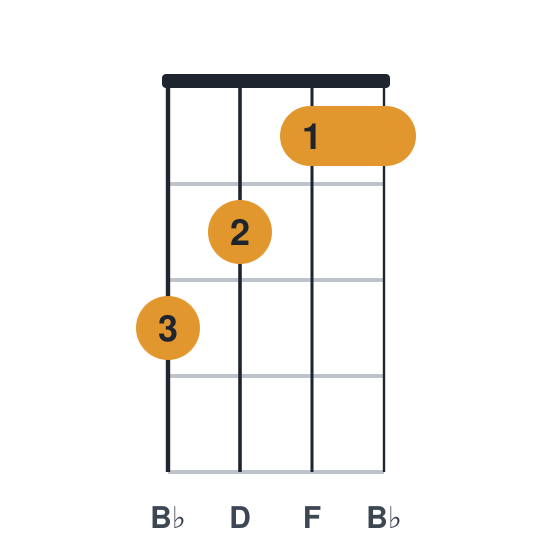
- Bbwhere F9 wants to resolve
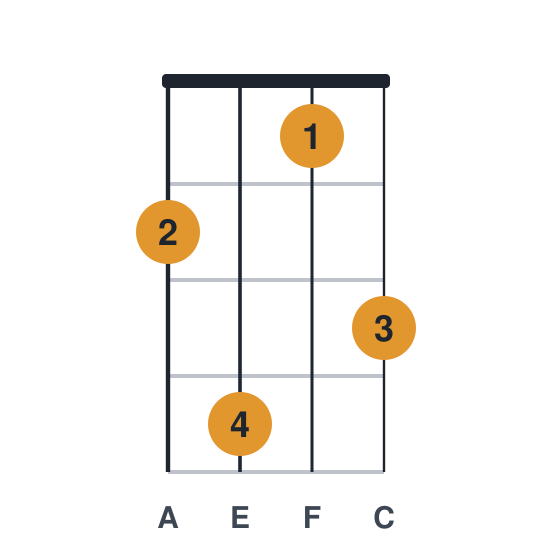
- Fmaj7the other seventh built on this root
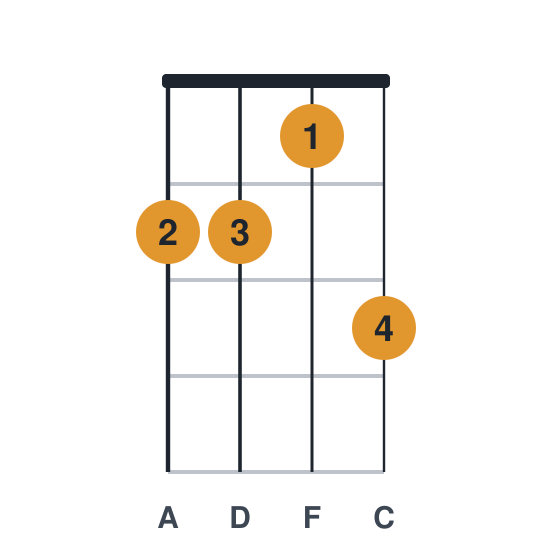
- F6the same root with a sixth instead of a seventh


Other F chords
F9 ukulele chord chart (0310) from melodician.com