Caug Ukulele Chord
Caug is the C augmented chord. It has three notes: C, E and G sharp. The standard shape is the familiar C at 0003 with one change: the open G string fretted at the 1st fret. Two fingers, two open strings in the middle.

The familiar C shape with the G string fretted at 1: index there, middle on the A string at 3, the C and E strings open in the middle.
How to play Caug on ukulele, step by step
- Index finger: 1st fret, G string
- Middle finger: 3rd fret, A string
- Leave the C and E strings open. Strum all four strings.
Play C first, then set the index at the 1st fret of the G string. That single fret is the fifth rising from G to G sharp, and switching between 0003 and 1003 is the clearest augmented demonstration a ukulele can give.
More ways to play Caug
There are 3 common Caug shapes: the standard one at the top of the page, plus these further up the neck. You only ever need one. Tap any card to hear it.

Compact and even, all four notes fretted. The workhorse grip once you leave the open position.

Spacious and unusual, the open E ringing inside a fretted stack. Worth having when the standard grips feel cramped.
If it buzzes or sounds wrong
- It still sounds like plain C
- The whole difference lives at the 1st fret of the G string. If the index is soft the open G rings instead. Pluck the G string alone; you should hear G sharp, not G.
- The open C and E strings get clipped
- The index on the G string must stand on its tip. Lean it back and its underside will rest on the C string and kill the middle of the chord.
- The A string note buzzes
- The middle finger holds the 3rd fret alone up there. Keep it close behind the fret wire and press with the tip, not the pad.
What makes it a Caug
C · E · G♯ 1 3 ♯5
Caug is an augmented triad: C major with the fifth raised from G to G sharp. The G sharp is what your ear notices. It sits a half step above the note it replaced and a half step below A, so the chord feels caught mid climb, which is why writers use it to connect chords rather than to rest on.
The textbook move is C to Caug to F: Caug acts as the V chord of F with a raised fifth, and the G sharp resolves up to A, the third of F. The same G sharp is the leading tone of A minor, so Caug walks there too. And because C to E and E to G sharp are both major thirds, Caug contains exactly the same notes as Eaug and Abaug.
C vs Caug
On a ukulele the two chords are one fret apart: C is 0003 with the G string open, Caug frets that string at 1. One half step turns the most settled chord on the instrument into one that cannot wait to leave.
That suggests how to use it: C for the body of the song, Caug for a beat on the way to F or A minor. The classic line C, Caug, F walks the fifth upward one half step at a time.
Caug chord questions
Is Caug the same as C+?
Yes. C+, Caug and C augmented all mean the same three notes: C, E and G sharp.
What does Caug usually resolve to?
F major is the most common target, with the G sharp rising to A. A minor works for the same reason, and the chord can simply fall back to C.
How is Caug different from C?
One note: the fifth. C is C, E, G; Caug raises the G to G sharp. On the standard shape that is one added finger at the 1st fret of the G string.
Does Caug really have the same notes as Eaug?
Yes, and as Abaug too. The augmented triad stacks two identical major thirds, so C, E and G sharp can be read as a chord on any of those three roots.
Is Caug hard to play?
No. Two fingers, three frets apart, with the C and E strings open between them. If you can play C, you can play this.
Chords to learn next
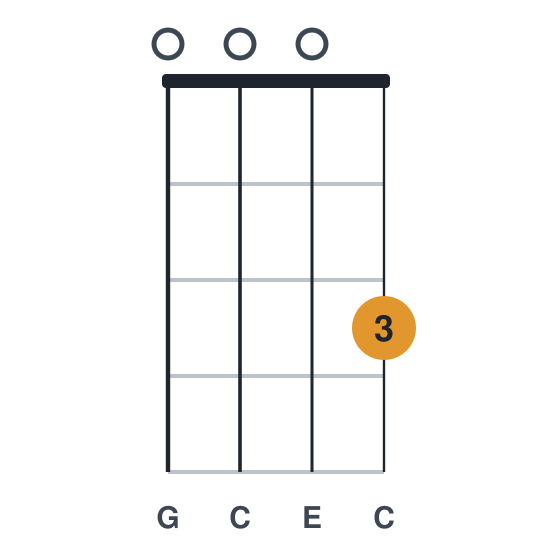
- Cthe plain major, one note apart
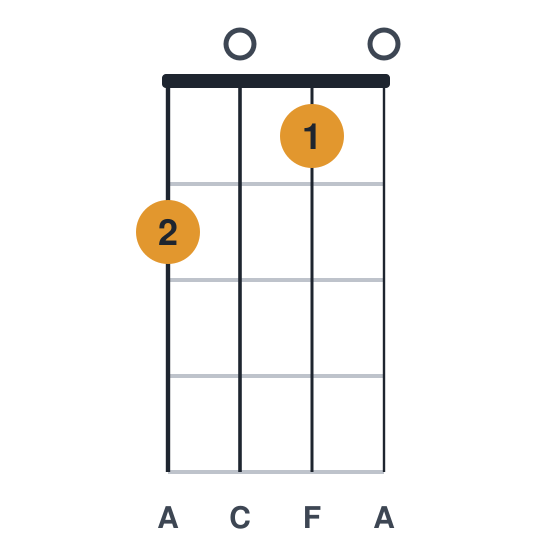
- Fwhere Caug usually resolves
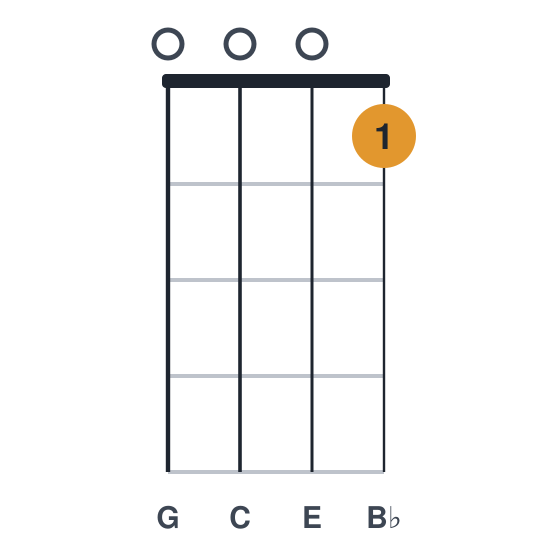
- C7another chord built to push forward
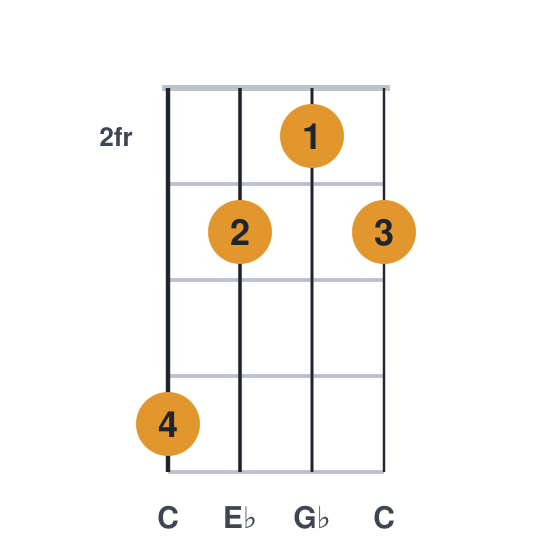
- Cdimthe other chord built out of equal intervals


Other C chords
Caug ukulele chord chart (1003) from melodician.com