Cdim Ukulele Chord
Cdim is the C diminished chord, a diminished triad. It has three notes: C, E♭ and G♭. There is no open shape for it on a ukulele: the standard grip uses all four fingers between the 2nd and 5th frets, with the root on both outside strings and the tense flat five tucked in the middle.

Root on the A string at the 3rd fret and on the G string at the 5th, with the flat three and flat five in between. Fully fretted, so it slides to any root.
How to play Cdim on ukulele, step by step
- Index finger: 2nd fret, E string
- Middle finger: 3rd fret, C string
- Ring finger: 3rd fret, A string
- Pinky finger: 5th fret, G string
- Strum all four strings.
With no open strings the grip is movable: one fret up it becomes C#dim, and the same shape names a new diminished chord on every fret of the neck.
More ways to play Cdim
There are 3 common Cdim shapes: the standard one at the top of the page, plus these further up the neck. You only ever need one. Tap any card to hear it.

Rounder, with the tension folded into the middle of the chord rather than worn on the outside.

Bright, tight and a little brittle. Useful when the same chord needs to answer itself an octave up.
If it buzzes or sounds dead
- The pinky note on the G string is weak
- The pinky holds the 5th fret while the index sits at the 2nd. Lower the thumb on the back of the neck so the hand can open enough for the reach.
- The E string note goes dull
- The index carries the 2nd fret alone and tends to flatten out. Keep it on its tip; if it lies down it also brushes the A string next door.
- The chord sounds lumpy
- Four fretted strings means four chances for one weak note. Pick each string once before strumming and even out the pressure.
What makes it a Cdim
C · E♭ · G♭ 1 ♭3 ♭5
Cdim is two minor thirds stacked: C up to E♭, then E♭ up to G♭. C minor would reach up to G; the diminished chord stops one fret short, and that flat fifth is what makes it sound like it is holding its breath.
Cdim is the leading tone chord of D♭, written C# on this site's pages: it sits one fret below and climbs home. A useful ear anchor: C, E♭ and G♭ are three of the four notes of A♭7, so Cdim pushes toward D♭ the same way A♭7 does.
Cdim vs Cm
Both begin with C and E♭. C minor finishes with G, a perfect fifth, and sounds grounded. Cdim finishes with G♭, one fret lower, and refuses to settle.
Use them accordingly: Cm can hold a verse on its own, while Cdim is a connector you pass through, typically for a beat or two on the way up a fret. When a chart writes C° it means the diminished triad, not the minor.
Cdim chord questions
Is the 2323 grip in my songbook the same as this Cdim?
Not quite. That popular grip has four different notes and is really Cdim7, the diminished seventh chord. Cdim proper is the three note triad, and the shapes on this page play exactly those three notes.
What does Cdim resolve to?
C♯ (the same key as D♭), one half step up, or its minor. The upward pull is the point of the chord.
Is Cdim hard to play?
It is one of the harder diminished shapes: four fingers, no open strings, and a reach from the 2nd to the 5th fret. No barre, though, and it slides everywhere once it settles.
What does the circle in C° mean?
The small circle is the standard symbol for a diminished chord. C°, Cdim and C diminished are the same three notes.
When would a song use Cdim?
As a chromatic step, usually one or two beats climbing from C toward C♯ or D♭ territory, or as extra tension in a jazz style turnaround. It is rarely strummed for a full bar.
Chords to learn next
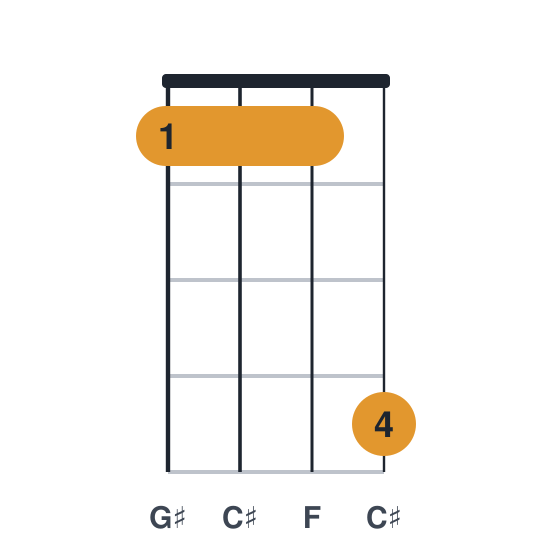
- C#Cdim pulls up a half step to C#
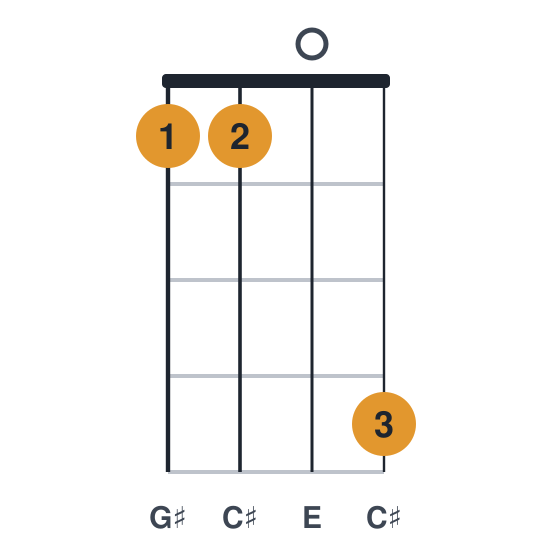
- C#mthe minor resolution one fret up
- Cmone note away from C minor
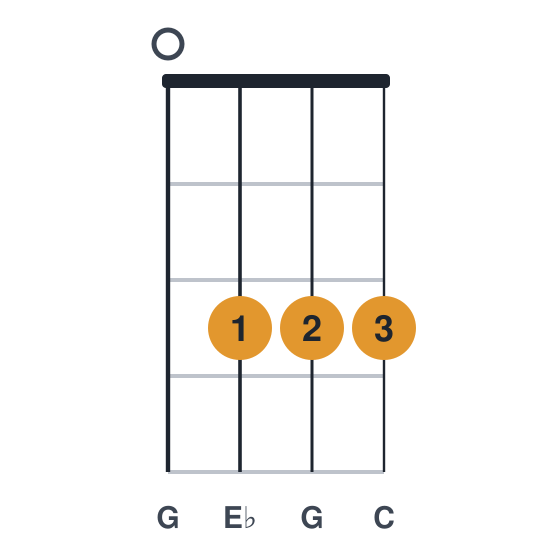
- Caugthe other chord built out of equal intervals
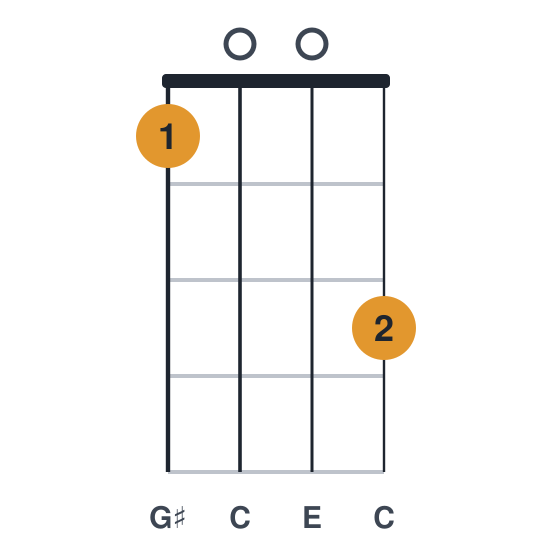


Other C chords
Cdim ukulele chord chart (5323) from melodician.com