Ebaug Ukulele Chord
Ebaug is the E flat augmented chord, also written D#aug. It has three notes: E flat, G and B. The standard shape sits in the first three frets with the G string ringing open as the chord's third.

Index on the A string at 2, middle and ring paired at the 3rd fret, G string open as the chord's third. The root E flat sits on the C string.
How to play Ebaug on ukulele, step by step
- Index finger: 2nd fret, A string
- Middle finger: 3rd fret, C string
- Ring finger: 3rd fret, E string
- Leave the G string open. Strum all four strings.
This is the same physical shape as Gaug and Baug, because the three chords are built from the same three notes. Only the root changes, and the root here is the E flat under your middle finger.
More ways to play Ebaug
There are 3 common Ebaug shapes: the standard one at the top of the page, plus these further up the neck. You only ever need one. Tap any card to hear it.

Leaner and more pointed, all notes fretted, with the root doubled. The shape to move around the neck.

Glassy and unresolved, the drone under high notes. More atmosphere than accompaniment.
If it buzzes or sounds wrong
- The paired 3rd fret fingers buzz
- Middle and ring share the fret on the C and E strings. Set both fingertips close behind the wire with a small gap between the knuckles.
- The open G string dies
- The middle finger's underside is the usual cause. Arch it; the open G carries the third and the chord goes hollow without it.
- The B on the A string is faint
- The index holds the 2nd fret alone. Press with the tip and keep the finger from leaning into the E string above it.
What makes it an Ebaug
E♭ · G · B 1 3 ♯5
Ebaug is an augmented triad: E flat major with the fifth raised a half step, B flat becoming B. The raised note hangs a half step below C and a half step above the fifth it replaced, so the chord sounds suspended, ready to snap up or fall back.
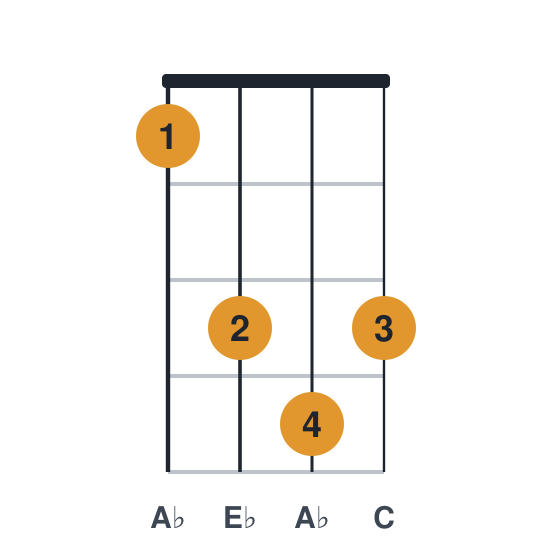
Its natural resolution is A flat, where Ebaug works as the V chord with a raised fifth: Eb to Ebaug to Ab, the B rising to C. It slips into C minor just as easily. And because E flat to G and G to B are both major thirds, Ebaug shares all three notes with Gaug and Baug.
Eb vs Ebaug
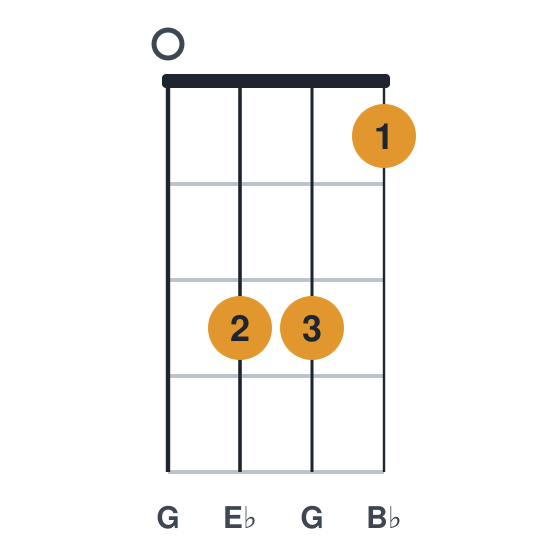
One fret separates the standard shapes: Eb is 0331 and Ebaug is 0332, the A string note raised from B flat to B. The chord keeps its body and gains an itch.
Eb can carry a verse in a flat key; Ebaug is the connective tissue, a beat or two on the way to Ab or C minor. The raised fifth is a leading note and behaves like one.
Ebaug chord questions
Are Ebaug and D#aug the same chord?
Yes. E flat and D sharp are one pitch with two names, so Ebaug and D#aug are the same shape and sound. Flat keys write Ebaug, sharp keys D#aug.
What does Ebaug resolve to?
A flat major most often, the raised fifth B climbing to C. C minor is the other natural landing, and plain Eb takes it home.
How is Ebaug different from Eb?
One note: the fifth. Eb is E flat, G, B flat; Ebaug raises the B flat to B. On the standard shapes that is one fret on the A string.
Does Ebaug share notes with other chords?
Yes, with Gaug and Baug. The augmented triad is two equal major thirds stacked, so its three notes can each act as the root.
Is Ebaug hard to play?
No. Three fingers inside three frets with the G string open, no barre. It is no harder than plain Eb.
Chords to learn next
- Ebthe plain major, one note apart
- Abwhere Ebaug usually resolves
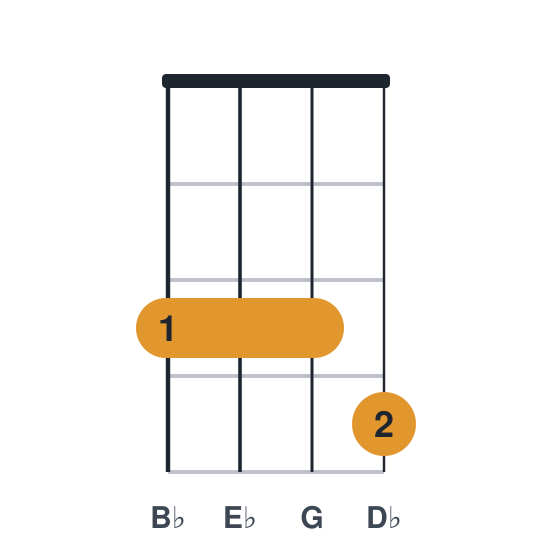
- Eb7another chord built to push forward
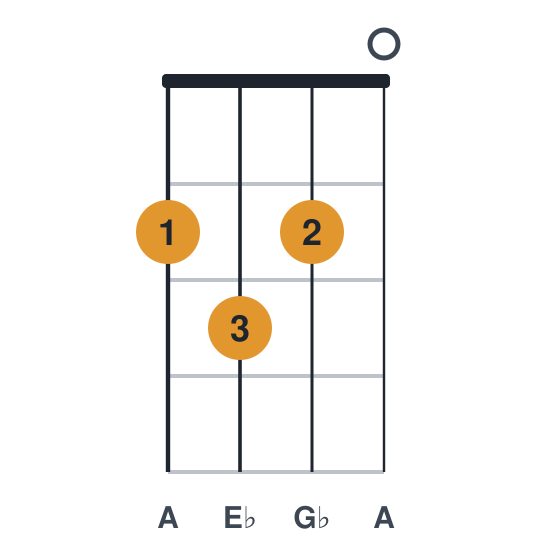
- Ebdimthe other chord built out of equal intervals


Other Eb chords
Ebaug ukulele chord chart (0332) from melodician.com