Ebsus2 Ukulele Chord
Ebsus2 is the E flat suspended second chord on ukulele. It has three notes: E♭, F and B♭. The standard shape is a small two string barre at the 1st fret with two fingers stacked at the 3rd, and nothing rings open, so the whole grip slides.

A small index barre on the E and A strings at the 1st fret with ring and pinky at the 3rd on the G and C. Fully fretted, so it slides anywhere.
How to play Ebsus2 on ukulele, step by step
- Index finger: press flat across the E to A strings at fret 1
- Ring finger: 3rd fret, G string
- Pinky finger: 3rd fret, C string
- Strum all four strings.
No open strings means the shape is movable: slide it up two frets and the same finger pattern is Fsus2. The flat key sus chords all live under this one grip.
More ways to play Ebsus2
There are 3 common Ebsus2 shapes: the standard one at the top of the page, plus these further up the neck. You only ever need one. Tap any card to hear it.

Rounder than the 1st fret shape, with the root on top of the strum.

Dark and close, the version that sounds most like one chord and least like separate strings.
If the shape is not clean
- The barre pair is weak
- The index holds the E and A strings at the 1st fret, where the strings are stiffest. Press right behind the fret wire and roll the finger slightly onto its edge.
- The 3rd fret pair buzzes
- Ring and pinky sit side by side on the G and C strings. Keep both curled so they press on their tips.
- The chord sounds hollow
- The B♭ appears at both edges of this voicing. If the middle two strings are weak you hear only the fifth; pick each string to find the one not speaking.
What makes it an Ebsus2
E♭ · F · B♭ 1 2 5
Ebsus2 replaces the third of the E flat chord, G, with F. What remains is a root, a whole step and a fifth: no major or minor identity at all. The F normally rises back to G as the chord resolves to E♭.
E♭ is a flat key chord, at home in E♭, A♭ and B♭, the keys of soul, gospel and horn charts. The same three notes read from B♭ spell Bbsus4, the sus4 twin a fifth up, and in sharp spelling the chord is D#sus2, a name mostly seen in chord apps.
Ebsus2 vs Ebsus4
Ebsus2 fills the space left by the missing G with F, approaching from below; Ebsus4 fills it with A♭, from above. Same root and fifth, opposite direction of hang.
The sus4 makes a short, tense lead-in that wants E♭ immediately; the sus2 makes a softer, emptier colour that can last whole bars before resolving.
Ebsus2 chord questions
Is D#sus2 the same as Ebsus2?
Yes. D♯ and E♭ name the same pitch, so the chords are identical. E♭ is the spelling real songs use, because this root lives in flat keys.
Is Ebsus2 major or minor?
Neither. The G that would make it major has been swapped for F, so the chord floats until a third returns.
Is Ebsus2 hard to play?
Middling. A two string barre at the 1st fret plus two stacked fingers; harder than an open shape, easier than a full barre chord.
What is the difference between Ebsus2 and Ebsus4?
Ebsus2 suspends F, a whole step over the root; Ebsus4 suspends A♭, a fourth over it. The sus4 is the tense one, the sus2 the spacious one.
What does Ebsus2 resolve to?
E♭ major, when the F steps up to G. It can also fall into E flat minor, since nothing in the chord blocks the minor third.
Chords to learn next
- Ebwhere the suspension usually lands
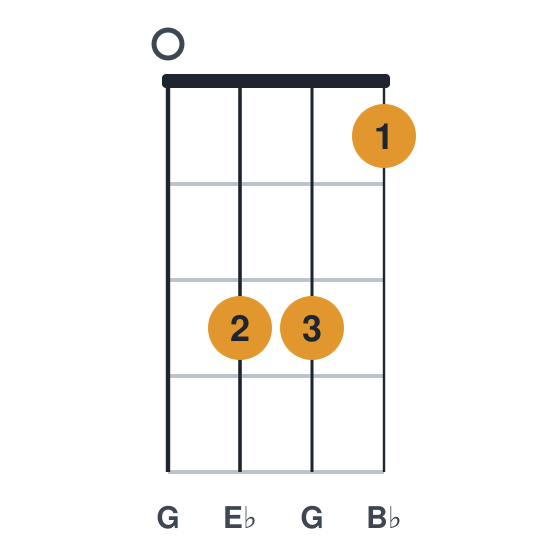
- Ebsus4the other suspension
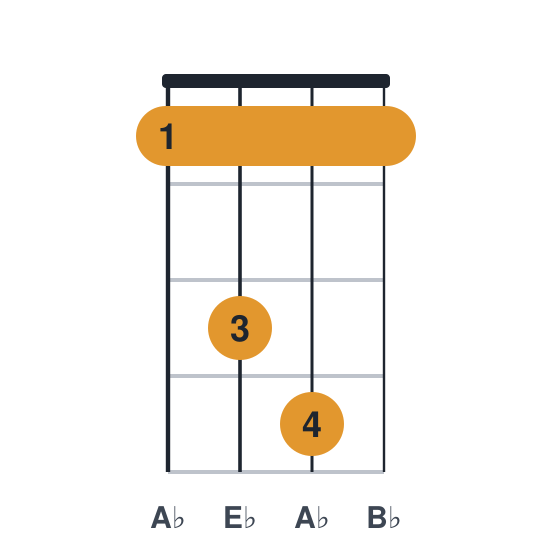
- EbmEbsus2 sits between major and minor
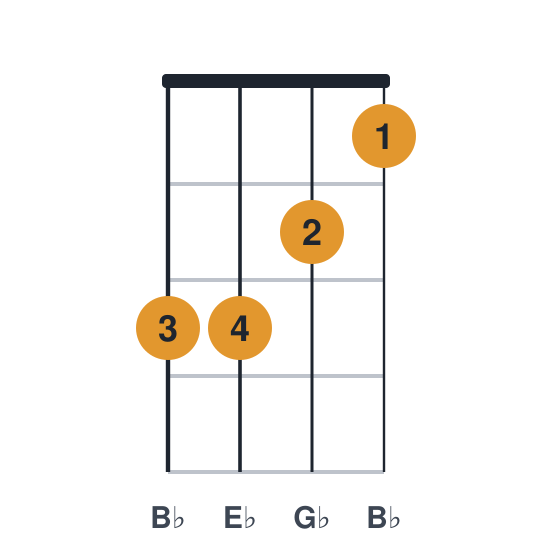
- Ebadd9the same colour with the third kept in
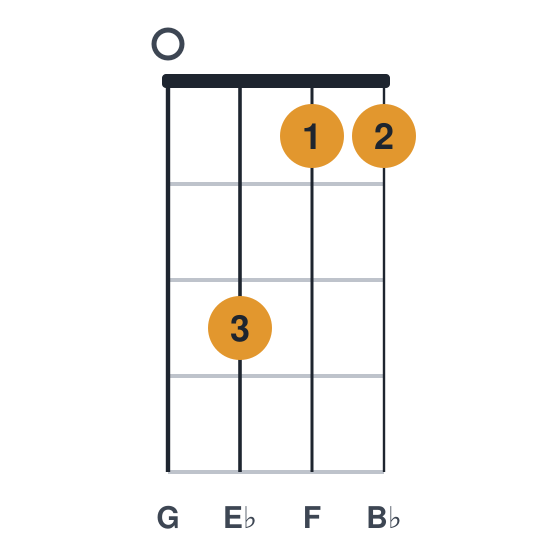


Other Eb chords
Ebsus2 ukulele chord chart (3311) from melodician.com