Chords in the Key of Bb Minor
The key of Bb minor contains seven chords: Bbm, Cdim, Db, Ebm, Fm, Gb and Ab. It has five flats, it is common in horn music, soul and piano writing, and on guitar it has no open shapes at all, so most players either barre it or use a capo.
The seven chords on guitar
Each chord below opens its own page, with more shapes up the neck, audio for every voicing and a printable chart. Tap the play button on any card to hear it.


The seven chords on piano
The same seven chords on a keyboard, in root position. Each one opens its own page, with every inversion and the finger numbers for both hands.
iBbmB♭ D♭ F 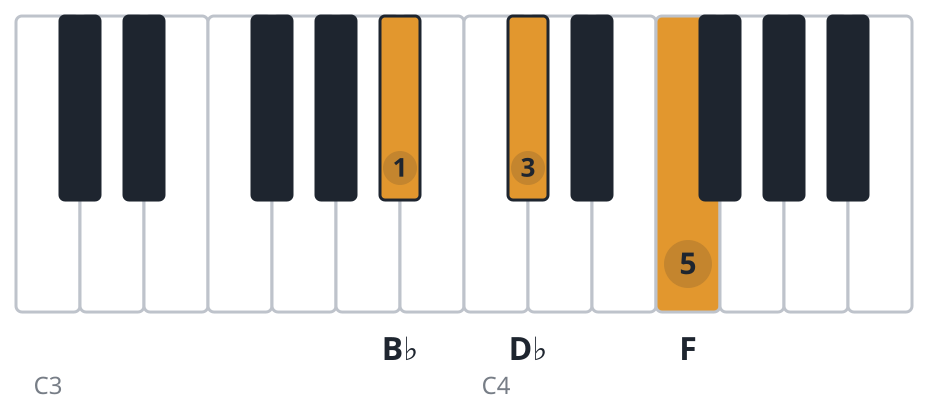
the home chord
ii°CdimC E♭ G♭ 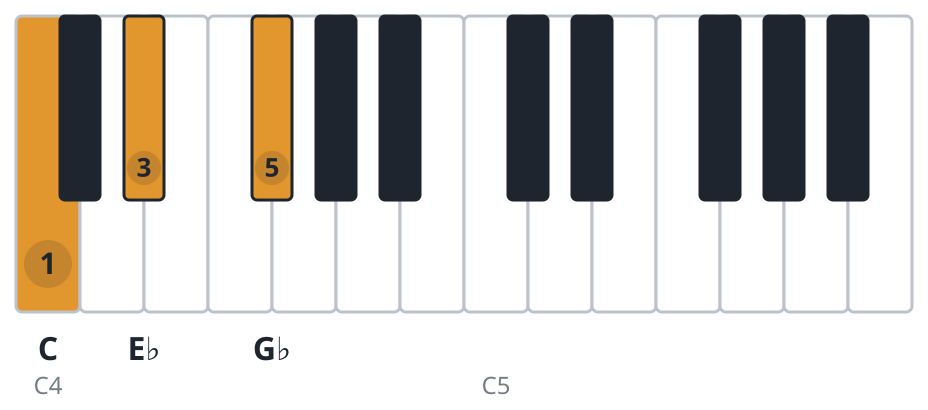
the tense one, used sparingly
IIIDbC♯ F G♯ 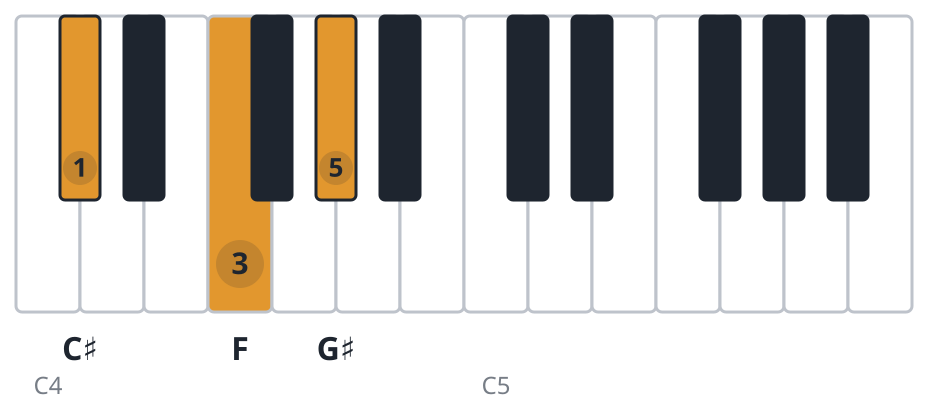
the relative major, the bright lift, filed as C#
ivEbmE♭ G♭ B♭ 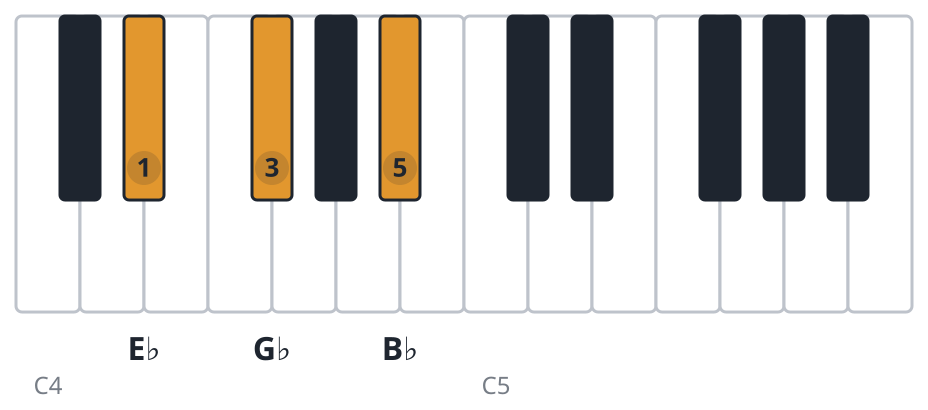
the darker step away from home
vFmF A♭ C 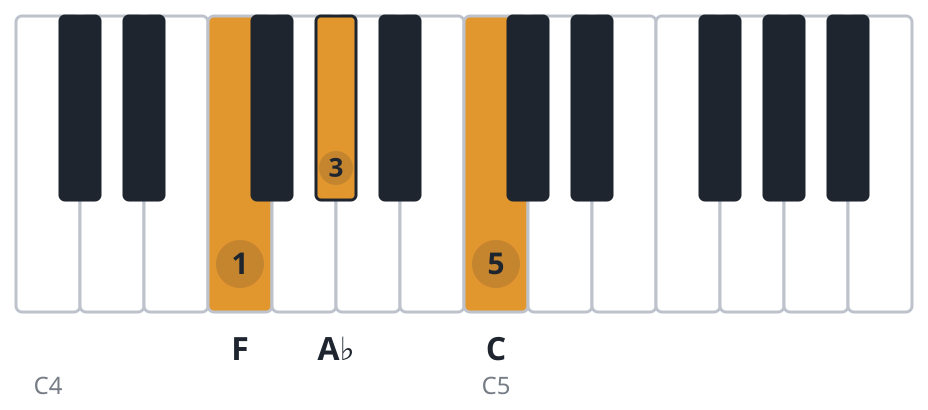
the pull home, usually played major
VIGbF♯ A♯ C♯ 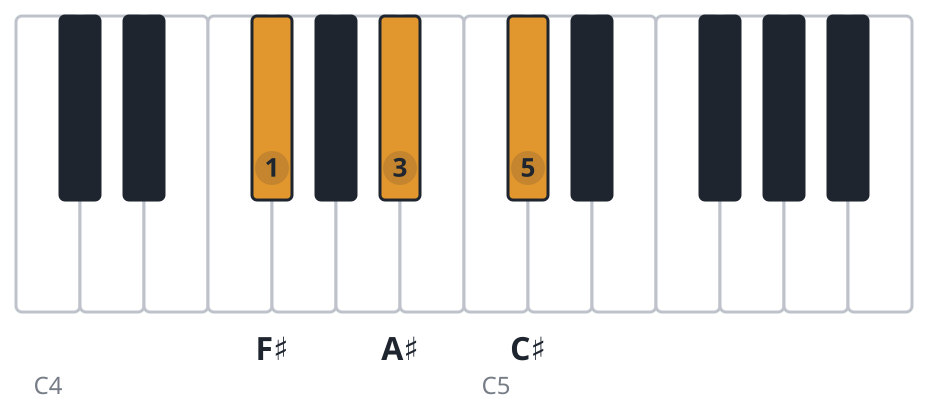
the warm place to rest, filed as F#
VIIAbA♭ C E♭ 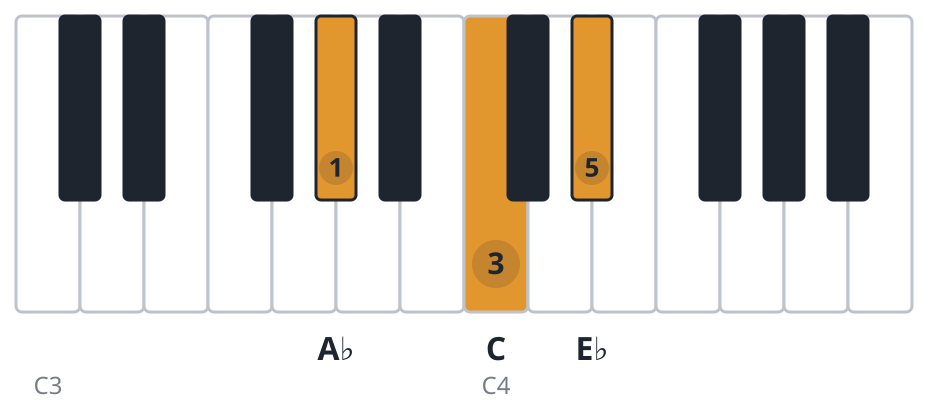
a step below home, the rock cadence


The seventh chords in Bb minor
Add one more note to each chord and the key gains its seventh chords, which is where most jazz and a good deal of soul begins.
Common progressions in Bb minor
- i - VI - III - VII
Bbm Gb Db Ab
The most common minor progression in popular music, and the same four chords as the Db major loop started from a different place. With a capo at the first fret it is just Am, F, C, G shapes, which is the fastest way to get this key sounding right.
- i - VII - VI
Bbm Ab Gb
Three chords walking down in whole steps. This is the sound of most minor key rock, and barred straight it is a first fret barre, then fourth, then second, so the hand travels a lot. Capo 1 turns it into Am, G, F.
- i - iv - v
Bbm Ebm Fm
The saddest of the group, because all three chords are minor and nothing pulls hard toward home. Swap the Fm for F or F7 and the ending suddenly sounds closed, which is the harmonic minor change at work.
- i - iv - VII - III
Bbm Ebm Ab Db
A circling progression that keeps drifting toward the relative major. Let it run and Db starts to feel like home, which is how close Bb minor and Db major sit to each other.
Why these seven chords
On a stave, Bb minor is written with five flats, which is how a reader knows the key before playing a note.
The seven chords come from the Bb natural minor scale, one chord built on each note using only notes from that scale. The pattern of qualities is the same in every minor key: minor, diminished, major, minor, minor, major, major. Written as numerals that is i, ii dim, III, iv, v, VI and VII, so Bbm is home, Cdim is the odd one almost nobody plays, and Db, Gb and Ab are the three major chords a song leans on.
Two of the seven are worth pointing at. The VII, Ab, is a major chord a whole step below the home chord, and the drop from Bbm to Ab is the sound of a great deal of rock and soul. The v, Fm, is minor in the natural minor scale, but songs constantly raise its third from Ab to A natural and play it major instead, as F or more often F7. That raised note is the leading note borrowed from the harmonic minor scale, and it is what makes the return to Bbm sound finished rather than drifting. F7 is the one chord you will meet again and again in Bb minor that is not in the list of seven, so do not be surprised when a chart shows it.
On guitar
Bb minor is one of the hardest keys on guitar, and it is fair to say so. Not one of the seven is an open shape. Bbm is a barre at the first fret using the Am shape, Fm is a barre at the first fret using the Em shape, Gb is a barre at the second fret, Db and Ab are barres at the fourth fret, and Ebm sits as a barre at the sixth fret. Six barres in a row is why guitar bands rarely write in this key, while horn players and singers land in it often.
The honest fix is a capo. Put a capo at the first fret and play A minor shapes: Am becomes Bbm, C becomes Db, Dm becomes Ebm, Em becomes Fm, F becomes Gb and G becomes Ab. That is exactly this key, with open strings ringing, and it is the route to use when you are backing a singer who needs Bb minor. Capo 3 with G minor shapes also gives the same key, but Gm, Cm, Bb and Eb are barre shapes themselves, so it only helps if you already play in G minor and want to keep the fingerings you know. Cdim comes up so rarely that most players never learn a shape for it.
On piano
On piano Bb minor is the opposite story. The scale is Bb, C, Db, Eb, F, Gb and Ab, so five of the seven notes are black keys and only C and F are white. That lies very well under the hand: the long fingers sit up on the black keys and the thumb falls naturally on C and on F, which is the standard fingering and the reason many pianists find this key more comfortable than C minor or even C major.
The chords follow the same pattern. Bbm, Ebm and Gb are handfuls of black keys with an easy shape, Db is black, white, black, and Cdim is the one that feels odd because it starts on a white key and reaches up to two black ones. When a song plays the v as F or F7, the A natural is a white key sitting right next to the Ab you have been using, so the change of colour is easy to hear and easy to find. Every triad and seventh here shows all of its inversions with fingering for both hands, which is the quickest way to move from Bbm to Gb to Db without lifting the hand off the keys.
Questions about the key of Bb Minor
What are the 7 chords in the key of Bb minor?
Bbm, Cdim, Db, Ebm, Fm, Gb and Ab. Bbm, Ebm and Fm are minor, Db, Gb and Ab are major, and Cdim is diminished.
What is the relative major of Bb minor?
Db major. It has the same key signature of five flats and exactly the same seven chords. The only difference is which chord feels like home: Db in Db major, Bbm in Bb minor.
How many flats does Bb minor have?
Five: Bb, Eb, Ab, Db and Gb. The scale is Bb, C, Db, Eb, F, Gb and Ab, which means only C and F are natural.
Why do songs in Bb minor use an F or F7 chord?
The fifth chord of the natural minor scale is Fm, but raising its third from Ab to A natural turns it into F or F7 and creates a strong pull back to Bbm. That raised note comes from the harmonic minor scale, and F7 is the one common chord in Bb minor that is not one of the seven.
What capo position works for Bb minor on guitar?
Capo at the first fret and play A minor shapes, which gives Bbm, Cdim, Db, Ebm, Fm, Gb and Ab with open strings. Capo 3 with G minor shapes reaches the same key, but those shapes are barres anyway, so capo 1 is the easier route.
Is Bb minor hard to play?
On guitar, yes, because every chord in the key needs a barre and none are open shapes. On piano it is one of the friendlier keys, since five of its seven notes are black keys and the thumb falls on the white C and F.
What do the numbers next to each chord mean?
They are each chord's place in the key, written as Roman numerals. In Bb minor the i is Bbm, the iv is Ebm and the v is Fm. The numbering holds in every key, so the v of A minor is Em. That is why progressions get written as numerals like i, VI, III, VII: learn one and you have it in all twelve minor keys.
Why are some numerals capitals and some lowercase?
The case tells you the chord quality. Lowercase are minor, which in Bb minor means Bbm, Ebm and Fm. Capitals are major: Db, Gb and Ab. The small circle on ii° means diminished, and here that is Cdim.
What is the relative major of Bb minor?
Db major. It is written with five flats, the same signature as Bb minor, and it contains the same seven chords. Only the chord that sounds like home changes, from Bbm to Db.
The relative major
Db major is written with the same five flats and contains the same seven chords as Bb minor. What changes is which one sounds like home, so the same shapes can be played brighter without learning anything new. Chords in the key of Db