C#aug Guitar Chord
C#aug is the C sharp augmented chord, also written Dbaug. It has three notes: C♯, F and A. There is no open shape, so you play it as a small movable grip with a two string barre. Expect to hold it for a beat or two at a time: this chord exists to connect other chords, not to be lived on.

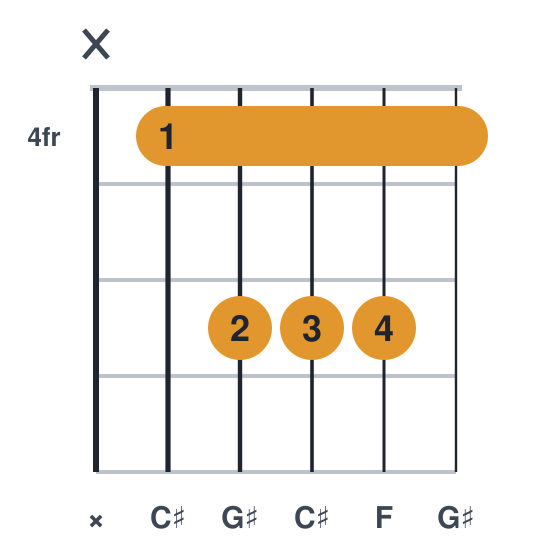
Root on the A string under the ring finger, middle finger a fret below it, and a small index barre over the G and B strings at fret 2. The whole grip slides to any fret.
How to play C#aug, step by step
- Index finger: press flat across the G to B strings at fret 2
- Middle finger: 3rd fret, D string
- Ring finger: 4th fret, A string
- Strum from the A string down, skipping the low E. The high E string stays muted; let the nearest fretting finger touch it lightly.
This is the same grip as Caug moved up one fret. If you learn where the root sits, under the ring finger on the A string, you can name this shape anywhere on the neck.
More ways to play C#aug
There are 2 common C#aug shapes in total: the standard one at the top of the page, plus these, easiest first. You only ever need one. Tap any card to hear it.

Brighter and glassier than the standard grip, high up with no bass under it.
If it sounds choked or buzzy
- The barre notes do not both speak
- The index only covers two strings, so a small roll toward its bony edge is enough. Check the G and B strings one at a time and adjust the pressure point.
- The root on the A string buzzes
- The ring finger sits two frets above the barre and tends to land far from the fret wire. Slide it right up behind the 4th fret before you press.
- Open strings leak in on either side
- The low E and high E are both outside the chord. Touch the low E with your thumb over the neck, and let the index barre's underside rest against the high E.
What makes it a C#aug
C♯ · F · A 1 3 ♯5
C#aug is an augmented triad: C♯ major with the fifth, G♯, raised a half step to A. The chord splits into two identical major thirds, C♯ to F and F to A, and that even spacing is why it sounds rootless and suspended, like it could tip in any direction. It is also why C#aug, Faug and Aaug are the same three notes under different names.
Its home key is F♯ major, where C#aug is the V chord with a raised fifth: C♯ to C#aug to F♯, the A note climbing to A♯ as the chords land. Charts in flat keys write the same sound as Dbaug pushing to Gb. Either spelling, the job is identical: one short chord that leans hard into the next one.
C# vs C#aug
The only note that changes is the fifth: G♯ in C♯ major, A in C#aug. Neither chord has an open shape, but the effort differs: C♯ major is normally a full barre chord, while C#aug is a lighter four string grip with just a two string barre. Use C♯ major wherever the song needs solid ground; C#aug earns its place for a beat when the harmony should strain upward, usually on the way to F♯.
C#aug chord questions
Are C#aug and Dbaug the same chord?
Yes. C♯ and D♭ are one pitch with two names, so the chords are identical. Sharp keys write C#aug, flat keys write Dbaug.
Is C#aug hard to play?
It is a compact fretted shape with a two string barre, so it takes more control than an open chord. Most players find it manageable once the similar Caug grip is comfortable one fret lower.
What does C#aug resolve to?
F♯ major most naturally, since C#aug is the V chord of F♯ with a raised fifth. It can also settle back into plain C♯.
What is the difference between C# and C#aug?
One note. Both chords share their root and third; the augmented version raises the fifth from G♯ to A. That half step is the entire difference in sound.
Which chords share their notes with C#aug?
Faug and Aaug. An augmented triad is built from equal major thirds, so its three notes can each act as the root.
Chords to learn next
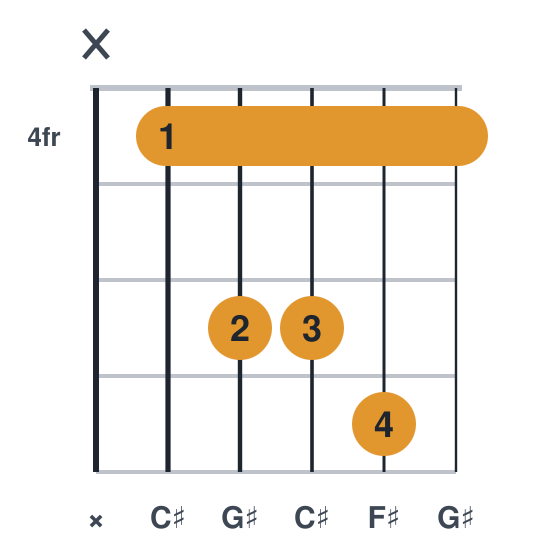
- C#the plain major, one note apart
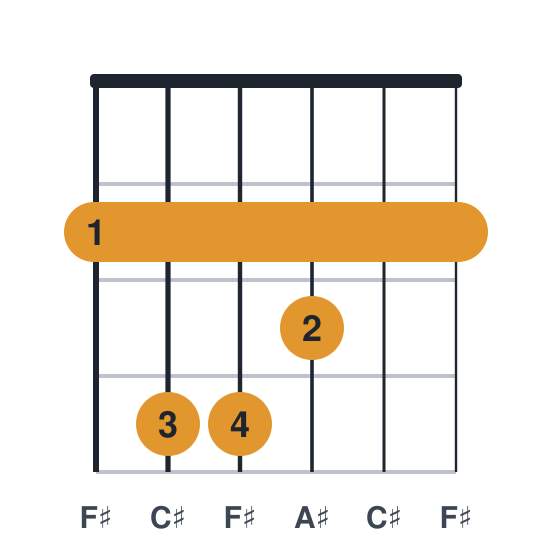
- F#where C#aug usually resolves
- C#7another chord built to push forward
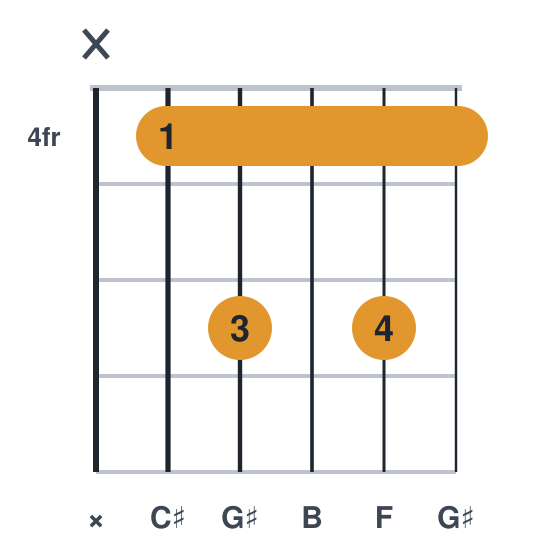
- C#sus4another color built on the same root, pulling elsewhere


Other C# chords
C#aug guitar chord chart (x4322x) from melodician.com