Bmaj7 Ukulele Chord
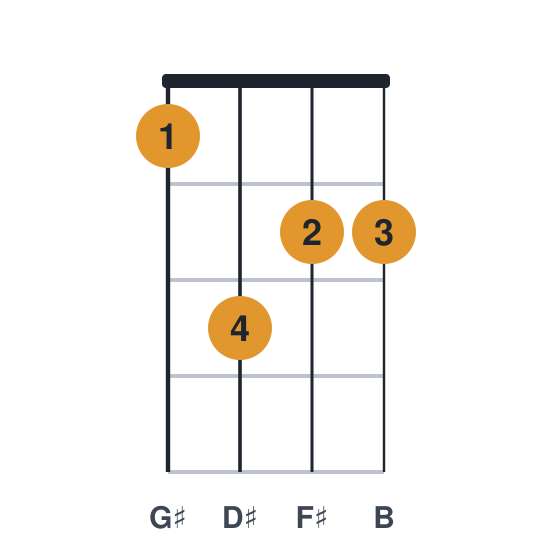
Bmaj7 is the B major seventh chord. It has four notes: B, D sharp, F sharp and A sharp. The standard shape is a staircase: one finger per string, stepping down a fret at a time from the 4th fret of the G string to the 1st of the A.

One finger per string, stepping down from the pinky at the 4th fret of the G string to the index at the 1st of the A.
How to play Bmaj7 on ukulele, step by step
- Index finger: 1st fret, A string
- Middle finger: 2nd fret, E string
- Ring finger: 3rd fret, C string
- Pinky finger: 4th fret, G string
- Strum all four strings.
Every note is fretted, so the chord stops the moment you lift off, which keeps changes clean. The same staircase slides: two frets higher it is C#maj7, and anywhere else it is whatever maj7 the G string names.
More ways to play Bmaj7
There are 3 common Bmaj7 shapes: the standard one at the top of the page, plus these further up the neck. You only ever need one. Tap any card to hear it.

Thicker than the staircase, the three notes at one fret moving as a single block.

Bright and cutting with the whole chord above the 7th fret; more a chord melody voicing than a strumming shape.
If the staircase collapses
- The fingers bump into each other
- The shape runs diagonally, so give each finger its own lane: fingertips upright, knuckles staggered, thumb low behind the neck to open the hand.
- The A string chokes
- The index has the lightest job at the 1st fret and tends to get lazy. Keep it on its tip; the A sharp it holds is the note that makes the chord a maj7.
- Notes cut off early
- Four fretted notes need even pressure. Squeeze gently from the thumb rather than clamping one finger harder than the rest, then strum slowly and listen for all four.
What makes it a Bmaj7
B · D♯ · F♯ · A♯ 1 3 5 7
Bmaj7 is a major seventh chord: a B major triad (B, D sharp, F sharp) plus a major seventh (A sharp). The A sharp sits one half step under the root, close enough to shimmer against it, which is the sound every maj7 chord shares.
Bmaj7 is the I chord of B major and the IV chord of F sharp major. B is an awkward key on most instruments, but on a ukulele the maj7 is just this staircase at the bottom of the neck, four frets and four fingers with no barre anywhere.
B vs Bmaj7
B major is 4322, a grip with a small barre inside it. Bmaj7 unstacks that into 4321: four single notes, one finger per string, sliding one fret further down with each string. The barre disappears and an A sharp takes over from the doubled root.
Plain B lands solidly and moves on. Bmaj7 hangs, the seventh leaning into the root without arriving, which is why it suits endings and slow songs in B and F sharp.
Bmaj7 chord questions
Is Bmaj7 hard to play on ukulele?
It takes all four fingers, which earns its Hard label, but each finger has exactly one job on one string. Most players find it easier than a full barre once the diagonal sits under the hand.
Is the Bmaj7 shape movable?
Yes. Nothing in 4321 is open, so the staircase plays any major seventh chord: slide it up two frets for C#maj7, three for Dmaj7.
What is the difference between Bmaj7 and B7?
The seventh. B7 carries an A natural and pushes toward E like a blues chord; Bmaj7 carries an A sharp and stays put. One half step in the chord, a whole world in the mood.
Do you strum all four strings in Bmaj7?
Yes. All four are fretted and every one is a different chord tone: root, third, fifth and seventh, bottom string to top.
What keys use Bmaj7?
It is the I chord of B major and the IV chord of F sharp major, both common in jazz and in songs that have drifted up from A or B flat.
Chords to learn next
- Bthe plain major
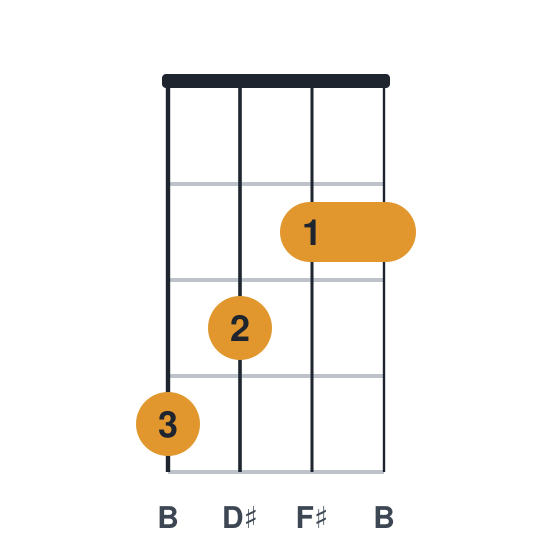
- C#m7the ii chord beside Bmaj7 in the key of B
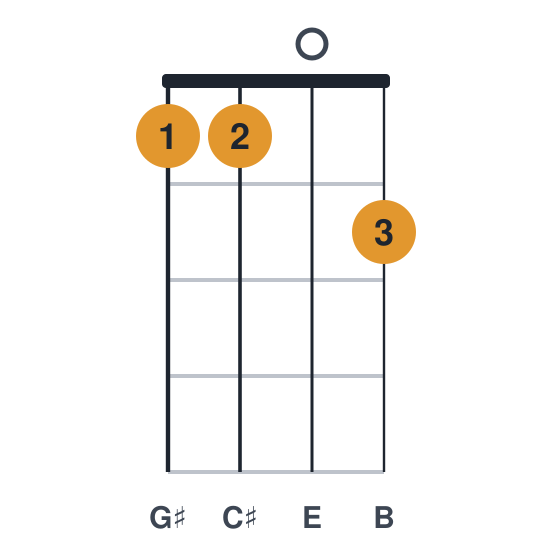
- F#7the V chord of B
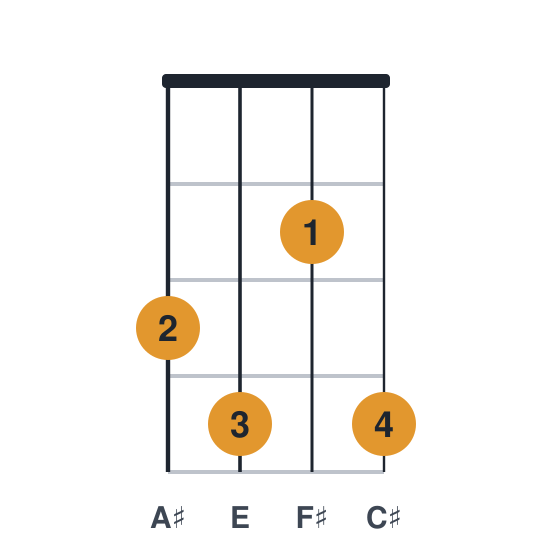
- B6the other soft colour on the same major


Other B chords
Bmaj7 ukulele chord chart (4321) from melodician.com