Baug Ukulele Chord
Baug is the B augmented chord. It has three notes: B, D sharp and G. The standard shape sits in the first three frets with the G string open, which is friendlier than plain B, a chord that needs a barre.

Index on the A string at 2, middle and ring stacked at the 3rd fret of the C and E strings, G string open. The root B sits under the index.
How to play Baug on ukulele, step by step
- Index finger: 2nd fret, A string
- Middle finger: 3rd fret, C string
- Ring finger: 3rd fret, E string
- Leave the G string open. Strum all four strings.
The open G string is doing quiet theory work here: G is B's raised fifth, strictly an F double sharp, and it is the note that gives the chord its upward lean.
More ways to play Baug
There are 3 common Baug shapes: the standard one at the top of the page, plus these further up the neck. You only ever need one. Tap any card to hear it.

Tighter and darker, the root at the bottom of the grip. The movable version for keys where open strings do not fit.

Chiming and suspended, the drone against high fretted notes. Good for a last chord that refuses to settle.
If it buzzes or sounds wrong
- The paired fingers at fret 3 collide
- Middle and ring sit on neighbouring strings at the same fret. Stagger them slightly, each on its tip, so neither leans on the other's string.
- The open G hums wrong
- Nothing should touch the G string. If it sounds choked, the middle finger on the C string has flattened; arch it and let the re-entrant string ring.
- The root is lost
- B sits at the 2nd fret of the A string under the index. It is the only B in the shape, so if it buzzes the chord loses its name. Press just behind the fret.
What makes it a Baug
B · D♯ · G 1 3 ♯5
Baug is an augmented triad: B major with the fifth raised a half step. Strictly that note is F double sharp, which is the same key as G, and chord charts print the plain name. The raised note hangs a half step below G sharp, so the chord pulls toward E major and E's relative territory.
The textbook line is B to Baug to E: Baug acts as the V chord of E with a raised fifth, and the G climbs to G sharp, the third of E. And because B to D sharp and D sharp to G are both major thirds, Baug contains exactly the same notes as Ebaug and Gaug, one pitch set with three names.
B vs Baug
Plain B on ukulele is a barre chord at 4322; Baug is three separate fingers and an open string in the first three frets. The one note that changes is the fifth, F sharp rising to G, and it flips the chord from stable to leaning.
So the division of labour is clear: B for the destination, Baug for the corridor, almost always on the way to E or back to B itself.
Baug chord questions
Is Baug the same as B+?
Yes. B+, Baug and B augmented all name the same three notes: B, D sharp and G.
Why does the chart say G and not F double sharp?
Raising B major's fifth, F sharp, strictly gives F double sharp, the same key as G. Charts print the plain enharmonic name, and this page does too.
What does Baug resolve to?
E major first, the raised fifth climbing to G sharp. E minor and plain B are the other usual landings.
Is Baug easier than B?
Yes. Plain B needs a barre; Baug is three fingertips and an open G string, all inside three frets.
Does Baug share notes with other chords?
Yes, with Ebaug and Gaug. The augmented triad splits the octave into three equal major thirds, so its notes serve three roots.
Chords to learn next
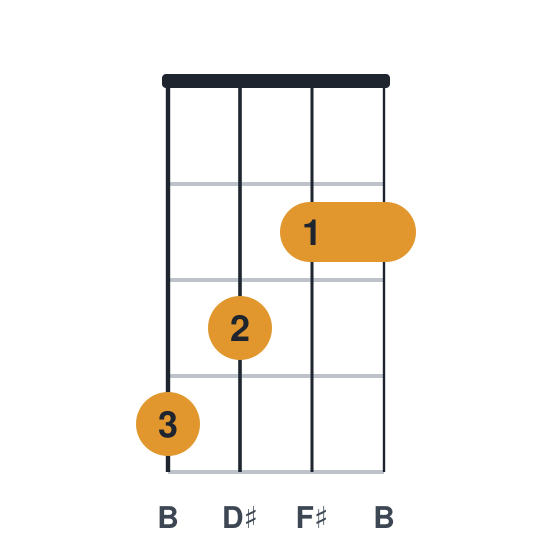
- Bthe plain major, one note apart
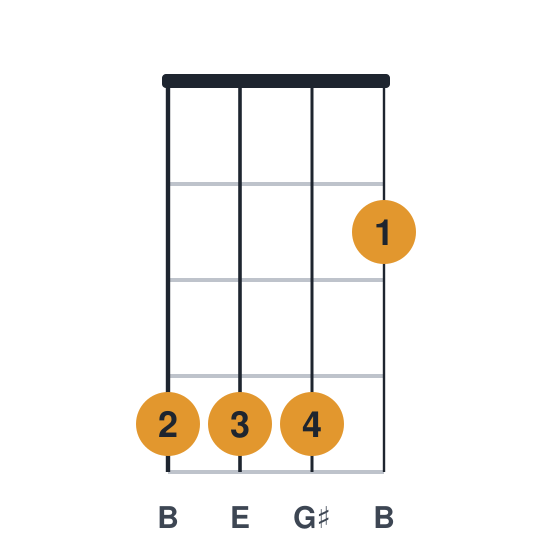
- Ewhere Baug usually resolves
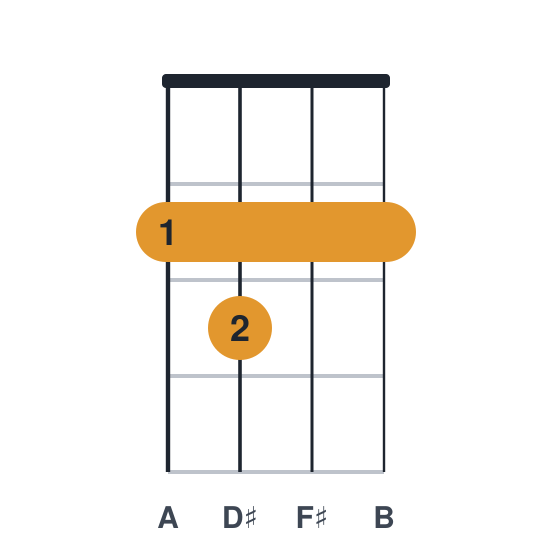
- B7another chord built to push forward
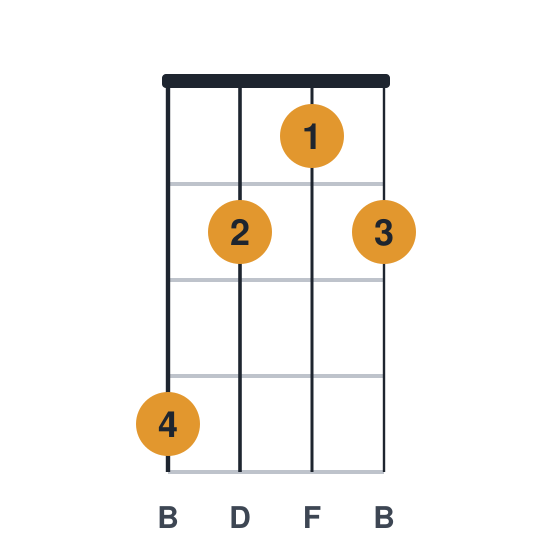
- Bdimthe other chord built out of equal intervals


Other B chords
Baug ukulele chord chart (0332) from melodician.com