Cadd9 Piano Chord
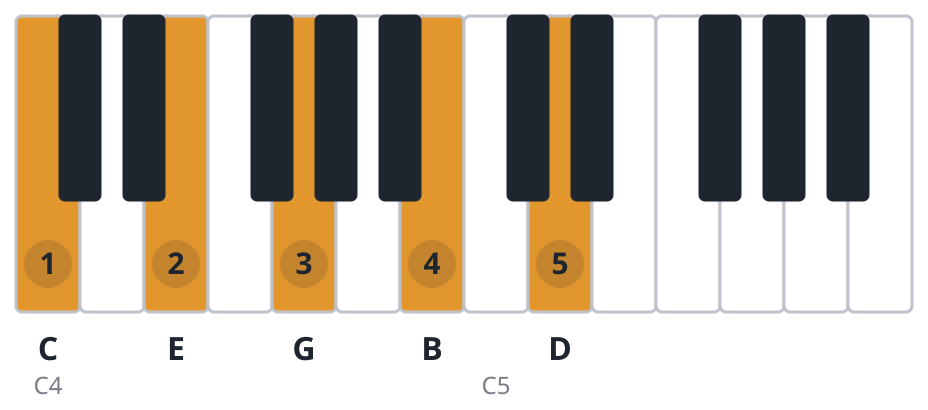
Cadd9 is the C added ninth chord on piano. It has four notes: C, E, G and D, with the D sitting a ninth above the root, a whole step past the octave. Every note is a white key, so the reach is the only thing about it that needs work.

C at the bottom, then E and G, with D on top a ninth above the root. If one hand cannot span it, put C in the left hand and the other three notes in the right.
How to play Cadd9 on piano, step by step
- Start on middle C. That is the lowest note of the chord.
- Thumb (1): C
- Index finger (2): E
- Middle finger (3): G
- Little finger (5): D
- That reach is wider than an octave, so most players split it: play C with the left hand and the other notes with the right. If you keep it in one hand, use the two-hand split shown on this page. Leaving out the fifth (G) can thin the sound, but it does not shorten the span from the root to the ninth.
If the reach is uncomfortable, tuck the D inside the octave instead: C, D, E, G. Charts call that Cadd2, and it is the same colour built from the same four note names.
If it sounds wrong
- The top note does not reach
- The span from C up to D is a ninth, wider than an octave. Split the chord: C alone in the left hand, E, G and D in the right. Nothing about the sound is lost.
- It sounds like plain C
- The D is the point of the chord. Let the little finger sing a touch louder than the middle notes, or the added ninth disappears into the triad.
- It sounds cluttered
- Check where the D sits. Next to the C it turns the chord into a cluster; the shimmer comes from the ninth ringing above the octave.
What makes it a Cadd9
C · E · G · D 1 3 5 9
Cadd9 is a C major triad (C, E, G) with a ninth added on top: D, the second note of the C scale played an octave higher. The third stays in the chord, so Cadd9 still sounds fully major, just brighter and more open than plain C.
The added D belongs to the keys where C does most of its work, C major and G major, which is why the chord blends in so easily there. Pop ballads and worship songs write Cadd9 where plain C would sound too settled, and guitarists know the same trick: half of them play Cadd9 wherever a chart says C.
Cadd9 vs Csus2
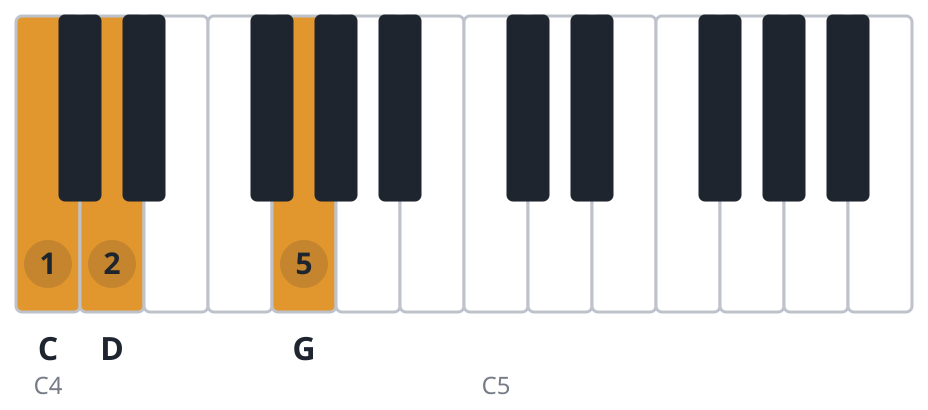
Both chords add a D to C. Csus2 removes the third, E, to make room for it, so it sounds hollow and undecided, neither major nor minor. Cadd9 keeps the E and stacks the D a ninth up, so it stays clearly major with extra shimmer on top.
On the keyboard the difference is one finger. Hold C, E and G, then add a D above for Cadd9, or swap the E for a D to get Csus2. Play them back to back and the names stop being abstract: one is a colour, the other is a suspension waiting to land.
Cadd9 in major keys
Every note of Cadd9 sits inside these keys. See how it works alongside the other chords in each one.
Questions about Cadd9
What notes are in Cadd9 on piano?
C, E, G and D. The first three make a plain C major chord; the D on top, a ninth above the root, is the added note. All four are white keys.
What is the difference between Cadd9 and Cadd2?
The same four note names. Add2 puts the D inside the octave, next to the C; add9 puts it on top. Most players treat the two names as one chord and place the D wherever the hand allows.
What is the difference between Cadd9 and C9?
C9 also contains the flat seventh, B flat, which makes it a dominant chord that wants to move somewhere. Cadd9 adds only the D and stays a bright major chord.
Why does this page show no inversions?
This page teaches one practical root-position voicing because a ninth spans more than an octave. Ninth chords can still be inverted: an inversion changes the bass note, and players often reorder or omit notes to fit the hand. The diagrams here keep the beginner-friendly voicing visible.
Is Cadd9 hard to play?
Only the span is hard: root to ninth is wider than an octave. Split between two hands it is as easy as plain C.
Chords to learn next
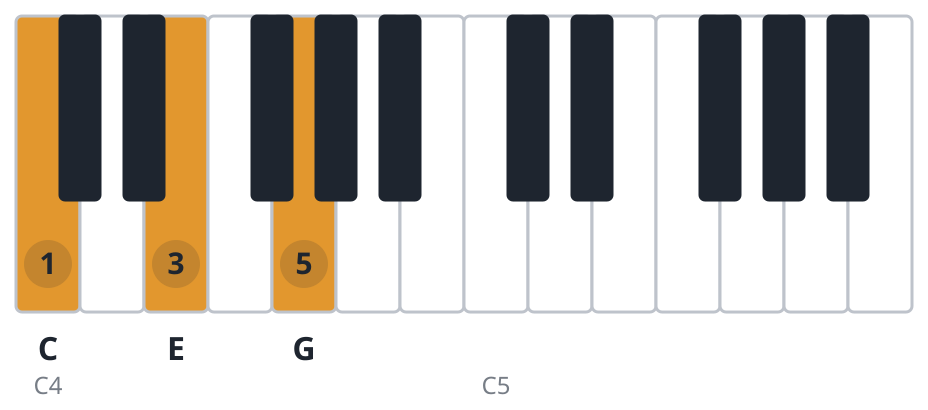
- Cthe plain major
- Csus2the 9 without the 3
- Cmaj7another colour on the same major
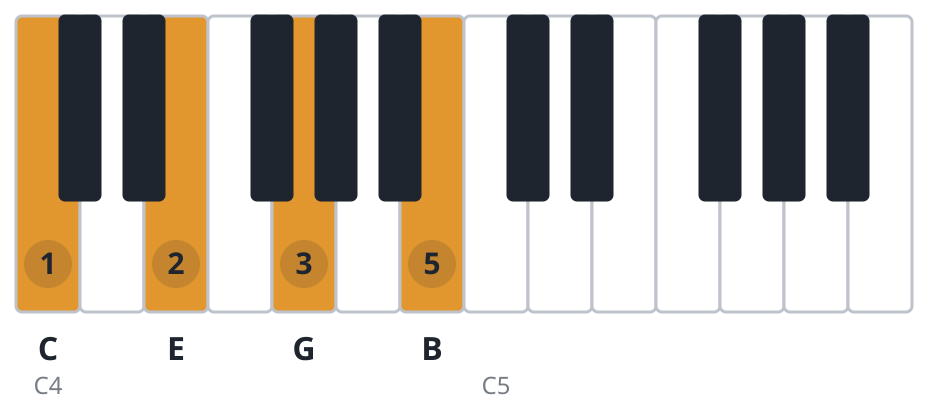
- Cmaj9the same ninth with the seventh under it