Abaug Ukulele Chord
Abaug is the A flat augmented chord, also written G#aug. It has three notes: A flat, C and E. The standard shape needs only two fingers, with the C and E strings ringing open, and the root sits at the 1st fret of the G string.

Index on the root at the 1st fret of the G string, middle at the 3rd fret of the A string, the C and E strings open between them.
How to play Abaug on ukulele, step by step
- Index finger: 1st fret, G string
- Middle finger: 3rd fret, A string
- Leave the C and E strings open. Strum all four strings.
This is the same physical shape as Caug and Eaug, because the three chords share the same three notes. Which chord you are playing depends only on which note the song treats as the root.
More ways to play Abaug
There are 3 common Abaug shapes: the standard one at the top of the page, plus these further up the neck. You only ever need one. Tap any card to hear it.

Firm and balanced, each note fretted and even. The version that works mid progression at speed.

Spread and shimmering, the doubled raised fifth giving it extra glow. A colour chord more than a workhorse.
If it buzzes or sounds wrong
- The open middle strings die
- The index at the 1st fret of the G string must stay on its tip. Flatten it slightly and the C string underneath stops ringing, which takes the third out of the chord.
- The root sounds thin
- A flat lives at the 1st fret of the G string, the highest string on a re-entrant ukulele's left side. Press cleanly; if it buzzes the whole chord goes anonymous.
- The A string note wobbles
- The middle finger sits alone at the 3rd fret. Place it just behind the fret wire and strike the string straight on to check it.
What makes it an Abaug
A♭ · C · E 1 3 ♯5
Abaug is an augmented triad: A flat major with the fifth raised a half step, E flat becoming E. The raised note hangs a half step below F and a half step above the fifth it replaced, so the chord sounds suspended between two magnets, ready to snap either way.
Its natural resolution is C sharp major, which flat key players write as D flat: Abaug works as its V chord with a raised fifth, the E rising to F. It slips just as easily into F minor. There is also a neat coincidence of spelling: A flat, C and E are the same three pitches as Caug and Eaug, because the augmented triad cuts the octave into three equal slices.
Ab vs Abaug
They differ by a single half step: the fifth is E flat in A flat major and E in Abaug. On ukulele the plain chord is a four finger climb while Abaug is two fingers and two open strings, so the augmented version is actually the easier grip.
Ab holds the floor; Abaug tilts it, usually toward the D flat family or F minor. Give the augmented chord one or two beats and let it deliver you to the next bar.
Abaug chord questions
Are Abaug and G#aug the same chord?
Yes. A flat and G sharp are one pitch with two spellings, so Abaug and G#aug are the same chord. Flat keys write Abaug, sharp keys G#aug.
What does Abaug resolve to?
Most often to the chord a fourth up, spelled C sharp or D flat depending on the key, with the raised fifth E climbing to F. F minor is the other common landing.
Does Abaug really contain the same notes as Caug?
Yes, and the same as Eaug too. The augmented triad is built from two equal major thirds, so its three notes can each be treated as the root.
Is Abaug hard to play?
No. The standard shape is two fingers with the C and E strings open, easier than plain Ab. The closed shape at the 3rd fret takes four fingers but slides anywhere.
Where would I actually meet Abaug?
As a passing chord in flat keys: between Ab and Db, under a melody climbing by half steps, or in older pop and show tunes that love chromatic movement.
Chords to learn next
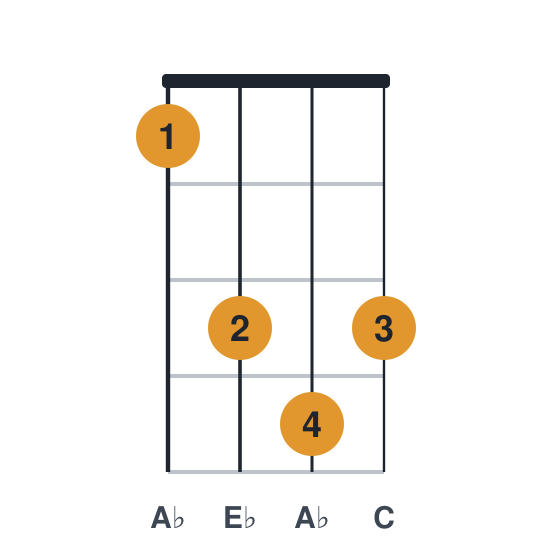
- Abthe plain major, one note apart
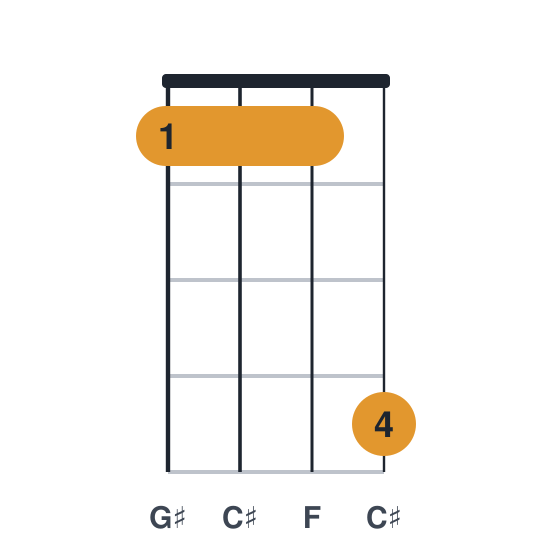
- C#where Abaug usually resolves
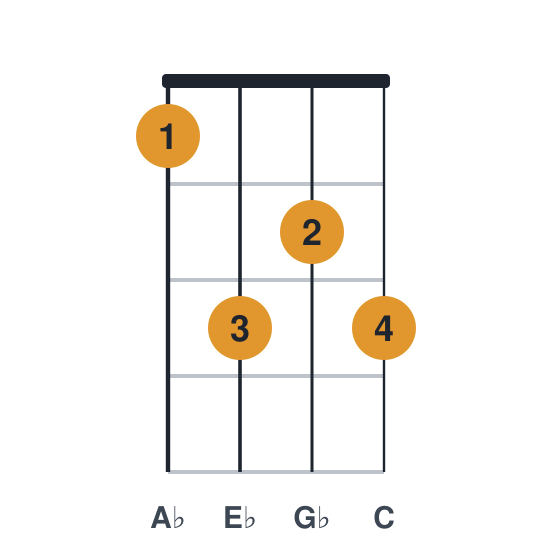
- Ab7another chord built to push forward
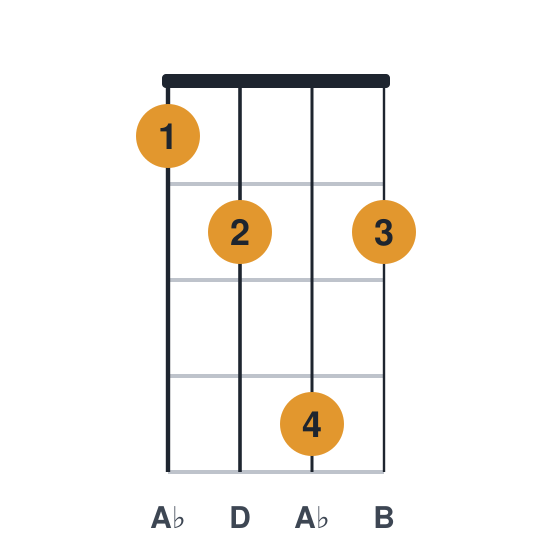
- Abdimthe other chord built out of equal intervals


Other Ab chords
Abaug ukulele chord chart (1003) from melodician.com