Abmaj7 Ukulele Chord
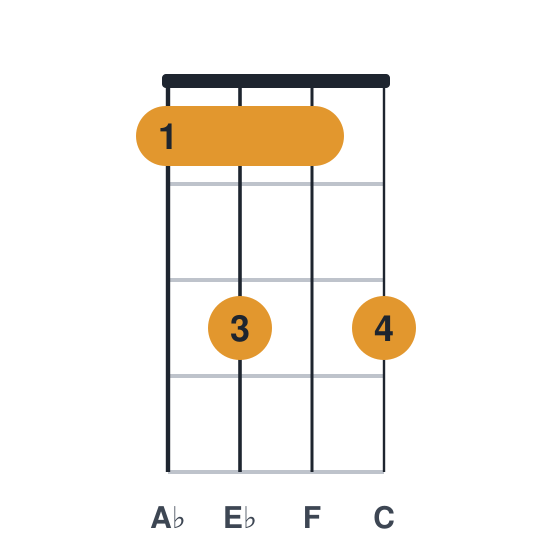
Abmaj7 is the A flat major seventh chord. It has four notes: A flat, C, E flat and G. The standard shape roots it at the 1st fret of the G string with three fingers in a row across the 3rd fret, no barre and nothing open.

Root at the 1st fret of the G string with middle, ring and pinky in a row across the 3rd. Movable: the grip plays any maj7 chord.
How to play Abmaj7 on ukulele, step by step
- Index finger: 1st fret, G string
- Middle finger: 3rd fret, C string
- Ring finger: 3rd fret, E string
- Pinky finger: 3rd fret, A string
- Strum all four strings.
Nothing in this shape rings open, so the whole grip slides: moved up three frets it becomes the 4666 Bmaj7. If three separate fingers feel crowded at the 3rd fret, laying the ring finger flat across all three works just as well.
More ways to play Abmaj7
There are 3 common Abmaj7 shapes: the standard one at the top of the page, plus these further up the neck. You only ever need one. Tap any card to hear it.

Airy and surprising: two open strings carry the colour notes while the fretted pair anchors the chord.

High and glassy, the open seventh humming beneath the fretted voices.
If it sounds squeezed
- Three fingers crowd the 3rd fret
- Middle, ring and pinky share one fret on neighbouring strings. Stagger them in a diagonal so each tip lands its own string, or swap to a flat ring finger across all three.
- The root buzzes at the 1st fret
- The index on the G string sits closest to the nut, where strings fight back hardest. Move it snug behind the fret wire and press with the very tip.
- One string inside the row is silent
- Pick the C, E and A strings one at a time. The middle string of a three finger row is the usual casualty; re-arch whichever finger has folded flat.
What makes it an Abmaj7
A♭ · C · E♭ · G 1 3 5 7
Abmaj7 is a major seventh chord: an A flat major triad (A flat, C, E flat) plus a major seventh (G). The G presses gently up against the root a half step away, and that tension without urgency is the maj7 signature.
Abmaj7 is the I chord of A flat major and the IV chord of E flat major. Those flat keys belong to piano, horns and voices more than to open strings, so a ukulele reaches them with movable grips exactly like the one this page leads with.
Ab vs Abmaj7
A flat major is 1343 and Abmaj7 is 1333: the E string note drops one fret, and the doubled root becomes a G. One finger, one fret, and the chord stops landing and starts hovering.
The plain chord suits marches and strong cadences; the maj7 suits the slow soul and gospel writing that actually lives in A flat. When a chart in this key says maj7, this softness is the point.
Abmaj7 chord questions
Are Abmaj7 and G#maj7 the same chord?
Yes, the same pitches spelled from different letters. Charts nearly always write Abmaj7, since A flat is a working key and G sharp major is a spelling headache.
Is Abmaj7 hard to play on ukulele?
Middling. Four fingers with three sharing a fret takes a moment to organise, but there is no barre and no stretch beyond the 3rd fret.
Is the Abmaj7 shape movable?
Yes. 1333 has no open strings, so the same grip plays every major seventh chord: three frets up it is Bmaj7, five up it is C#maj7.
What is the difference between Abmaj7 and Ab7?
The seventh. Ab7 uses G flat and drives toward D flat like a blues chord; Abmaj7 uses G natural and rests in place. They share a root and little else about their mood.
What keys use Abmaj7?
It is the I chord of A flat major and the IV chord of E flat major, both staples of jazz, soul and gospel.
Chords to learn next
- Abthe plain major
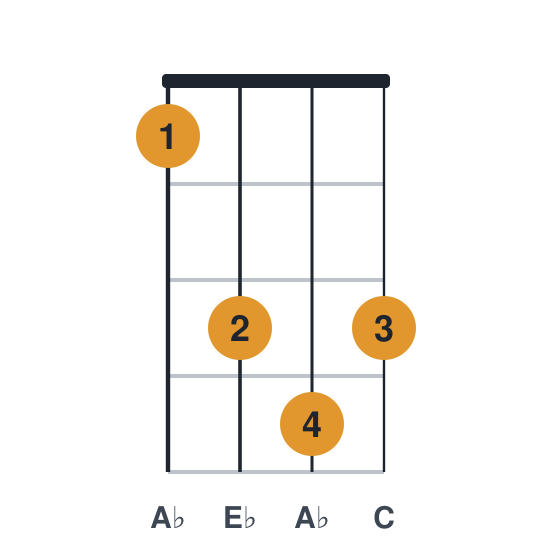
- Bbm7the ii chord beside Abmaj7 in the key of Ab
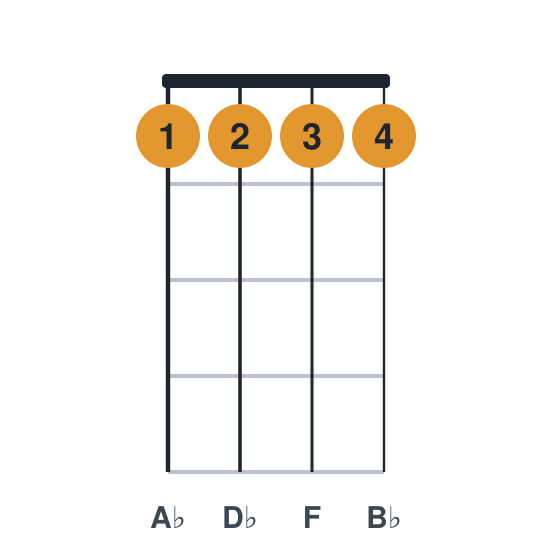
- Eb7the V chord of Ab
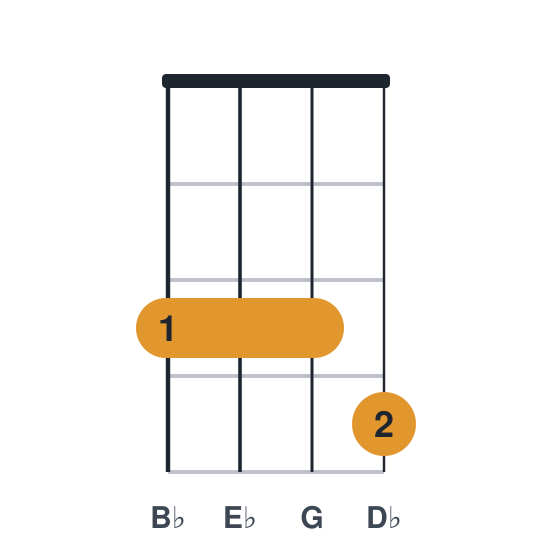
- Ab6the other soft colour on the same major


Other Ab chords
Abmaj7 ukulele chord chart (1333) from melodician.com