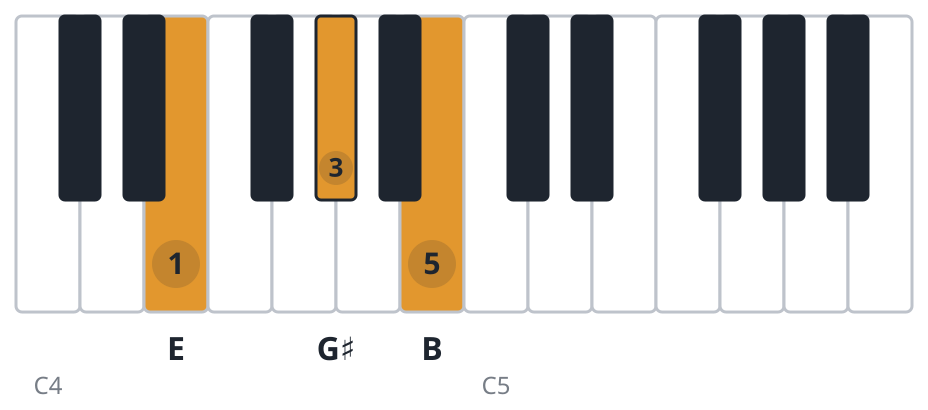
Em7 Piano Chord
Em7 is the E minor seventh chord. It has four notes: E, G, B and D. All four are white keys, and the chord is one of the most relaxed sounds on the instrument.

E at the bottom, then G and B and D. Right hand 1-2-3-5, left hand 5-3-2-1. Every key here is white.
How to play Em7 on piano, step by step
- Start on the E above middle C. That is the lowest note of the chord.
- Thumb (1): E
- Index finger (2): G
- Middle finger (3): B
- Little finger (5): D
- Press them together with the right hand. The left hand plays the same notes with fingers 5, 3, 2, 1 an octave lower, or just E on its own as a bass note.
Em7 and G major share three notes: G, B and D. That overlap is why the two chords sit so comfortably next to each other and why songs in G lean on Em7 so heavily.
Inversions of Em7
The same 4 notes with a different one at the bottom. All of them are Em7; which you play depends on what the hand is coming from. Tap any card to hear it.


If it sounds wrong
- The top note is D sharp
- It has to be D natural. The flat seventh is what makes this a minor seventh rather than a much tenser chord.
- The chord sits too low
- Root position Em7 starts below middle C, where four notes turn muddy. The first inversion, G B D E, puts them higher.
- One note is missing
- With four white keys in a row of skips it is easy to leave a finger resting without pressing. Play them one at a time to find the gap.
What makes it an Em7
E · G · B · D 1 ♭3 5 ♭7
Em7 is an E minor triad, E G B, with a D added on top: the flat seventh.
It is the ii chord of D and the vi of G. It also shares three of its four notes with G major, which is why the two chords can often stand in for one another.
Em7 vs Em
Em7 is E minor with a D on top. E minor is plain; Em7 is warmer and less final.
Both are all white key chords, so the change costs nothing under the hand. In most pop songs either one works where the chart says E minor.
Em7 in major keys
Every note of Em7 sits inside these keys. See how it works alongside the other chords in each one.
Questions about Em7
Which notes are in an Em7 chord on piano?
E, G, B and D. All four are white keys.
What fingers do you use for Em7?
Right hand: thumb on E, index on G, middle on B, little finger on D. Left hand: 5, 3, 2, 1.
What is the difference between Em7 and G?
They share G, B and D. Em7 adds an E below them, which changes the chord's centre from G to E even though only one note is different.
Is Em7 easy to play?
Yes. Four white keys and an even shape, and it is one of the three minor sevenths that use no black keys.
Where is the Em7 chord used?
As the ii chord in D and the vi in G. It is very common in folk, pop and soul.
Chords to learn next
- Emthe same chord without the seventh
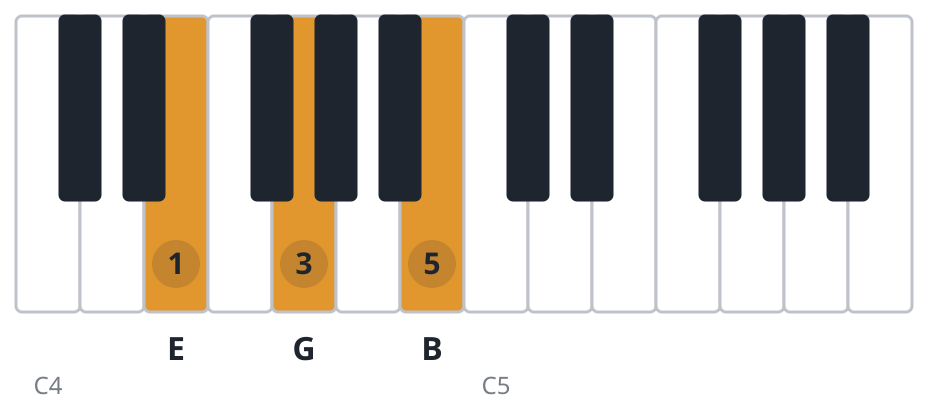
- B7the V chord that resolves to E minor
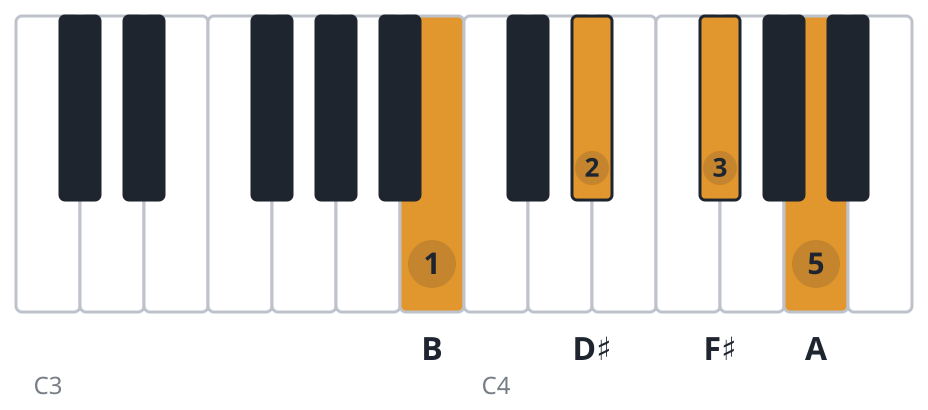
- A7partner in the ii V of D major
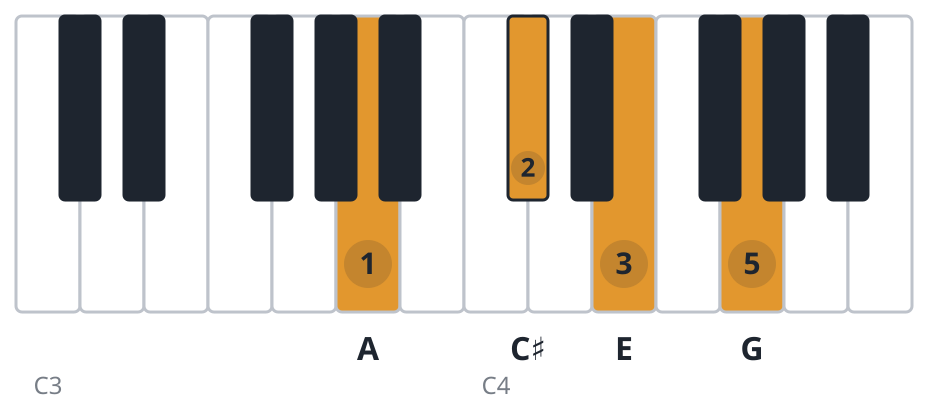
- Ethe major on the same root