E Piano Chord
E major is the E piano chord. It has three notes: E, G sharp and B. The middle note is a black key, with white keys either side of it.

E at the bottom, then G♯ and B. Right hand 1-3-5, left hand 5-3-1. The black key is G♯.
How to play E on piano, step by step
- Start on the E above middle C. That is the lowest note of the chord.
- Thumb (1): E
- Middle finger (3): G♯
- Little finger (5): B
- Press them together with the right hand. The left hand plays the same notes with fingers 5, 3, 1 an octave lower, or just E on its own as a bass note.
E, A and D majors share the same white, black, white layout. If one of them is comfortable, the other two need no new hand shape, only a new starting key.
Inversions of E
The same 3 notes with a different one at the bottom. All of them are E; which you play depends on what the hand is coming from. Tap any card to hear it.


If it sounds wrong
- The chord sounds sad
- The middle note is G sharp, the black key to the right of G. Playing G natural turns it into E minor.
- The hand feels twisted
- The middle finger has to reach further into the keyboard than the other two. Move the whole hand forward rather than stretching one finger back.
- The notes do not sound together
- Practise dropping the shape from a couple of inches above the keys. Aiming the hand as one unit is more reliable than placing three fingers in turn.
What makes it an E
E · G♯ · B 1 3 5
E major is the first, third and fifth notes of the E major scale: E, G sharp and B. G sharp is the note that makes it major; without it the chord would be E minor.
It is the I chord of E major, the IV of B and the V of A. In guitar based music it appears constantly, since E is the instrument's home key, so pianists meet it far more often than the four sharps in its key signature would suggest.
E vs Em
The middle note moves one key down, from the black G sharp to the white G. That turns E major into E minor, which is one of the most used minor chords in popular music.
E minor is easier under the hand, being all white keys. Rocking the middle finger between G and G sharp while the outer fingers stay put is a good five second exercise in what major and minor mean.
E in major keys
Every note of E sits inside these keys. See how it works alongside the other chords in each one.
Questions about E
Which notes are in an E chord on piano?
E, G sharp and B. G sharp is the black key just to the right of G; E and B are white.
What fingers do you use for an E chord?
Right hand: thumb on E, middle finger on G sharp, little finger on B. Left hand: little finger on E, middle on G sharp, thumb on B.
What is the difference between E and Em?
One key. E major uses G sharp, E minor uses G. That black key is the only difference, and it decides whether the chord sounds bright or sad.
Is the E chord hard on piano?
No. It is the same white, black, white shape as A and D major, and nothing in it stretches beyond a fifth.
Where is the E chord used?
As the I chord in E, the IV in B and the V in A. It is everywhere in rock and blues, where E is the guitar's home key.
Chords to learn next
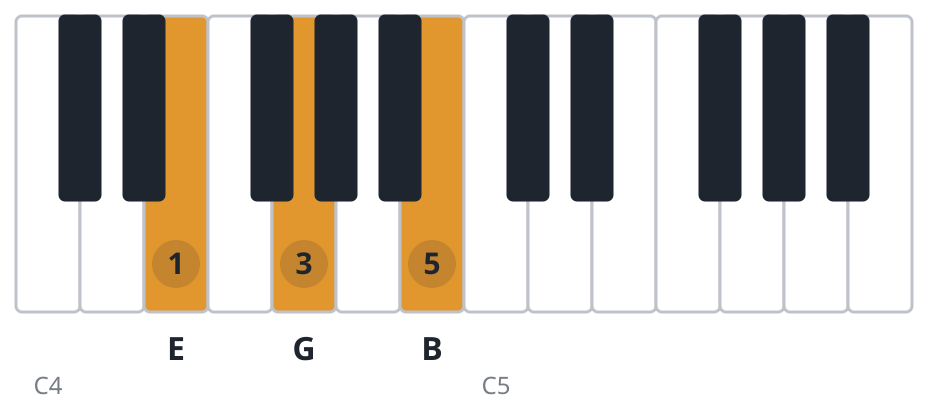
- Emthe minor version of E, one note lower in the middle
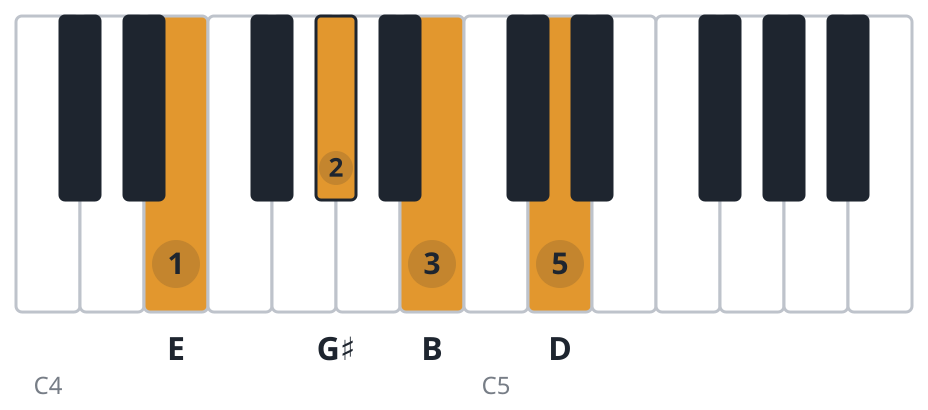
- E7E with a seventh added, the chord that pushes to A
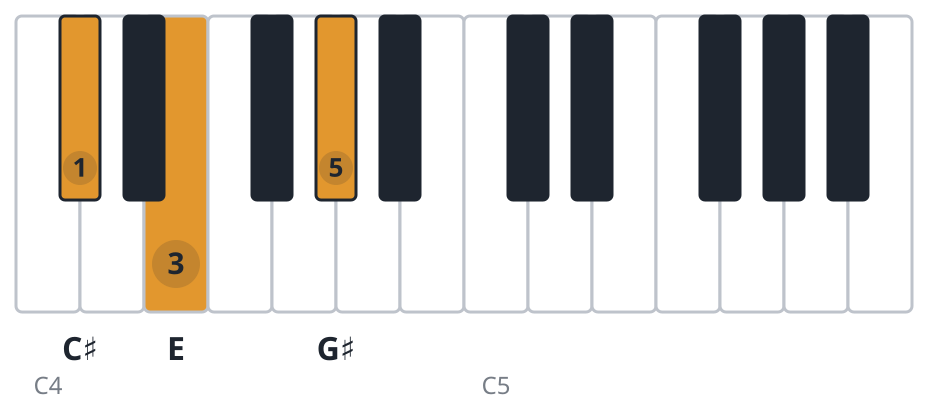
- C#mthe relative minor of E, the same key signature
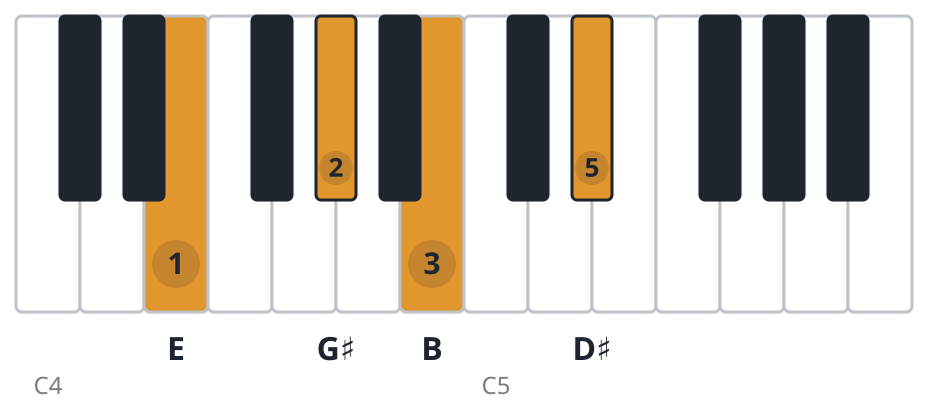
- Emaj7the soft version of the same chord