G7 Piano Chord
G7 is the G dominant seventh chord. It has four notes: G, B, D and F. Every one of them is a white key, which makes it the easiest seventh chord on the piano.

G at the bottom, then B and D and F. Right hand 1-2-3-5, left hand 5-3-2-1. Every key here is white.
How to play G7 on piano, step by step
- Start on the G below middle C. That is the lowest note of the chord.
- Thumb (1): G
- Index finger (2): B
- Middle finger (3): D
- Little finger (5): F
- Press them together with the right hand. The left hand plays the same notes with fingers 5, 3, 2, 1 an octave lower, or just G on its own as a bass note.
Four fingers, four white keys, no gaps to think about beyond the usual skip-a-key pattern. If you can play G major, this is that chord with the fourth finger position added on top.
Inversions of G7
The same 4 notes with a different one at the bottom. All of them are G7; which you play depends on what the hand is coming from. Tap any card to hear it.


If it sounds wrong
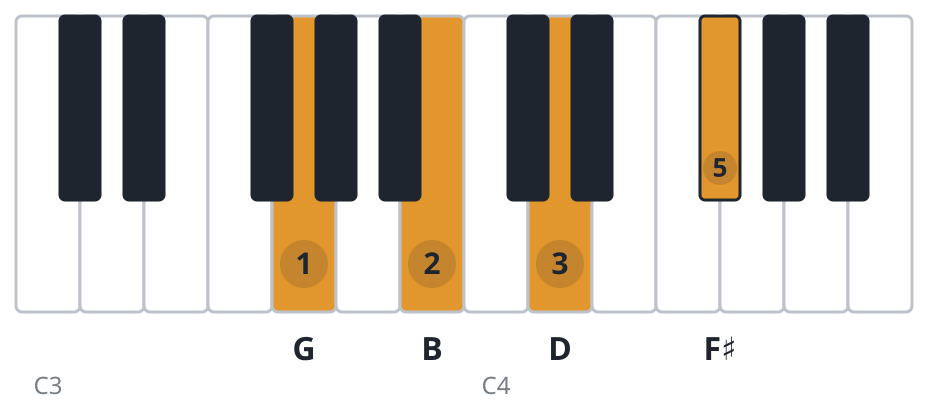
- The top note is F sharp
- It has to be F natural. F sharp would make Gmaj7, which sounds settled instead of restless. The flat seventh is the whole point of this chord.
- The middle fingers are uneven
- Four notes means fingers 2 and 3 are both working, and they are different lengths. Keep the knuckles level and drop the hand as one unit.
- The chord sounds thick
- Four notes low on the keyboard can turn muddy. Try the first inversion, B D F G, which spreads the same chord higher up.
What makes it a G7
G · B · D · F 1 3 5 ♭7
G7 is a G major triad, G B D, with an F added on top: the flat seventh. That F sits a half step below the G above it, and the resulting friction is what makes the chord sound unfinished.
It is the V7 of C, which is the most common job any chord has. G7 pulls toward C harder than plain G does, because the F wants to fall to E and the B wants to rise to C. Play G7 then C and you can hear both notes move.
G7 vs G
G7 is G major with one more note. G on its own is a resting chord; G7 is a chord that wants to move, and in the key of C it always wants to move to the same place.
That is why so many songs end with G7 to C rather than G to C. The seventh sharpens the pull without changing the chord's job.
G7 in major keys
Every note of G7 sits inside these keys. See how it works alongside the other chords in each one.
Questions about G7
Which notes are in a G7 chord on piano?
G, B, D and F. All four are white keys.
What fingers do you use for G7?
Right hand: thumb on G, index on B, middle on D, little finger on F, which is 1, 2, 3 and 5. Left hand reverses it: 5, 3, 2, 1.
What is the difference between G7 and Gmaj7?
One key. G7 has F natural and sounds restless; Gmaj7 has F sharp and sounds settled. They are a half step apart and opposite in mood.
Why does G7 lead to C?
Two of its notes pull there. The B wants to rise to C and the F wants to fall to E, and both of those are in a C chord. Playing G7 then C resolves both at once.
Is G7 hard on piano?
It is the easiest seventh chord there is: four white keys and a shape that fits the hand without stretching.
Chords to learn next
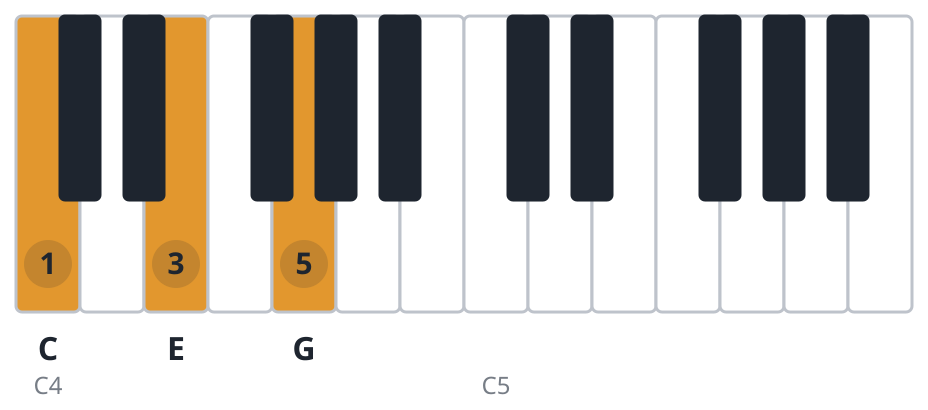
- CG7 resolves here
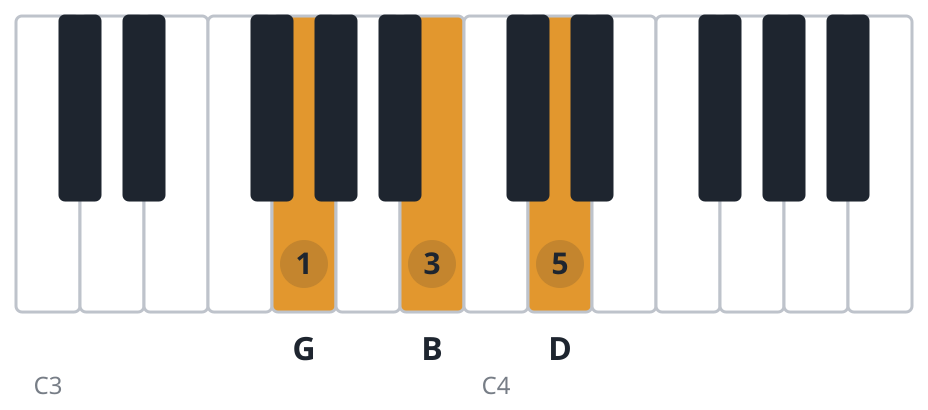
- Gthe plain major underneath it
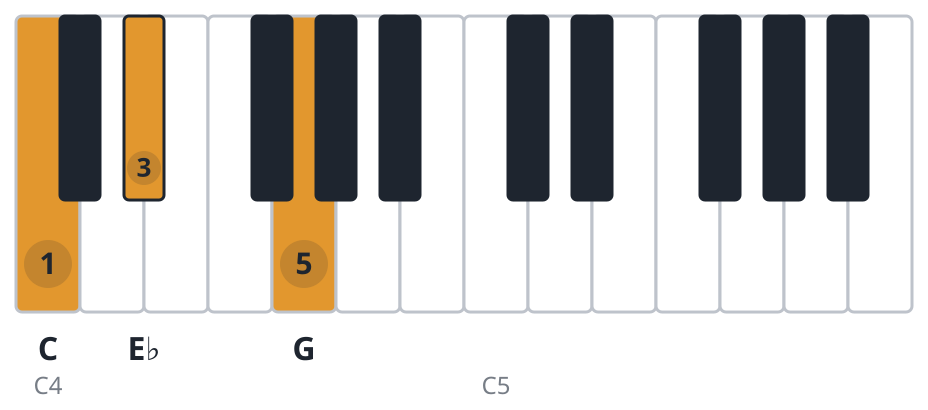
- CmG7 leads to the minor of C too
- Gmaj7the other seventh on this root, and a different mood