C#add9 Piano Chord
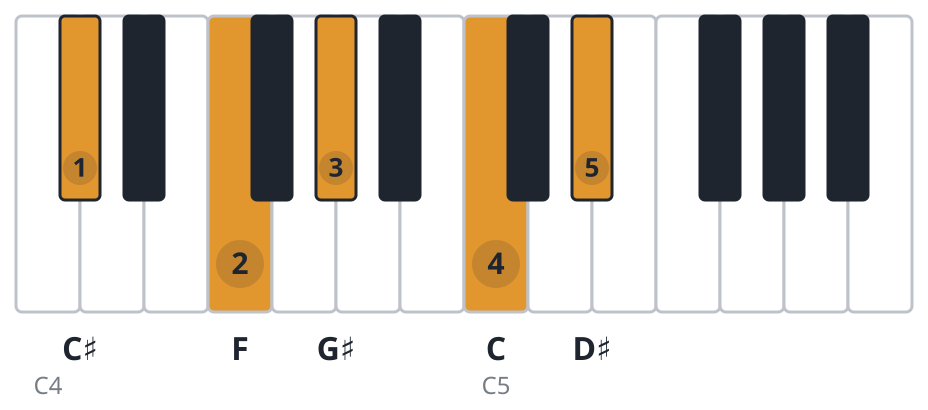
C#add9 is the C sharp added ninth chord on piano. It has four notes: C sharp, F, G sharp and D sharp, with the D sharp a ninth above the root. Three black keys frame one white one, and the shape reaches past the octave.

C sharp at the bottom, F and G sharp in the middle, D sharp on top a ninth above the root. The left hand takes the root when the span is too wide.
How to play C#add9 on piano, step by step
- Start on the C♯ above middle C. That is the lowest note of the chord.
- Thumb (1): C♯
- Index finger (2): F
- Middle finger (3): G♯
- Little finger (5): D♯
- That reach is wider than an octave, so most players split it: play C♯ with the left hand and the other notes with the right. If you keep it in one hand, use the two-hand split shown on this page. Leaving out the fifth (G♯) can thin the sound, but it does not shorten the span from the root to the ninth.
To keep it in one hand, fold the D sharp down beside the root: C sharp, D sharp, F, G sharp. Charts write that as C#add2; it is the same colour inside one octave.
If it sounds wrong
- The ninth is out of reach
- C sharp up to D sharp is a ninth. Take the root in the left hand and play F, G sharp and D sharp in the right; the sound does not change.
- The F feels out of place
- It is the one white key in the shape, sitting lower than its black neighbours. Curl the index finger a little more so the other notes stay seated while it reaches down.
- The chord blurs
- Keep the D sharp above the G sharp. Voiced in the middle it clouds the chord; on top it turns to shimmer.
What makes it a C#add9
C♯ · F · G♯ · D♯ 1 3 5 9
C#add9 is a C sharp major triad (C sharp, F, G sharp) with a ninth added: D sharp, the second note of the C sharp scale played an octave higher. Strictly the third is E sharp, the same key as F, and charts print F because that is the name on the key. The third stays in the chord, so the major colour holds.
The added D sharp belongs to C sharp major and to G sharp major territory; in flat spelling, D flat and A flat, the piano keys where this chord usually appears. R&B and pop ballads in D flat use this exact colour where the plain chord would sit too still.
C#add9 vs C#sus2
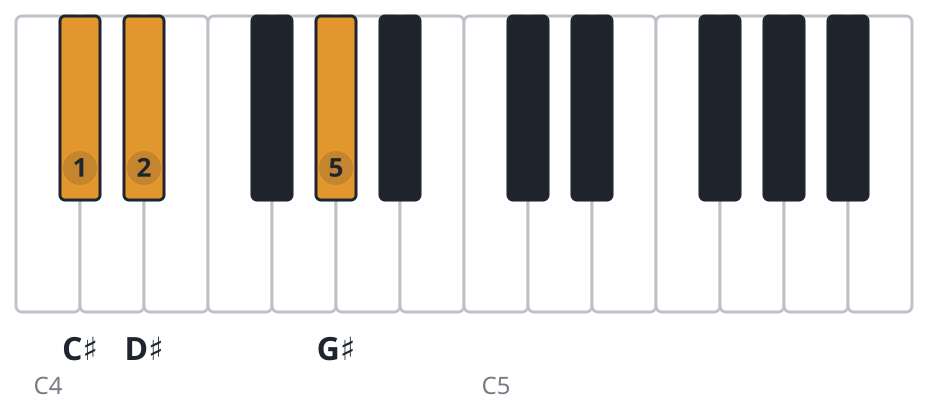
Both chords add a D sharp to C sharp. C#sus2 removes the third to make room and turns ambiguous; C#add9 keeps the third and raises the D sharp a ninth, so the chord stays major with light on it.
Play C sharp, D sharp, G sharp and then the full C#add9. The sus2 hovers; the add9 lands and glows. The held third makes the difference.
C#add9 in major keys
Every note of C#add9 sits inside these keys. See how it works alongside the other chords in each one.
Questions about C#add9
Is C#add9 the same as Dbadd9?
Yes, one chord with two spellings. Songs in flat keys write D flat; this page uses C sharp because that is the name people search for.
Why does the chart say F instead of E sharp?
The third of C sharp is strictly E sharp, and E sharp is the same key as F. Chord charts print the name that is on the keyboard, so this page does too.
What is the difference between C#add9 and C#add2?
The same four note names. Add2 keeps the D sharp inside the octave next to the root; add9 lifts it above the chord. Two names for one colour.
What is the difference between C#add9 and C#9?
C#9 also contains the flat seventh, B natural, and pulls toward F sharp like any dominant chord. C#add9 has no seventh; it is a brightened major chord.
Why does this page show no inversions?
This page teaches one practical root-position voicing because a ninth spans more than an octave. Ninth chords can still be inverted: an inversion changes the bass note, and players often reorder or omit notes to fit the hand. The diagrams here keep the beginner-friendly voicing visible.
Chords to learn next
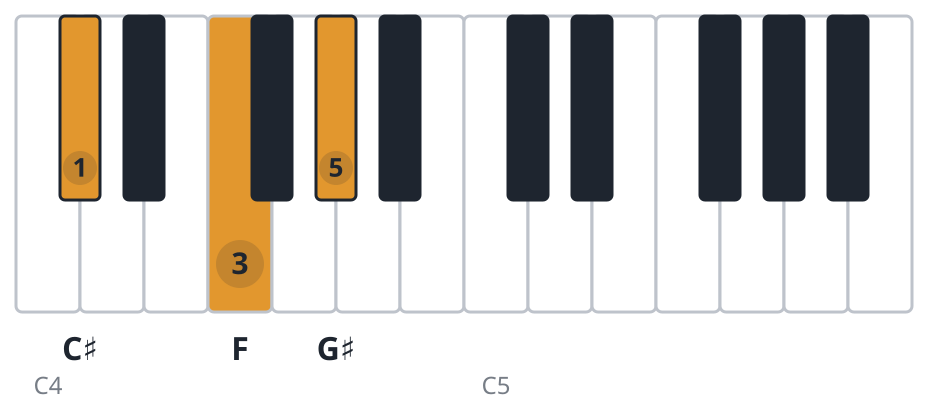
- C#the plain major
- C#sus2the 9 without the 3
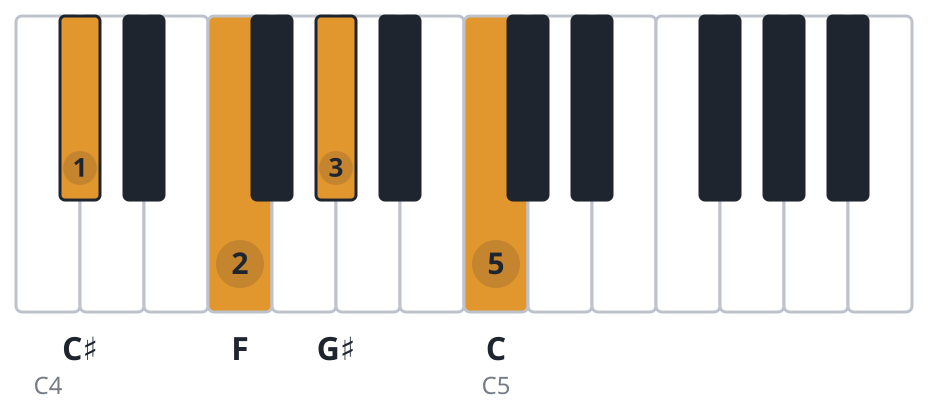
- C#maj7another colour on the same major
- C#maj9the same ninth with the seventh under it