Bbaug Guitar Chord
Bbaug is the B flat augmented chord. It has three notes: B♭, D and F♯. There is no practical open shape, so both voicings here live higher up the neck on four strings. That is normal for this chord: it is a brief passing sound, and a compact grip is all it needs.

The Daug grip planted at fret 8: index anchors the root on the D string, ring and pinky pair up three frets higher, middle fills in on the high E. The stretch is easier up here where the frets are narrow.
How to play Bbaug, step by step
- Index finger: 8th fret, D string
- Middle finger: 10th fret, high E string
- Ring finger: 11th fret, G string
- Pinky finger: 11th fret, B string
- Strum from the D string down, skipping the two lowest strings.
Once this grip feels stable, remember that augmented chords repeat every four frets: the same shape at fret 4 or fret 12 spells the same three notes. One grip covers the whole neck.
More ways to play Bbaug
There are 2 common Bbaug shapes in total: the standard one at the top of the page, plus these, easiest first. You only ever need one. Tap any card to hear it.

Rounder and more packed together than the standard shape, with the notes sitting close.
If strings buzz or go dead
- D string buzzes under the index
- The index reaches three frets behind the other fingers, so it tends to lie flat. Drop your thumb behind the neck and press with the fingertip.
- High E dies under the middle finger
- The middle finger sits a fret below the ring and pinky pair and gets squeezed. Curl it so it comes down steeply on the string.
- The two bass strings ring
- Neither belongs in the chord. Aim the strum at the D string, and let the tip of the index brush the A string to keep it quiet.
What makes it a Bbaug
B♭ · D · F♯ 1 3 ♯5
Bbaug is an augmented triad: a B flat major chord with the fifth raised a half step, so F becomes F♯. That single sharpened note turns a settled chord into one that leans forward. The F♯ sits a half step below G, and the ear expects it to climb, which is why Bbaug works as motion rather than as a resting place.
In real songs Bbaug usually appears as the V chord of E flat with a raised fifth: Bb to Bbaug to Eb, where the F♯ resolves up to G inside the Eb chord. It also links Bb to Gm, or sits for a beat between Bb and Eb in a turnaround. The triad is perfectly symmetric too: Bbaug, Daug and F♯aug all contain the same three notes.
Bb vs Bbaug
One note separates them: the fifth, F in B flat major, moves up to F♯ in Bbaug. On guitar the difference in effort runs the other way. Bb major usually means a full barre chord, while the standard Bbaug here is a four string grip with no barre at all. Choose Bb for anything the song rests on; reach for Bbaug when you want one bar of upward pull before Eb or Gm.
Bbaug chord questions
Are Bbaug and A#aug the same chord?
Yes. A♯ and B♭ are the same pitch written two ways, so A#aug is the same chord spelled the other way. Guitar charts usually write Bbaug.
Is there an open position Bbaug?
Not a practical one. B♭, D and F♯ do not fall on open strings in a usable way, so Bbaug is played as a compact fretted shape. The four string grips on this page are the standard answer.
What does Bbaug resolve to?
Most often E flat, since Bbaug is the V chord of Eb with a raised fifth. The F♯ rises to G. It can also fall back to plain Bb.
Is Bbaug the same as Daug and F#aug?
They share the same three notes: B♭, D and F♯. Which name a chart uses depends on which note the writer treats as the root. On guitar you can often use one grip for all three.
Why does the same Bbaug shape work every four frets?
The augmented triad divides the octave into three equal major thirds. Move any voicing four frets and you land on the same three notes in a different order, so the grip at frets 8, 12 or 4 is still Bbaug.
Chords to learn next
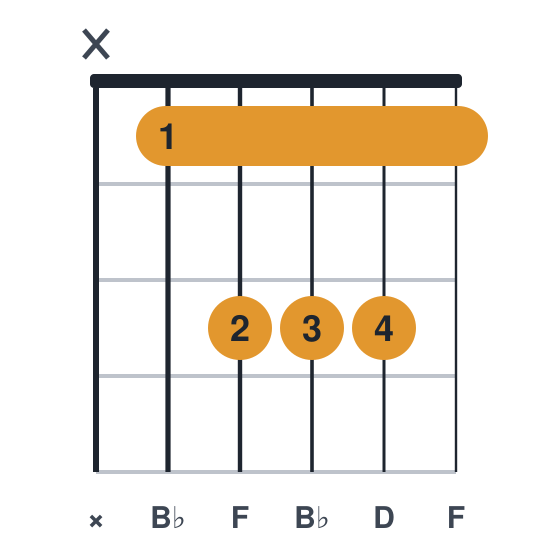
- Bbthe plain major, one note apart
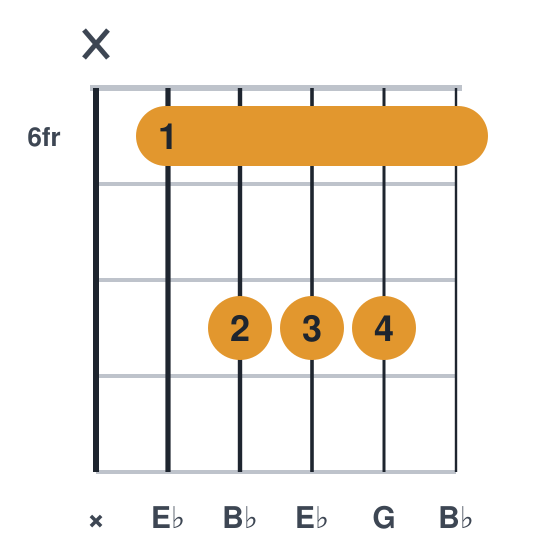
- Ebwhere Bbaug usually resolves
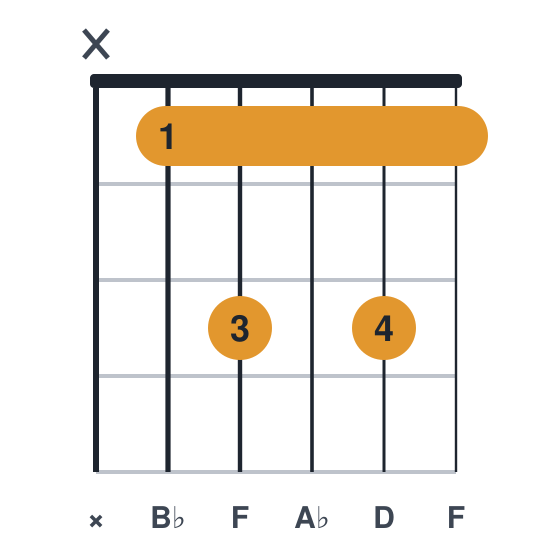
- Bb7another chord built to push forward
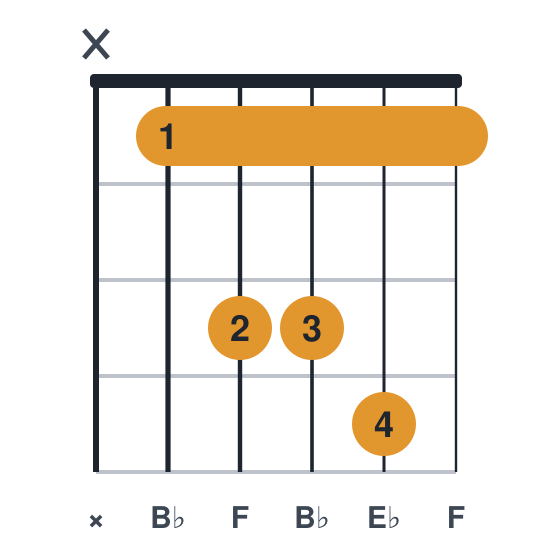
- Bbsus4another color built on the same root, pulling elsewhere


Other Bb chords
Bbaug guitar chord chart (x x 8 11 11 10) from melodician.com