Baug Guitar Chord
Baug is the B augmented chord. It has three notes: B, D♯ and G. Unusually for a B chord, the standard shape is open and needs only three fingers, no barre. That makes Baug easier to play than plain B major, even though you will use it far less often.

Three fingers and two open strings: index and middle sit low on the D and A strings while the ring finger reaches over to the 3rd fret of the high E. No barre anywhere.
How to play Baug, step by step
- Index finger: 1st fret, D string
- Middle finger: 2nd fret, A string
- Ring finger: 3rd fret, high E string
- Leave the G and B strings open. Strum from the A string down, skipping the low E.
The natural next step is B7, which lives in the same corner of the neck and resolves to the same E chord. If you can play Baug, the B7 grip will feel familiar.
More ways to play Baug
There are 2 common Baug shapes in total: the standard one at the top of the page, plus these, easiest first. You only ever need one. Tap any card to hear it.

Tighter and more concentrated than the open shape, all fretted notes and no jangle.
If it will not ring cleanly
- Open G string sounds choked
- The index on the D string is leaning over. Curl it so only its tip touches the D string and the G has room to ring.
- Open B string dies
- The ring finger reaching for the 3rd fret of the high E tends to flatten across the B string. Come down on the fingertip, almost vertical.
- Low E rumbles under the chord
- Start the strum from the A string, or let the middle finger's tip lean back slightly to touch the low E quiet.
What makes it a Baug
B · D♯ · G 1 3 ♯5
Baug is an augmented triad: B major with its fifth pushed up a half step, F♯ becoming G. That raised note gives the chord its unsettled, leaning sound. Because G sits only a half step below G♯ and a half step above F♯, the chord can slide out of itself in either direction, which is exactly how songs use it.
The classic role is the V chord of E with a raised fifth: B to Baug to E, where the G climbs to G♯ inside the E chord. Baug also resolves naturally into E minor, since its G note is already the third of Em. Either way it is a one or two beat chord, a hinge between stable chords rather than a destination.
B vs Baug
Only the fifth changes: F♯ in B major rises to G in Baug. On guitar, though, the two chords feel completely different to play. B major has no easy open shape and usually demands a barre, while Baug sits in open position with three fingers and two ringing open strings. Musically the trade runs the opposite way: B is a workhorse you can stay on, Baug is tension that must move, usually to E or Em.
Baug chord questions
Is Baug easier than B major?
Physically, yes. The standard Baug is an open three finger shape with no barre, while full B major needs a barre. Musically B major is far more common, so you still need both.
What does the plus sign in B+ mean?
B+ is shorthand for B augmented, the same chord as Baug: B, D♯ and G. The plus refers to the raised fifth.
What does Baug resolve to?
Usually E major or E minor. Baug is the V chord of E with a raised fifth, and its G note pulls up to G♯ in E major, or sits still as the third of Em.
Do you strum all six strings in Baug?
No. Skip the low E, it is not part of the chord. Strum from the A string down and let the open G and B strings ring, they are both chord tones.
Which other chords contain the same notes as Baug?
Ebaug and Gaug. An augmented triad is three equal major thirds stacked up, so B, D♯ and G can be named from any of its three notes.
Chords to learn next
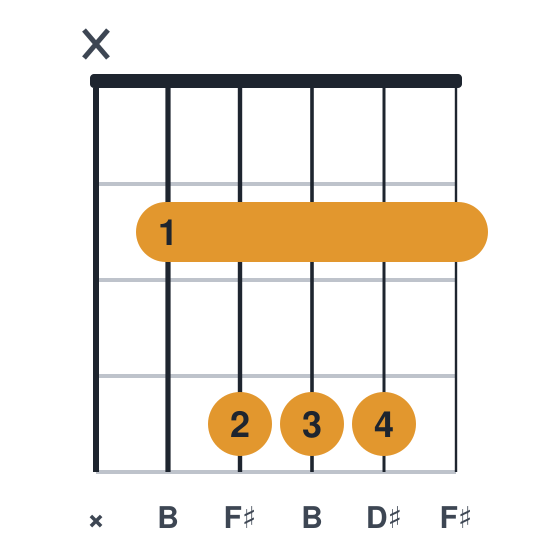
- Bthe plain major, one note apart
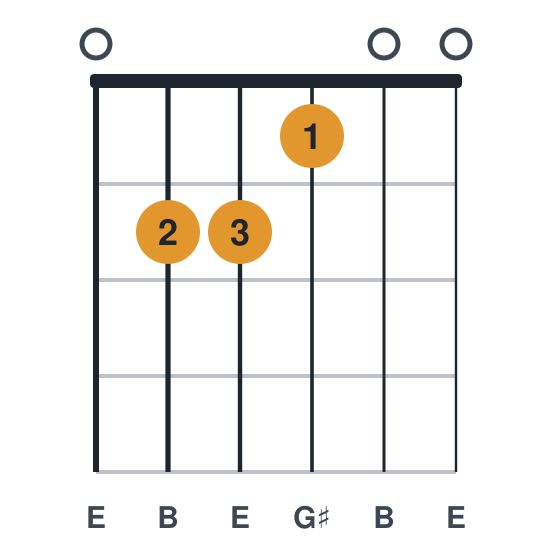
- Ewhere Baug usually resolves
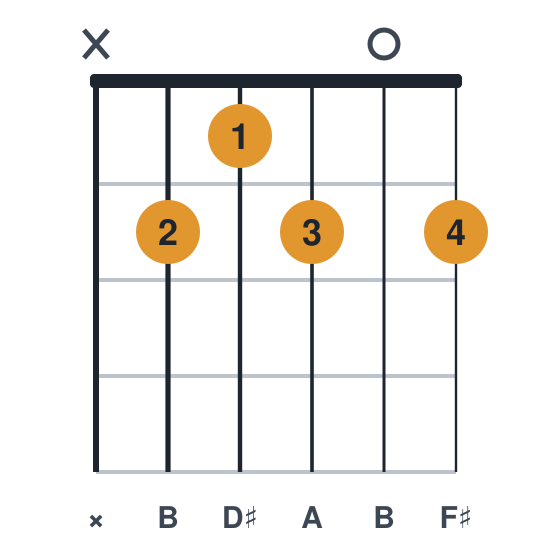
- B7another chord built to push forward
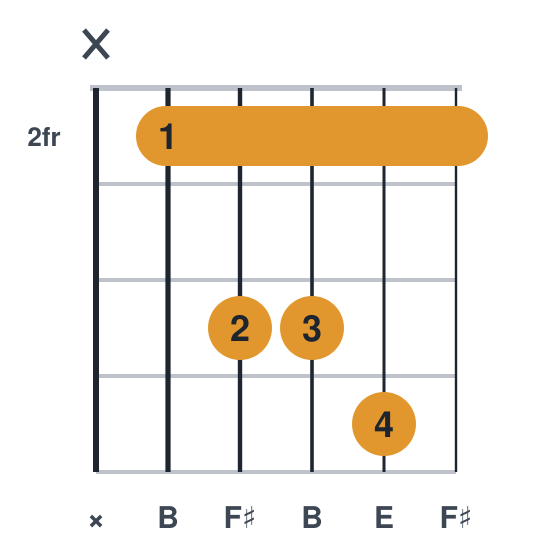
- Bsus4another color built on the same root, pulling elsewhere


Other B chords
Baug guitar chord chart (x21003) from melodician.com