Bm Piano Chord
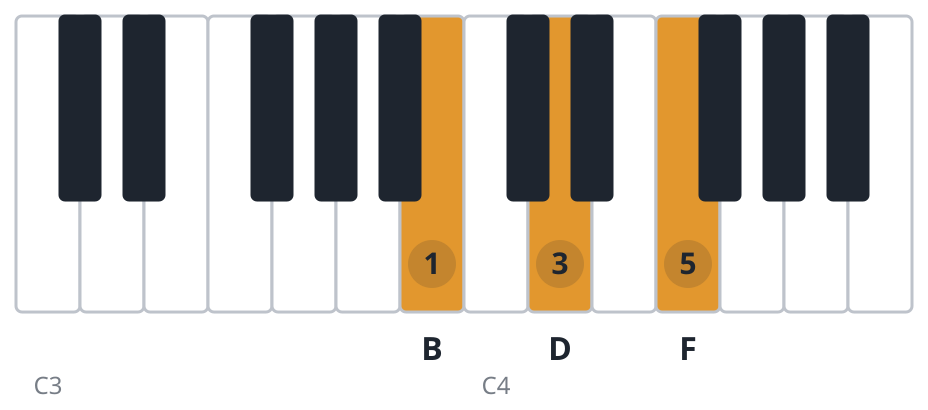
B minor is the Bm piano chord. It has three notes: B, D and F sharp. The top note is a black key and the lower two are white.

B at the bottom, then D and F♯. Right hand 1-3-5, left hand 5-3-1. The black key is F♯.
How to play Bm on piano, step by step
- Start on the B below middle C. That is the lowest note of the chord.
- Thumb (1): B
- Middle finger (3): D
- Little finger (5): F♯
- Press them together with the right hand. The left hand plays the same notes with fingers 5, 3, 1 an octave lower, or just B on its own as a bass note.
Unusually, the black key here is under the little finger rather than the middle one. That takes a little getting used to, since the weakest finger has to reach furthest into the keyboard.
Inversions of Bm
The same 3 notes with a different one at the bottom. All of them are Bm; which you play depends on what the hand is coming from. Tap any card to hear it.


If it sounds wrong
- The top note is missing or wrong
- It is F sharp, the black key to the right of F. If you play F natural the chord becomes B diminished, which sounds tense rather than sad.
- The little finger cannot reach the black key
- Bring the whole hand forward rather than stretching. If the thumb sits at the front of B, the little finger has too far to travel.
- The chord sounds bright
- Check the middle note is D, a white key. D sharp would give you B major.
What makes it a Bm
B · D · F♯ 1 ♭3 5
B minor is the first, flat third and fifth of the B scale: B, D and F sharp. The three half steps from B to D make it minor.
It is the relative minor of D major, the vi chord of D and the ii of A. Those are two of the most common keys in guitar based music, which is why pianists meet B minor so often.
Bm vs B
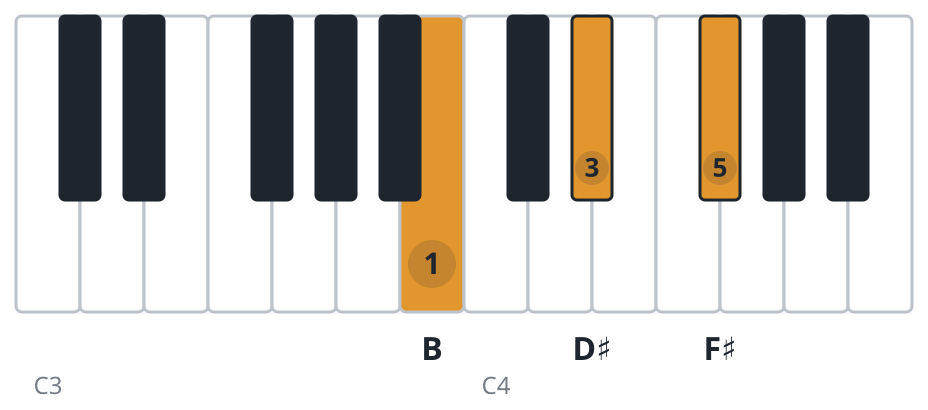
The middle note. B minor has D; B major has D sharp, the black key above it. B major therefore has two black keys and B minor only one.
B minor is the more common of the two in pop, being the relative minor of D. B major usually appears as the V chord in the key of E.
Bm in major keys
Every note of Bm sits inside these keys. See how it works alongside the other chords in each one.
Questions about Bm
Which notes are in a Bm chord on piano?
B, D and F sharp. B and D are white keys; F sharp is black.
What fingers do you use for Bm?
Right hand: thumb on B, middle finger on D, little finger on F sharp. Left hand: little finger on B, middle on D, thumb on F sharp.
What is the difference between Bm and B?
The middle note. B minor uses D, B major uses D sharp. Moving that one finger up onto the black key turns the chord bright.
Is Bm hard on piano?
It is slightly awkward at first because the black key is under the little finger, the weakest one. Moving the hand further into the keyboard solves it.
Where is the Bm chord used?
As the vi chord in D, the ii in A and the iii in G. It is everywhere in guitar led pop and folk.
Chords to learn next
- Bthe major version of Bm
- Bm7a seventh added, which softens the minor
- Dthe relative major of Bm
- Bdimthe fifth lowered as well as the third