Baug Piano Chord
B augmented is the Baug piano chord. It has three notes: B, D sharp and G. It is a B major chord with the fifth raised by one key onto the white key G.

B at the bottom, then D♯ and G. Right hand 1-3-5, left hand 5-3-1. The black key is D♯.
How to play Baug on piano, step by step
- Start on the B below middle C. That is the lowest note of the chord.
- Thumb (1): B
- Middle finger (3): D♯
- Little finger (5): G
- Press them together with the right hand. The left hand plays the same notes with fingers 5, 3, 1 an octave lower, or just B on its own as a bass note.
B major has two black keys; B augmented has one, because the raised fifth lands on G. The augmented chord is the simpler shape of the two.
Inversions of Baug
The same 3 notes with a different one at the bottom. All of them are Baug; which you play depends on what the hand is coming from. Tap any card to hear it.


If it sounds wrong
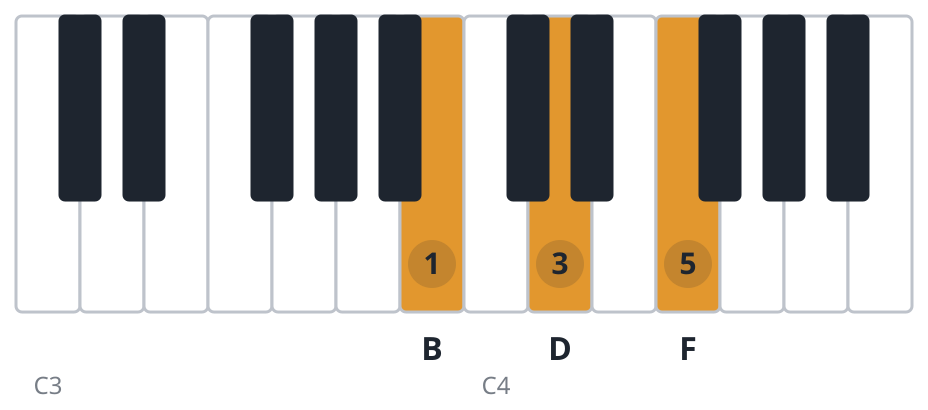
- The top note is F sharp
- That is plain B major. B augmented needs G, the white key above it.
- The middle finger slips
- D sharp is the only black key here, sitting between two white ones. Keep the hand at a middle depth.
- The chord sounds harsh
- It is meant to be unsettled. Follow it with E major and the raised fifth resolves.
What makes it a Baug
B · D♯ · G 1 3 ♯5
B augmented is B, D sharp and G: the root, the third and the sharp fifth. Written strictly the top note is F double sharp, which is the key called G.
It leads from B to E, with the F sharp climbing through G to G sharp. Two major thirds stacked, so it has no home key of its own.
Baug vs B
The top note. B major has F sharp, a black key; B augmented raises it to G, a white one.
That makes B augmented easier to play than B major, which is unusual: the more exotic sounding chord is the simpler shape.
Questions about Baug
Which notes are in Baug on piano?
B, D sharp and G. It is B major with the fifth raised by one key.
What is the difference between Baug and B major?
The top note. B major has a normal fifth; Baug raises it by one key, which makes the chord sound stretched and unsettled instead of finished.
Why do Baug, Ebaug and Gaug contain the same keys?
An augmented chord is two major thirds stacked, and four half steps repeated three times comes back to where it started. That means the same three keys can be named from any of its notes, so Baug, Ebaug and Gaug are one shape with three names.
Where is Baug used?
Almost always as a passing chord. It appears between B major and E major, or under a melody note that is climbing, and it resolves as soon as the raised fifth moves on.
Chords to learn next
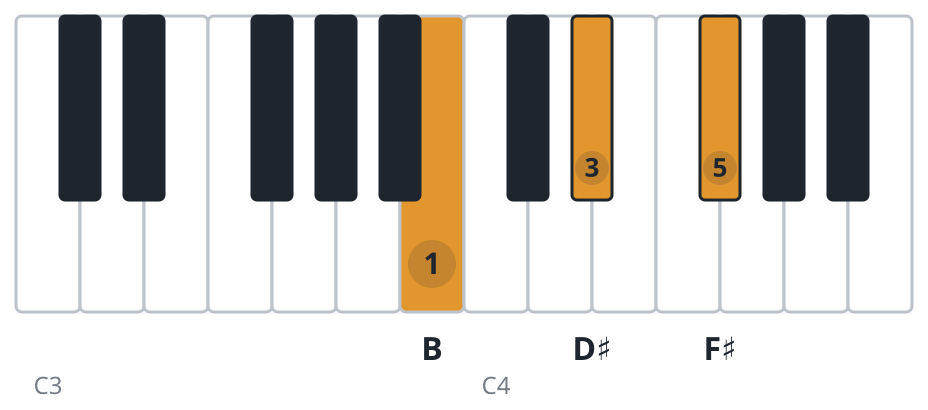
- Bthe plain major, one note apart
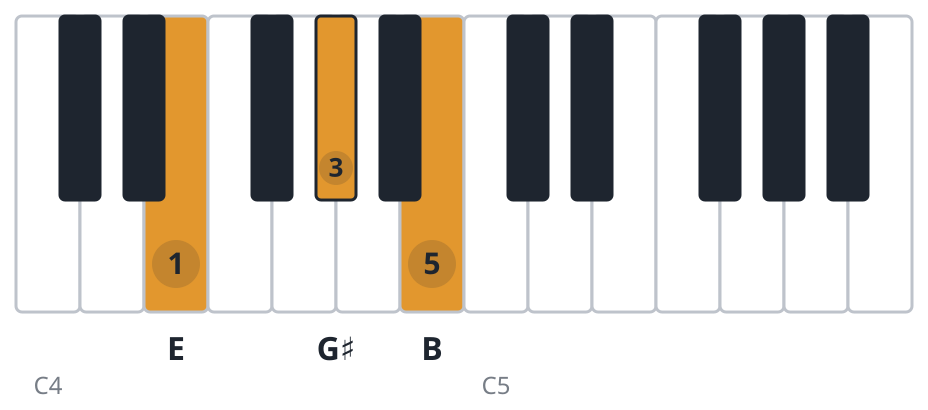
- Ewhere Baug usually resolves
- B7another chord built to push forward
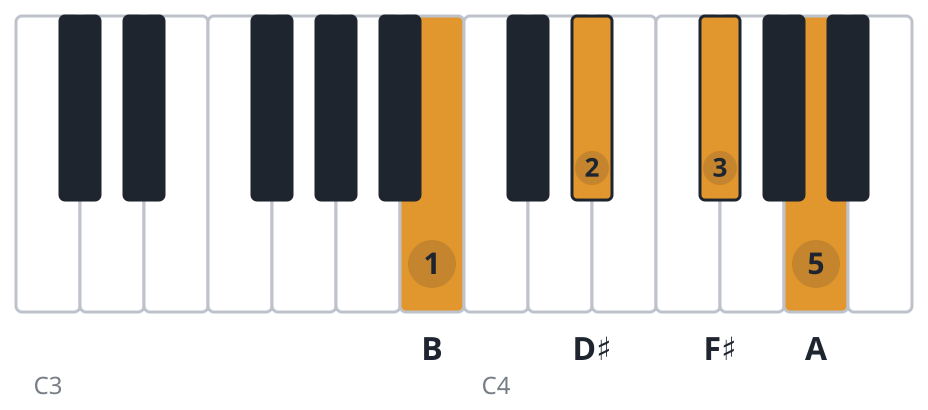
- Bdimthe other chord built out of equal intervals