Bb6 Piano Chord
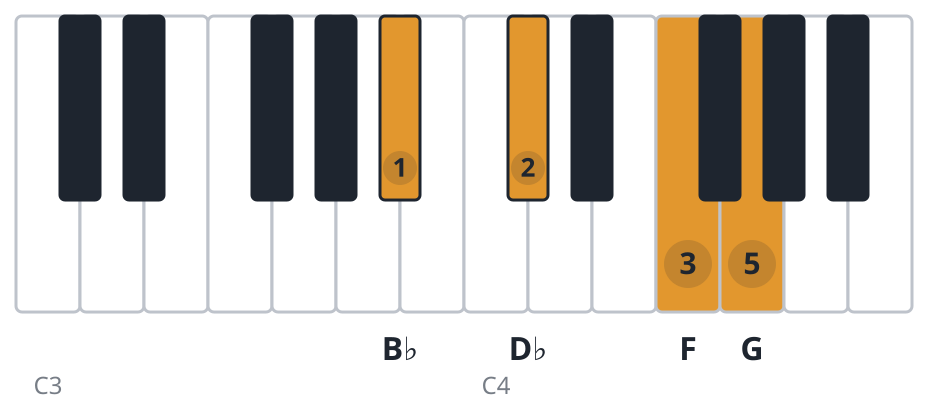
Bb6 is the B flat sixth chord. It has four notes: B flat, D, F and G. Only the B flat itself is a black key; the D, F and G above it are white, so the thumb does the awkward work and the rest of the hand relaxes.

B flat at the bottom under the thumb, then D, F and G, all white. Right hand 1-2-3-5, left hand 5-3-2-1.
How to play Bb6 on piano, step by step
- Start on the B♭ below middle C. That is the lowest note of the chord.
- Thumb (1): B♭
- Index finger (2): D
- Middle finger (3): F
- Little finger (5): G
- Press them together with the right hand. The left hand plays the same notes with fingers 5, 3, 2, 1 an octave lower, or just B♭ on its own as a bass note.
The thumb starts on the black key, B flat, and the other three fingers fall on white keys. Sliding the hand slightly into the keyboard makes the thumb's spot on B flat comfortable instead of a stretch.
Inversions of Bb6
The same 4 notes with a different one at the bottom. All of them are Bb6; which you play depends on what the hand is coming from. Tap any card to hear it.


If it sounds wrong
- The top note landed on A
- One white key too far turns the chord into Bbmaj7, the dreamy version. The sixth is G, the white key one whole step above F.
- It sounds like G minor
- Bb6 and Gm7 are the same four notes. If G ends up at the bottom the chord reads as G minor. Keep B flat lowest, or put a low B flat in the left hand.
- The thumb note is weak
- A thumb on a black key gets less leverage. Move the whole hand a little deeper into the keys so the thumb presses B flat near its edge with the arm behind it.
What makes it a Bb6
B♭ · D · F · G 1 3 5 6
Bb6 is a B flat major triad, B flat, D and F, with a G added: the sixth, a whole step above the fifth. The triad is untouched, so the chord still sounds like B flat major, only warmer and a little vintage.
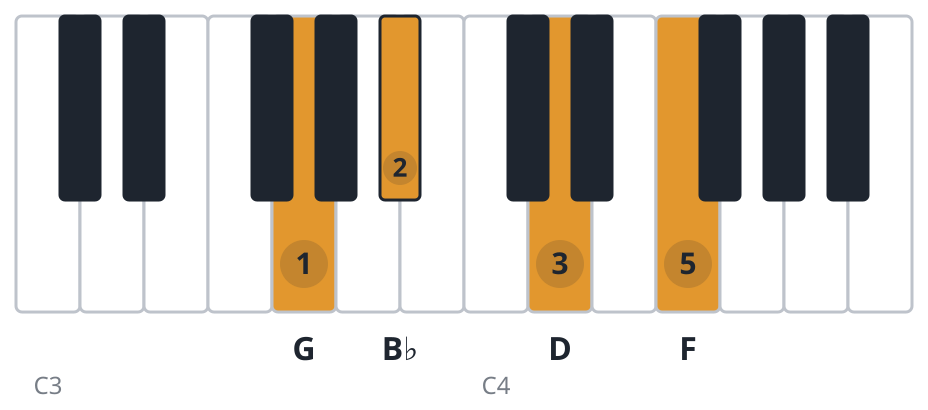
The same four notes read from G spell Gm7, the relative minor seventh. One handful, two names, settled by the bass note. Horn players and pianists trade on this constantly in jazz, where Bb6 is the tonic chord of choice.
Bb6 vs Bbmaj7
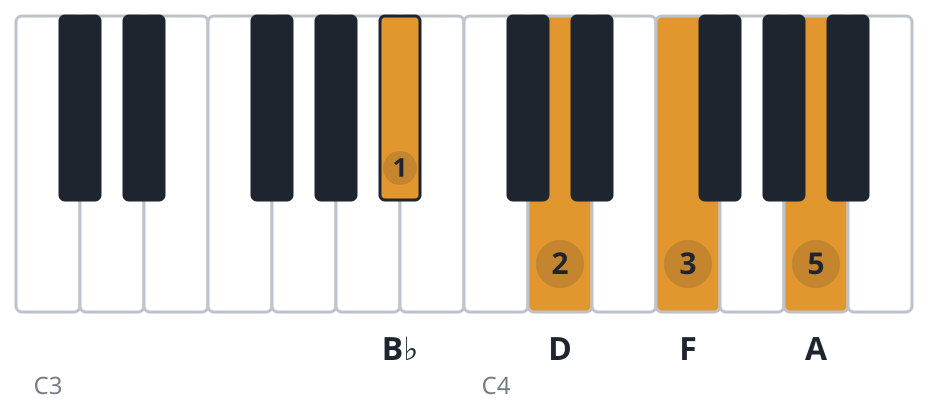
Both dress up B flat major with one white key. Bb6 adds G, a whole step over the F; Bbmaj7 adds A, a half step under the B flat above. G settles the chord; A suspends it.
Hold B flat, D and F, and alternate the top note between G and A. The G version is a big band ending; the A version is a ballad opening. Same triad, opposite temperatures.
Bb6 in major keys
Every note of Bb6 sits inside these keys. See how it works alongside the other chords in each one.
Questions about Bb6
Is Bb6 the same as A#6?
Yes, one chord with two spellings. B flat is the name that appears in real keys and real charts, so it is the spelling used here.
Is Bb6 the same as Gm7?
They contain the same notes: B flat, D, F and G. B flat in the bass makes it Bb6; G in the bass makes it Gm7.
What fingers do you use for Bb6?
Right hand: thumb on B flat, index on D, middle on F, little finger on G, which is 1, 2, 3, 5. Left hand: 5, 3, 2, 1.
What is the difference between Bb6 and Bb7?
Bb6 adds G, a colour note that stays put. Bb7 adds A flat, a flat seventh that pushes toward E flat. The sixth ends phrases; the seventh starts journeys.
When would I use Bb6?
As the tonic chord in jazz and swing tunes in B flat, where ending on the plain triad would sound bare, and under melodies resting on G.
Chords to learn next
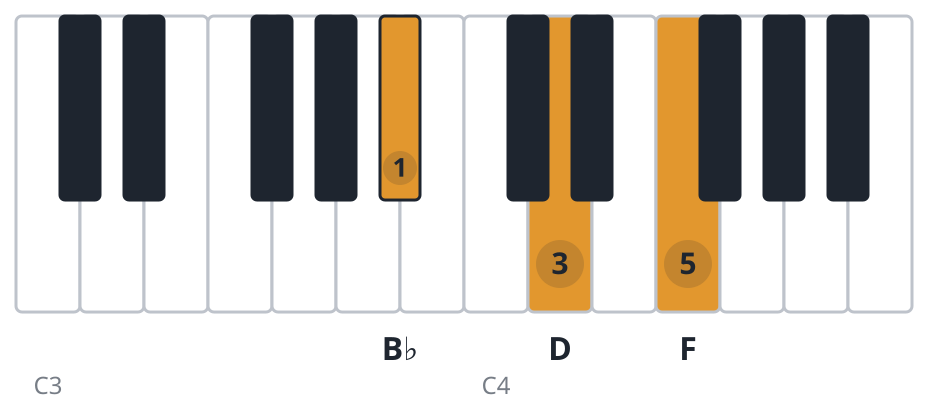
- Bbthe plain major underneath it
- Gm7the same four notes counted from G
- Bbmaj7the other note people add to a major chord
- Bbm6the same sixth over a minor chord