Ebaug Guitar Chord
Ebaug is the E flat augmented chord, also written D#aug. It has three notes: E♭, G and B. Both practical shapes sit low on the neck across four strings, and the standard one asks for a three fret stretch. Like every augmented chord, it is a tension chord: it appears briefly and hands the music to the next chord.

The Daug grip at the very bottom of the neck: index alone at fret 1, ring and pinky paired at fret 4, middle at fret 3 on the high E. The widest version of this stretch you will meet.
How to play Ebaug, step by step
- Index finger: 1st fret, D string
- Middle finger: 3rd fret, high E string
- Ring finger: 4th fret, G string
- Pinky finger: 4th fret, B string
- Strum from the D string down, skipping the two lowest strings.
The stretch from fret 1 to fret 4 is the widest in this book of shapes because the frets are broadest down here. If it fights you, start with the compact shape and come back.
More ways to play Ebaug
There are 2 common Ebaug shapes in total: the standard one at the top of the page, plus these, easiest first. You only ever need one. Tap any card to hear it.

Smoother and more compact, the notes packed close together in the middle of the neck.
If it buzzes or sounds thin
- The E♭ root buzzes at the 1st fret
- The three fret stretch pulls the index flat. Point your thumb down the back of the neck and reach from the wrist, not by splaying the fingers.
- High E chokes under the middle finger
- The middle finger sits below the ring and pinky pair and easily collapses onto its side. Keep the last knuckle bent so it drops straight down.
- A stray bass string rings
- The low E and A strings are not in the chord. Start the strum on the D string and let the index tip lean back to shade the A string.
What makes it an Ebaug
E♭ · G · B 1 3 ♯5
Ebaug is an augmented triad: E flat major with the fifth raised a half step, B♭ becoming B. The whole character of the chord lives in that one note. The B pushes upward toward C, so the chord sounds like a held breath, and progressions treat it that way, giving it a beat or two before moving on.
The natural landing place is A flat major: Ebaug is the V chord of Ab with a raised fifth, and the B resolves up to C, the third of Ab. The same tension resolves beautifully into C minor. Ebaug also shares all three of its notes with Gaug and Baug, a quirk of the augmented triad's perfectly even spacing.
Eb vs Ebaug
The fifth is the whole story: B♭ in E flat major, raised to B in Ebaug. On the instrument, plain Eb usually means a barre chord, while Ebaug is a four string shape with one finger per string. The major chord is the one you build songs on; the augmented version is seasoning, dropped between Eb and Ab, or between Eb and Cm, to make the join chromatic instead of plain.
Ebaug chord questions
Are Ebaug and D#aug the same chord?
Yes. E♭ and D♯ are the same pitch spelled differently, so the two names describe one chord. Flat keys write Ebaug, sharp keys write D#aug.
Is Ebaug hard to play?
Moderately. There is no barre, but the standard shape spans three frets in open position where the frets are widest. The compact shape at fret 4 is kinder to small hands.
What does Ebaug resolve to?
Ab major is the classic resolution, with the raised fifth climbing a half step to C. Falling back to plain Eb works just as well.
What is the difference between Eb and Ebaug?
One half step. Both chords contain E♭ and G; the plain major has B♭ as its fifth, and Ebaug raises it to B.
Which other chords have the same notes as Ebaug?
Gaug and Baug. Every augmented triad is three major thirds stacked evenly, so the same three notes serve three different roots.
Chords to learn next
- Ebthe plain major, one note apart
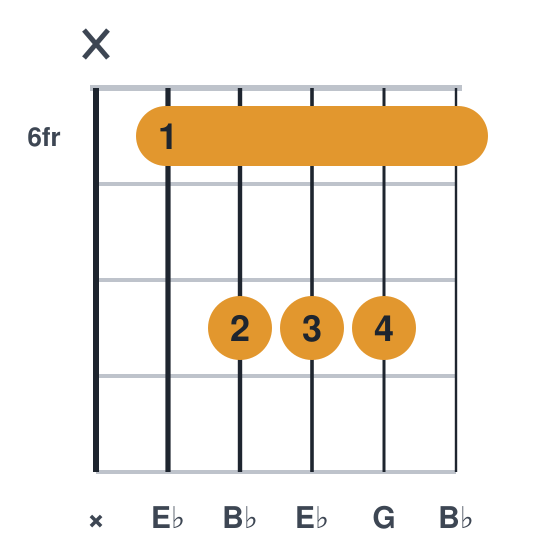
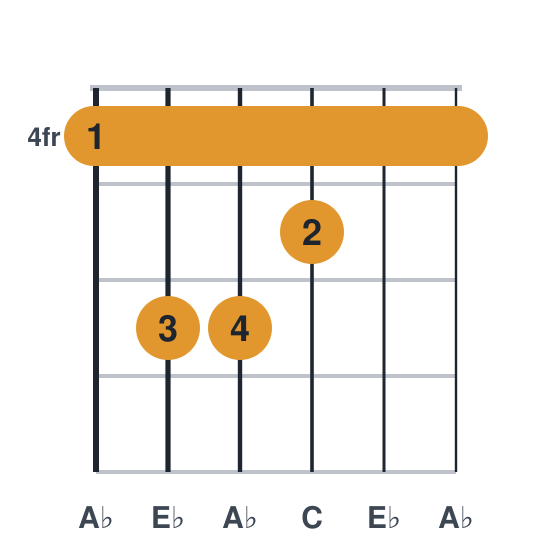
- Abwhere Ebaug usually resolves
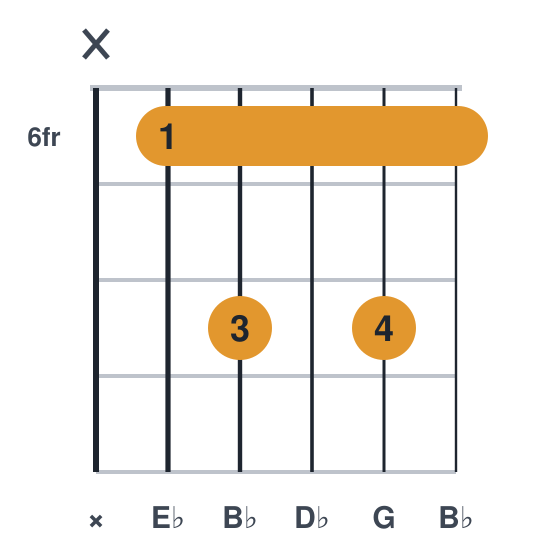
- Eb7another chord built to push forward
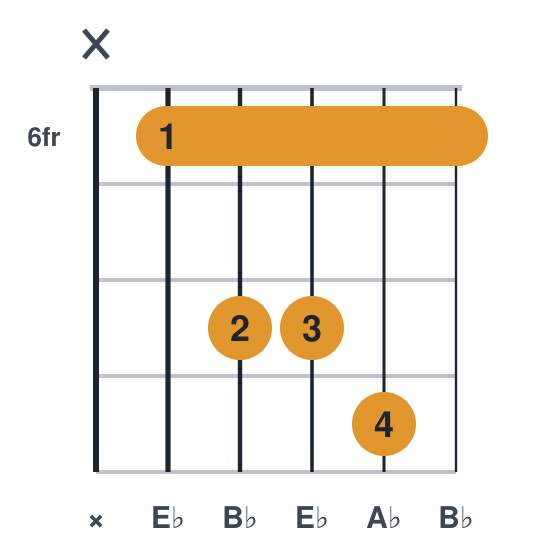
- Ebsus4another color built on the same root, pulling elsewhere


Other Eb chords
Ebaug guitar chord chart (xx1443) from melodician.com