Abaug Guitar Chord
Abaug is the A flat augmented chord, also written G#aug. It has three notes: A♭, C and E. Both voicings here are four string grips in the upper half of the neck, since the chord has no workable open shape. It behaves like every augmented chord: a short, tense visitor between two stable chords.

The Daug grip at fret 6: index alone on the root, ring and pinky side by side at fret 9, middle filling in on the high E. Four frets up or down, the notes repeat.
How to play Abaug, step by step
- Index finger: 6th fret, D string
- Middle finger: 8th fret, high E string
- Ring finger: 9th fret, G string
- Pinky finger: 9th fret, B string
- Strum from the D string down, skipping the two lowest strings.
The same finger pattern two frets lower is F#aug and two frets higher is Bbaug. Learn the pattern once, read the root off the D string, and the whole augmented family opens up.
More ways to play Abaug
There are 2 common Abaug shapes in total: the standard one at the top of the page, plus these, easiest first. You only ever need one. Tap any card to hear it.

Warmer and more contained than the standard shape, the four notes sitting close together.
If notes buzz or disappear
- The A♭ root buzzes at fret 6
- The index has to hold its note while the hand stretches three frets away. Keep the finger angled back toward the headstock and press with the very tip.
- The high E note vanishes
- The middle finger at fret 8 sits directly under the ring and pinky. If they crowd it, the top note mutes. Space the pair on their fingertips so the middle finger has a clear lane.
- The A string hums along
- It is not in the chord. Brush it quiet with the side of the index and begin the strum from the D string.
What makes it an Abaug
A♭ · C · E 1 3 ♯5
Abaug is an augmented triad: A flat major with its fifth raised a half step, E♭ becoming E. The raised note carries all the drama. It hangs a half step below F and a half step above the fifth it replaced, so the chord sounds suspended between two magnets, ready to snap either way.
Its natural resolution is D flat major, where Abaug works as the V chord with a raised fifth: Ab to Abaug to Db, the E rising to F. It slips just as easily into F minor. There is also a neat coincidence of spelling: A♭, C and E are the same three pitches as Caug and Eaug, because the augmented triad cuts the octave into three equal slices.
Ab vs Abaug
They differ by a single half step: the fifth is E♭ in A flat major and E in Abaug. On guitar, Ab major generally means a full barre chord, while Abaug is a lighter four string stretch. That does not make them interchangeable. Ab holds the floor; Abaug tilts it, usually toward Db or Fm. Give the augmented chord one or two beats and let it deliver you to the next bar.
Abaug chord questions
Are Abaug and G#aug the same chord?
Yes. A♭ and G♯ are one pitch with two spellings, so Abaug and G#aug are the same chord. Flat keys use Abaug, sharp keys use G#aug.
What does Abaug resolve to?
D flat major most often, with the raised fifth E climbing to F. F minor is the other common landing place, since the E leads straight into its neighborhood.
Is there an easy open shape for Abaug?
No. None of A♭, C and E fall usefully on open position for this chord, so it lives as a movable four string grip. The two shapes on this page are the practical options.
Does Abaug really contain the same notes as Caug?
Yes, and the same as Eaug too. The augmented triad is built from two equal major thirds, so its three notes can each be treated as the root.
Is Abaug hard to play?
It asks for a three fret reach but no barre, and at fret 6 the frets are narrow enough that most hands manage. If you can play F#aug or Gaug's compact shape, this is the same pattern.
Chords to learn next
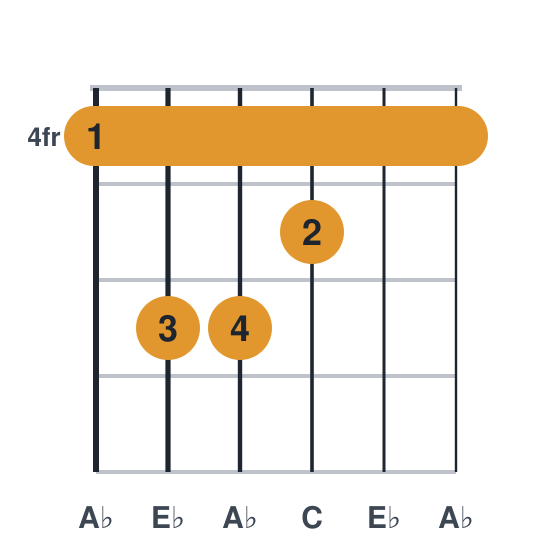
- Abthe plain major, one note apart
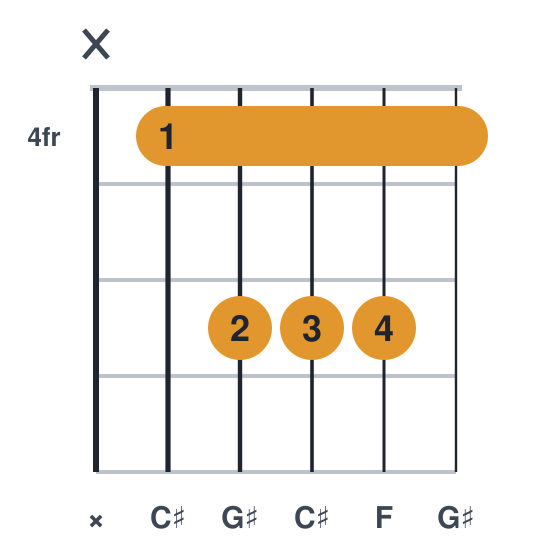
- C#where Abaug usually resolves
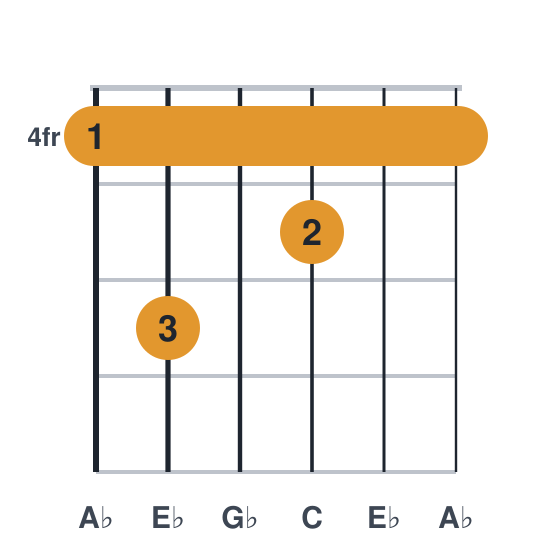
- Ab7another chord built to push forward
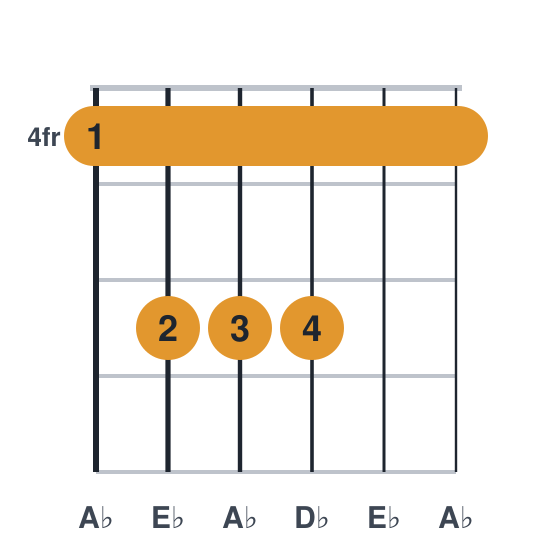
- Absus4another color built on the same root, pulling elsewhere


Other Ab chords
Abaug guitar chord chart (xx6998) from melodician.com