G#m7 Ukulele Chord
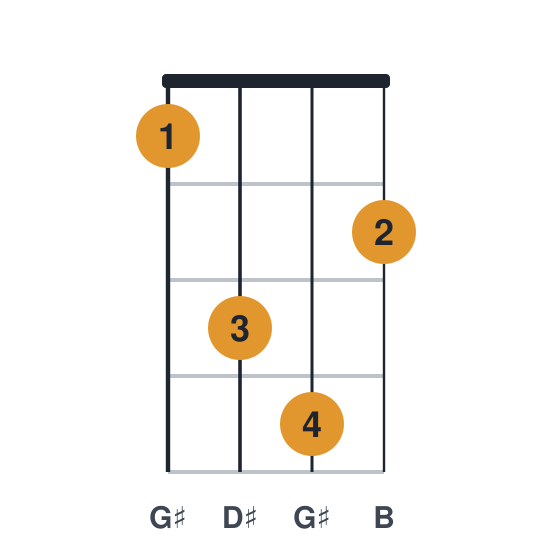
G#m7 is the G sharp minor seventh chord. It has four notes: G sharp, B, D sharp and F sharp. The standard shape uses all four fingers between the 1st and 3rd frets, with the root on the open side of the grip at the G string's 1st fret.

Index on the G string at the 1st fret, middle and ring paired at the 2nd on the E and A strings, pinky on the C string at the 3rd. The index note is the root.
How to play G#m7 on ukulele, step by step
- Index finger: 1st fret, G string
- Middle finger: 2nd fret, E string
- Ring finger: 2nd fret, A string
- Pinky finger: 3rd fret, C string
- Strum all four strings.
Move every finger down one fret and the G string note becomes the open string: the result is Gm7, the same shape settled into open position.
More ways to play G#m7
There are 3 common G#m7 shapes: the standard one at the top of the page, plus these further up the neck. You only ever need one. Tap any card to hear it.

Rounder and more settled than the nut position shape, with the seventh tucked low in the grip.

The high version: bright and tight, best when the chord has to sing over another instrument.
If the shape is not clean
- The index disappears under the other fingers
- It holds the G string at the 1st fret beneath three busier fingers. Place it first and keep its tip square while the others stack around it.
- The pinky reach to the 3rd fret collapses
- It takes the C string while middle and ring sit at the 2nd. Keep the wrist low and the pinky curled; a flat pinky mutes the E string next to it.
- One note is missing from the strum
- With all four strings fretted, one crooked finger silences a neighbour. Pick the strings one at a time and straighten whichever finger is leaning.
What makes it a G#m7
G♯ · B · D♯ · F♯ 1 ♭3 5 ♭7
G#m7 is a minor seventh chord: a G sharp minor triad (G sharp, B, D sharp) plus a minor seventh (F sharp). The seventh rounds off the minor and leaves it calm.
G#m7 is the ii chord of F sharp and the vi chord of B, and the iii chord of E, so it lives in the sharp keys guitar pop is written in. Charts in flat keys call the same chord Abm7.
G#m7 vs G#m
The E string decides. G#m puts it at the 4th fret, doubling the root; G#m7 drops it to the 2nd, where it sounds F sharp, the seventh. The rest of the grip stays put.
The drop shrinks the stretch as well as softening the sound: G#m7 sits inside three frets where G#m spans four. When the plain minor fights your hand, the seventh usually passes.
G#m7 chord questions
Is G#m7 the same as Abm7?
Yes. G sharp and A flat are one pitch, so the chords are identical. Sharp key charts write G#m7, which is the common spelling, since the chord lives in the keys of E, B and F sharp.
Is G#m7 hard on the ukulele?
It asks for all four fingers, which makes it one of the busier m7 grips. The small barre version at the 4th fret is a good alternative once the Fm7 style grip is familiar.
What is the difference between G#m and G#m7?
G#m7 moves the E string from the 4th fret down to the 2nd, replacing a doubled root with F sharp, the minor seventh. The chord softens and the stretch shortens.
What keys use G#m7?
B major, where it is the vi chord, F sharp major, where it is the ii, and E major, where it is the iii. All are common keys for guitar led pop.
Chords to learn next
- G#mthe same chord without the seventh
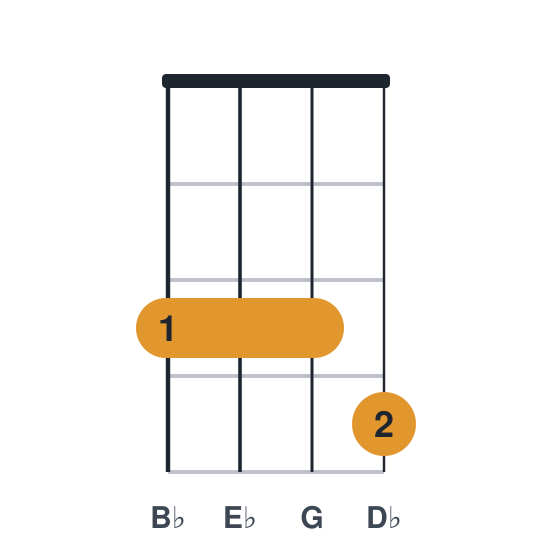
- Eb7the V chord that resolves to G# minor
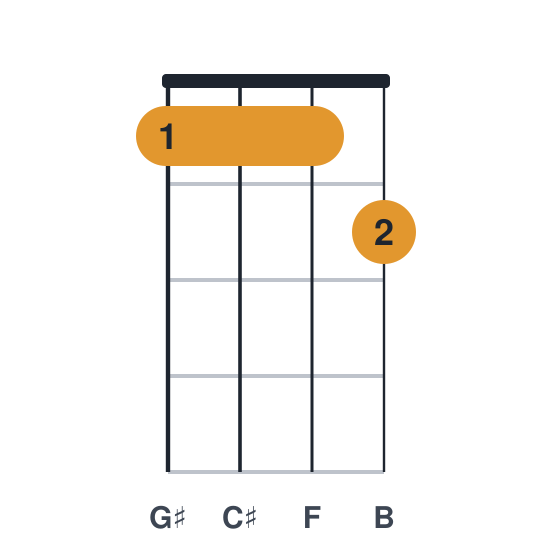
- C#7partner in the ii V of F# major
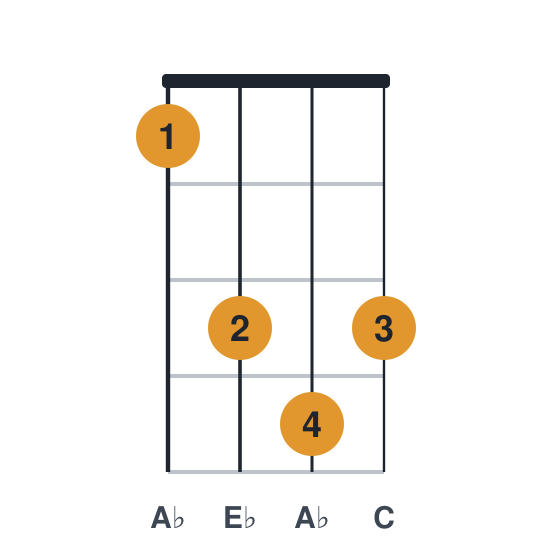
- Abthe major on the same root


Other G# chords
G#m7 ukulele chord chart (1322) from melodician.com