F#maj9 Piano Chord
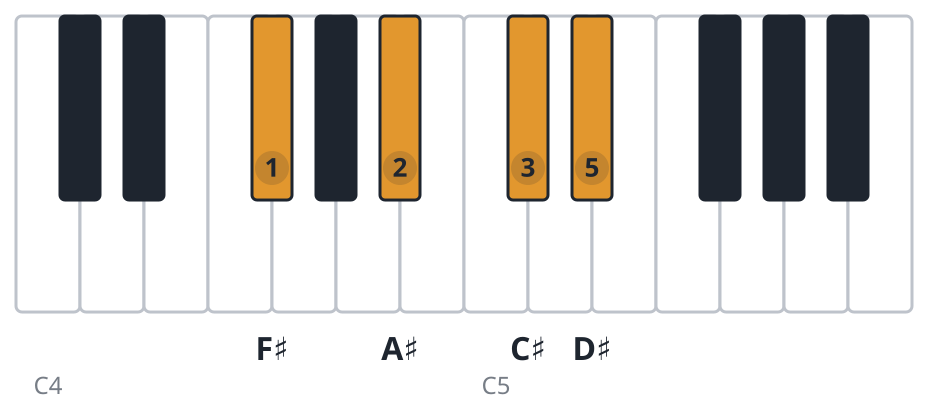
F#maj9 is the F sharp major ninth chord, often written Gbmaj9. It has five notes: F sharp, A sharp, C sharp, F and G sharp, and it spans a ninth, so the root usually goes to the left hand.

F sharp at the bottom, then A sharp, C sharp, F and G sharp. Give the root to the left hand if the reach is too much; the top four notes fit one hand easily.
How to play F#maj9 on piano, step by step
- Start on the F♯ above middle C. That is the lowest note of the chord.
- Thumb (1): F♯
- Index finger (2): A♯
- Middle finger (3): C♯
- Ring finger (4): F
- Little finger (5): G♯
- That reach is wider than an octave, so most players split it: play F♯ with the left hand and the other notes with the right. If you keep it in one hand, use the two-hand split shown on this page. Leaving out the fifth (C♯) can thin the sound, but it does not shorten the span from the root to the ninth.
The seventh is strictly E sharp, but the key you press is the white F, one half step below the octave F sharp. Charts print F because that is what the hand actually finds.
If it sounds wrong
- The stretch is too wide
- Play F sharp with the left hand and A sharp, C sharp, F and G sharp with the right. Sharing a ninth chord between hands is the normal way to play it.
- The seventh sounds wrong
- The seventh is the white key F, directly below the octave F sharp. Pressing E instead gives the flat seventh, which turns the chord into the pushier F#9.
- The chart says Gbmaj9
- Same chord, same keys. G flat is the friendlier spelling of this key in print, and most charts use it. Nothing about the shape changes.
What makes it an F#maj9
F♯ · A♯ · C♯ · F · G♯ 1 3 5 7 9
F#maj9 is F#maj7 with a ninth added: F sharp, A sharp, C sharp and F make the major seventh chord, and the G sharp on top makes it a ninth. Strict spelling calls the seventh E sharp; the key under the finger is F.
It is the I chord of F sharp major at its softest. Written as G flat, this key is home ground for gospel and soul piano, which is where this chord earns its living.
F#maj9 vs F#maj7
F#maj9 is F#maj7 with a G sharp on top. The seventh chord rests; the ninth widens it and softens the edges further.
In the hand it is one extra note and a reach past the octave, so it is usually split between hands where the seventh chord is not.
F#maj9 in major keys
Every note of F#maj9 sits inside these keys. See how it works alongside the other chords in each one.
Questions about F#maj9
Is F#maj9 the same as Gbmaj9?
Yes, one chord with two names, and Gbmaj9 is the spelling most charts prefer. The keys you press are identical.
Which notes are in an F#maj9 chord on piano?
F sharp, A sharp, C sharp and G sharp on the black keys, plus the white F, which stands in for E sharp.
What is the difference between F#maj9 and F#9?
The seventh. F#9 has E natural and pushes toward B; F#maj9 has the F a half step under the octave and stays put.
Why are there no inversions on this page?
This page teaches one practical root-position voicing because a ninth spans more than an octave. Ninth chords can still be inverted: an inversion changes the bass note, and players often reorder or omit notes to fit the hand. The diagrams here keep the beginner-friendly voicing visible.
Do I have to play all five notes?
You can omit the fifth (C sharp) when another part supplies the root; this thins the voicing without changing the chord quality.
Chords to learn next
- F#maj7the same chord without the ninth
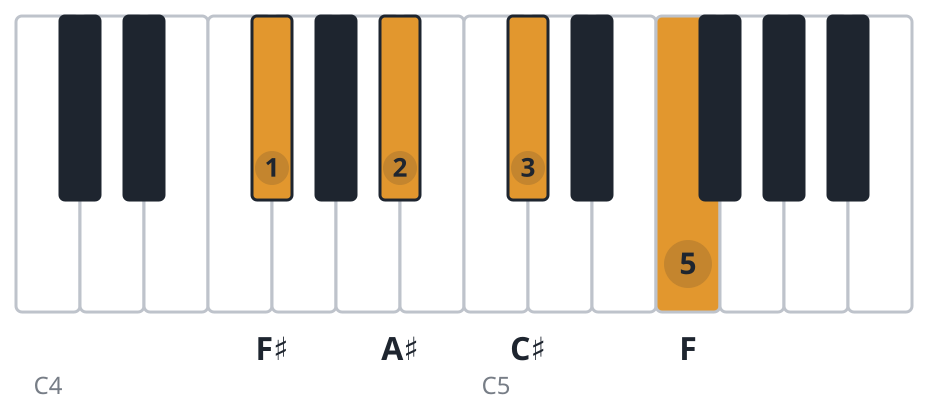
- F#add9the ninth without the seventh
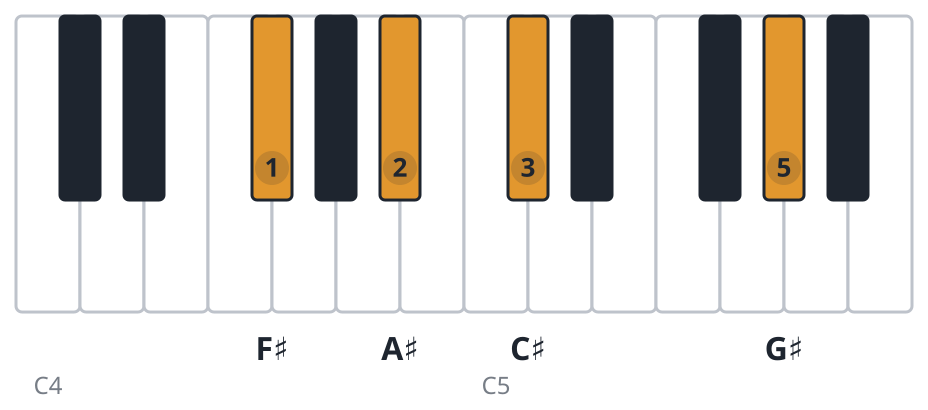
- F#the plain major
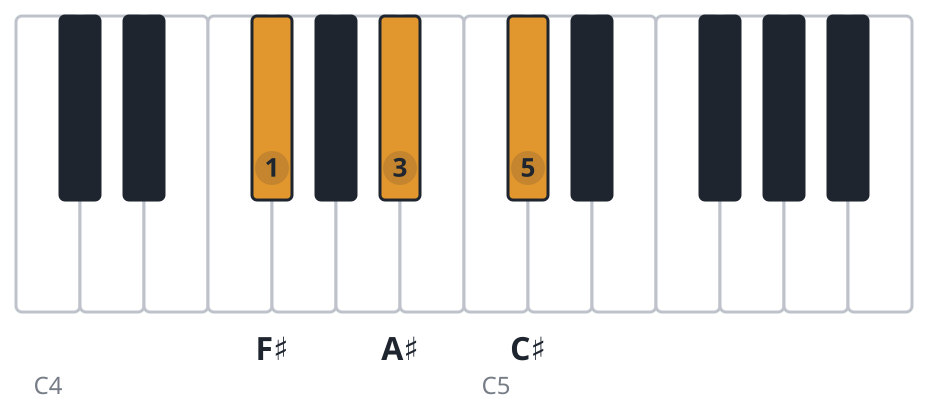
- F#6the other soft colour on the same major