F#6 Piano Chord
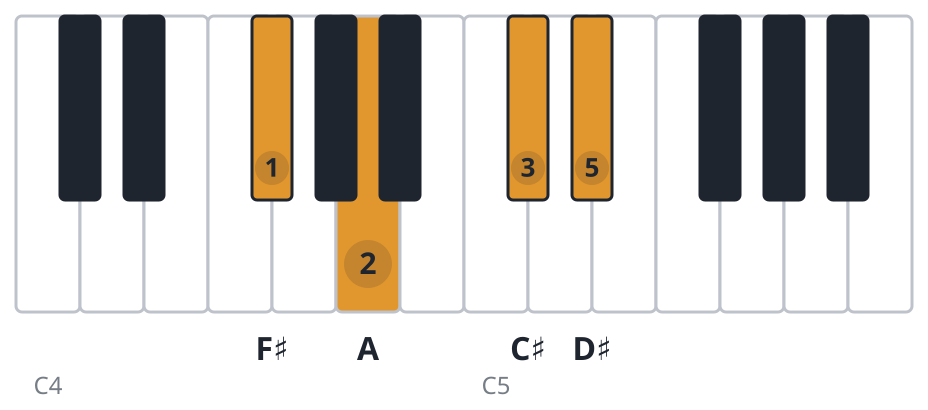
F#6 is the F sharp sixth chord. It has four notes: F sharp, A sharp, C sharp and D sharp, and every one of them is a black key. It is the only sixth chord on the piano played entirely on black keys.

F sharp at the bottom, then A sharp, C sharp and D sharp: four black keys in a row. Right hand 1-2-3-5, left hand 5-3-2-1.
How to play F#6 on piano, step by step
- Start on the F♯ above middle C. That is the lowest note of the chord.
- Thumb (1): F♯
- Index finger (2): A♯
- Middle finger (3): C♯
- Little finger (5): D♯
- Press them together with the right hand. The left hand plays the same notes with fingers 5, 3, 2, 1 an octave lower, or just F♯ on its own as a bass note.
All four fingers sit on black keys, so play well inside the keyboard, where the black keys are widest. The shape is symmetrical and comfortable once the hand accepts that no finger gets a white key to rest on.
Inversions of F#6
The same 4 notes with a different one at the bottom. All of them are F#6; which you play depends on what the hand is coming from. Tap any card to hear it.


If it sounds wrong
- The top note slid onto E
- Dropping from D sharp onto the white E gives an F#7 sound, which pulls toward B. The sixth is the black key D sharp, one whole step above C sharp.
- It sounds like E flat minor
- F#6 shares its notes with Ebm7. If the D sharp, the same key as E flat, sits lowest, the ear hears the minor chord. Keep F sharp at the bottom, or add a low F sharp in the left hand.
- Fingers slip off the black keys
- Four black keys give the hand nothing wide to grip. Play closer to the fallboard, keep the fingers curved, and let the fingertips land on the flat centres of the keys.
What makes it an F#6
F♯ · A♯ · C♯ · D♯ 1 3 5 6
F#6 is an F sharp major triad, F sharp, A sharp and C sharp, with a D sharp added: the sixth, a whole step above the fifth. All four notes are black keys, a keyboard coincidence no other sixth chord shares.
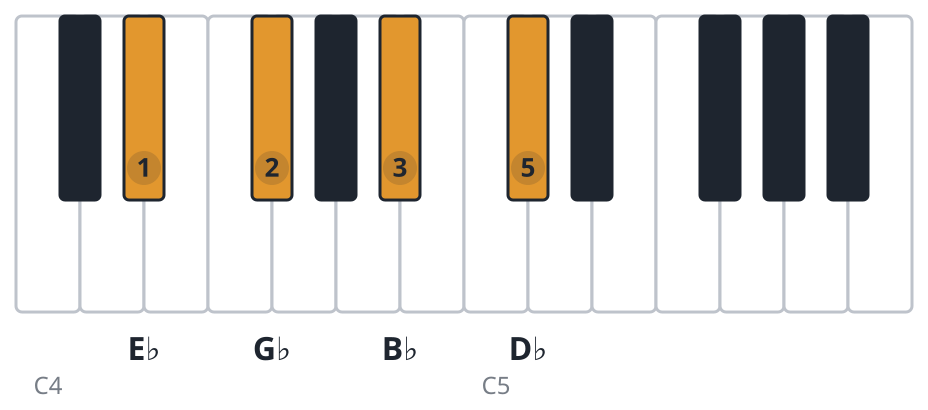
Counted from D sharp, the same notes spell the relative minor seventh, written Ebm7 on this site. As always with sixth chords, the bass note decides which of the two names the ear believes.
F#6 vs F#maj7
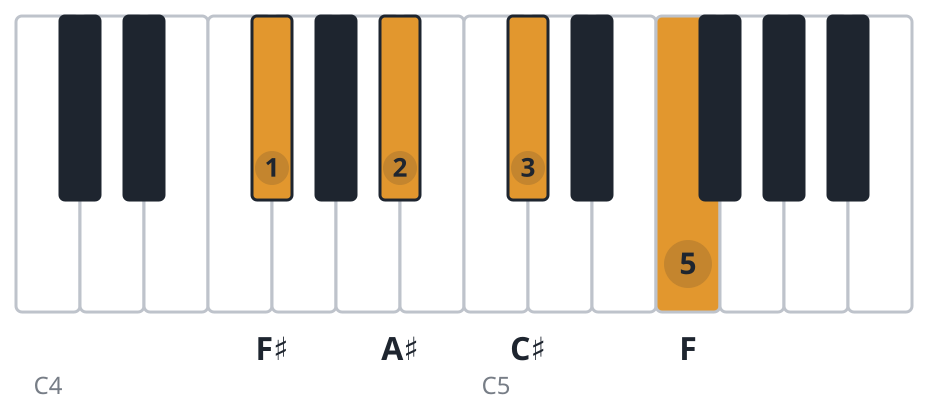
One top note apart. F#6 adds D sharp, a whole step over the C sharp, staying on the black keys; F#maj7 adds F, the white key a half step under the F sharp above. The sixth rests; the seventh glows.
Hold F sharp, A sharp and C sharp, then swap the top between D sharp and F. D sharp keeps the chord inside its black key world and settles it; the white F reaches out of that world and unsettles it. The contrast is easy to hear.
F#6 in major keys
Every note of F#6 sits inside these keys. See how it works alongside the other chords in each one.
Questions about F#6
Is F#6 the same as Gb6?
Yes, two spellings of one chord. Flat keys write Gb6; this site spells the root F sharp everywhere so pages link up consistently.
Is F#6 the same as Ebm7?
Same four notes: F sharp, A sharp, C sharp and D sharp. F sharp in the bass makes it F#6; E flat in the bass makes it Ebm7.
What fingers do you use for F#6?
Right hand: thumb on F sharp, index on A sharp, middle on C sharp, little finger on D sharp, which is 1, 2, 3, 5. Left hand: 5, 3, 2, 1.
Is F#6 really all black keys?
Yes. F sharp, A sharp, C sharp and D sharp are the four raised keys of the F sharp cluster, which makes this the one sixth chord with no white key in it.
When would I use F#6?
As a settled tonic in tunes written in G flat, under melodies resting on D sharp, and as the warmer ending wherever plain F sharp major sounds bare.
Chords to learn next
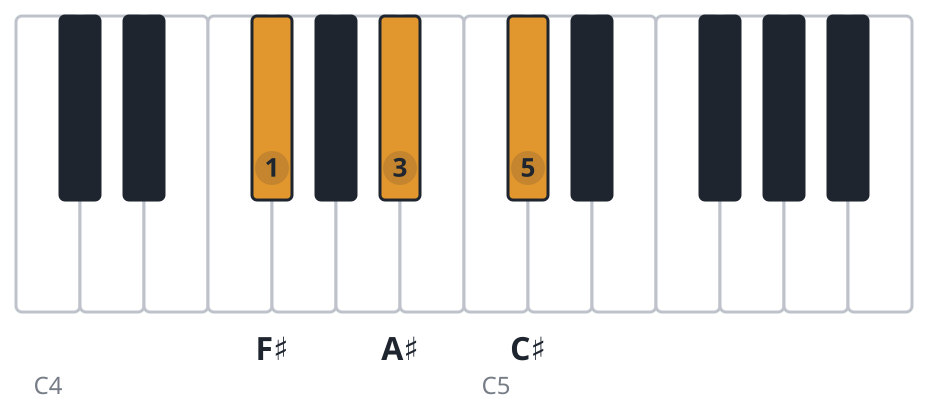
- F#the plain major underneath it
- Ebm7the same four notes counted from Eb
- F#maj7the other note people add to a major chord
- F#m6the same sixth over a minor chord